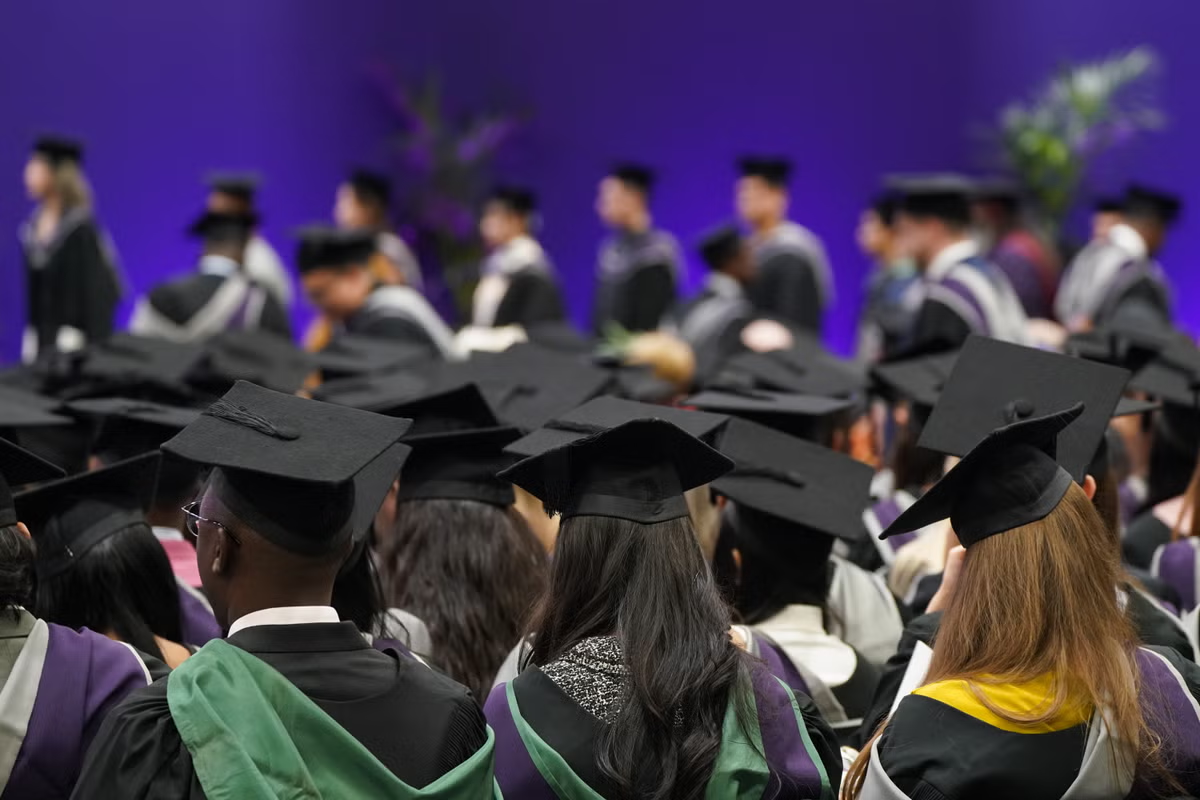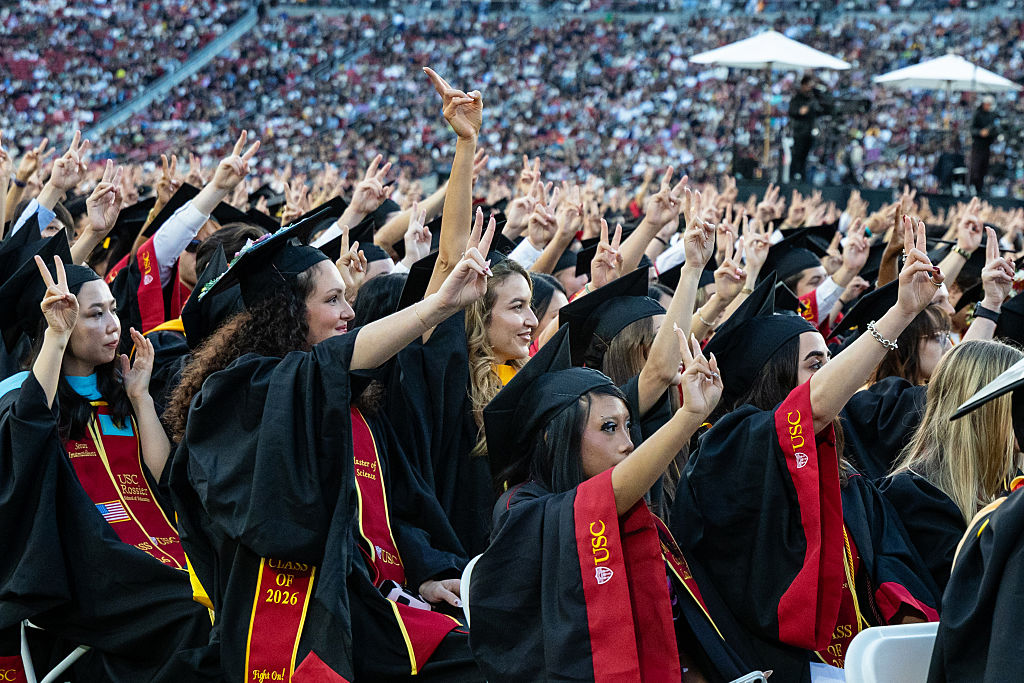
Throughout May and June, as wars persist in Iran, Lebanon, Palestine, Sudan and Ukraine, millions of students worldwide receive their diplomas. For the Class of 2026, the milestone has arrived in an economy still absorbing the post-pandemic crash. Housing costs, student debt and geopolitical fractures make the path forward opaque. It's not like the 1990s – a decade of economic growth and pre-9/11, when you could walk onto an airplane with much less security and when your loved ones could actually see you off at your gate.Today, jobs in finance are coveted but cutthroat. Law and medical school acceptance rates are so competitive that even near-perfect students stress over admissions exams. AI is booming, recruiting the best coders and mathematicians. In the US, some graduates feel uneasy working for firms like Palantir, entrenched in the Trump administration and whose leadership often expounds controversial views.Those drawn to government and diplomacy in western countries face cuts at the US State Department, the UK Foreign Office, the French Quai d'Orsay and other institutions that anchored their countries' influence. Journalism is shrinking. Major publishers are being consolidated.This is the cohort that came of age on Zoom, whose formative years were shaped by trauma: a global pandemic where most of them were cut off from friends, social life and school. If they were in America, they watched the January 6 uprising, the 2024 election, the curbing of many civil rights and ICE deportations of friends and colleagues. If in Europe, they watched the rise of right-wing, populist leaders. If in the Middle East, they saw the war in Gaza. If in Asia, they witnessed structural unemployment in India, job market saturation in China or rising youth joblessness in Bangladesh.QuotePessimism clarifies. It forces you to ask harder questionsThroughout Asia, there's a mismatch between university skills and employer demands – a terrible combination of overqualification and lost dignity. It's not just unemployment; it's underemployment. The Asia Society reports that 20 per cent of delivery drivers have higher-education degrees. “In the early 2020s,” writes Barclay Bram, a Fellow on Chinese Society at the Asia Society, “the term 'involution' became popular in China to describe a feeling of futility. Literally, the word means 'to spiral inward,' but metaphorically, it suggests wheels spinning in mud.”There's also an existential crisis: the institutions meant to support you are failing. Where is justice when international law has been so eroded? How can the law work when some recent or even actively serving leaders are indicted war criminals?Add climate change. Add the inheritance of an impossible problem left by previous generations. The mood is rightly sombre.But I'd like to inject some optimism here. Other generations went through miserable times. It’s true that my generation – Gen X – had a more happy-go-lucky approach to life, but it wasn't all fun. We also came of age during the wars of the 1990s, through the terror of Aids without a cure, through the spectre of genocide and apartheid. My parents graduated into the Great Depression, when unemployment reached 25 per cent and there was no social net to catch you if you fell.Young men were called up and died in vast numbers in the trenches of the First World War. And the Second World War mobilised the world; my father enlisted in the air force straight after university. There was fascism, Nazis, extremists. My grandparents fled fascist Italy. There was discrimination and sexism. My aunt, who had the intellect to run a major tech company, was denied university because she was an immigrant and a woman.None of them saw a clear path either. Yet work got done, people survived, and they lived good and productive lives.The Class of 2026 has an edge my generation did not. They are entering fields where real change is happening: climate tech, investigative journalism, digital governance, grassroots organising. The work is urgent and needs doing.Dark times make you work harder. They make you think. They force you to identify how you turn catastrophe into opportunity. Pessimism clarifies. It forces you to ask harder questions, to find the gaps where nobody else is working, to build community and coalition. When ICE agents came to Minneapolis, civil society activists met them. Where the UN has faltered, civil society sits at negotiation tables and implements policy. When USAID cuts threatened The Reckoning Project last year, my team chose not to shrink – we grew 400 per cent by being creative and building solidarity with other organisations. Sometimes you have to work with what you have, and make it bloom.My message to the Class of 2026, whether you're graduating from the University of Juba or Oxford, is this: the problems this generation has inherited are real.But they are not new. They are not unsolvable. And they need people who see them clearly and refuse to look away. That is this generation's work.
The Class of 2026 deserves honesty over comfort to face the trials ahead | The National
Graduates face wars, broken institutions and shrinking industries but history shows that is exactly when the real work gets done
807 words~4 min read