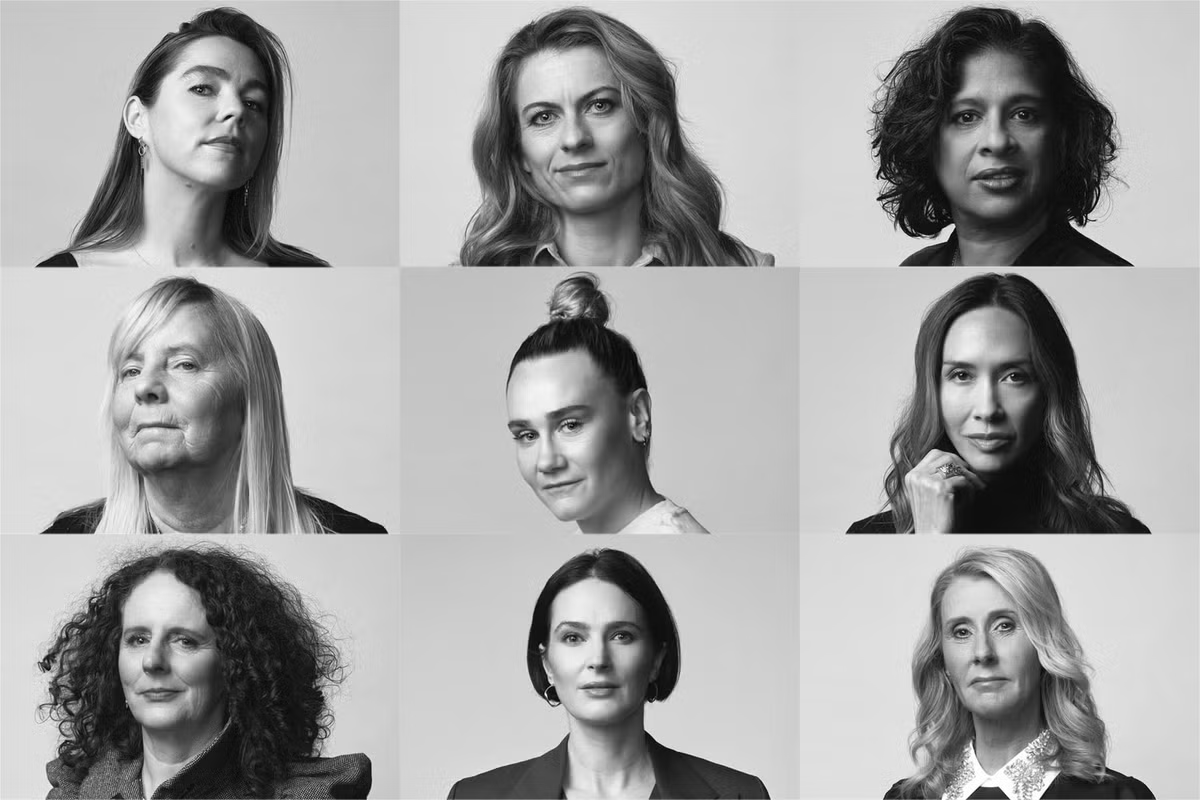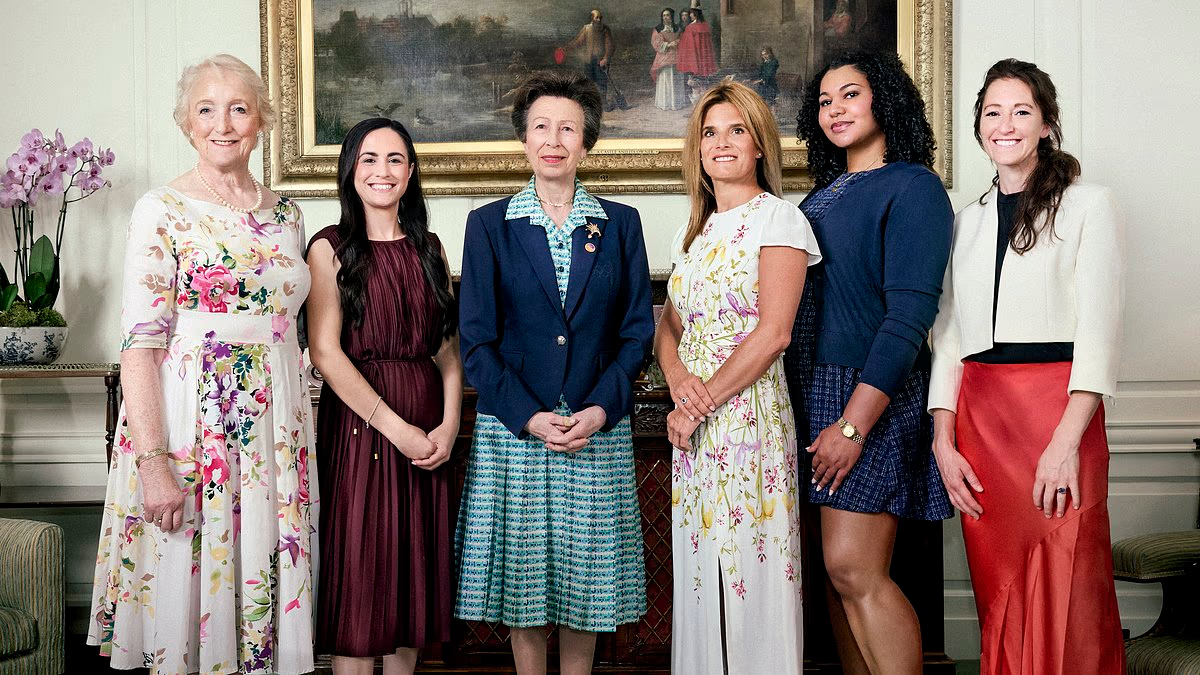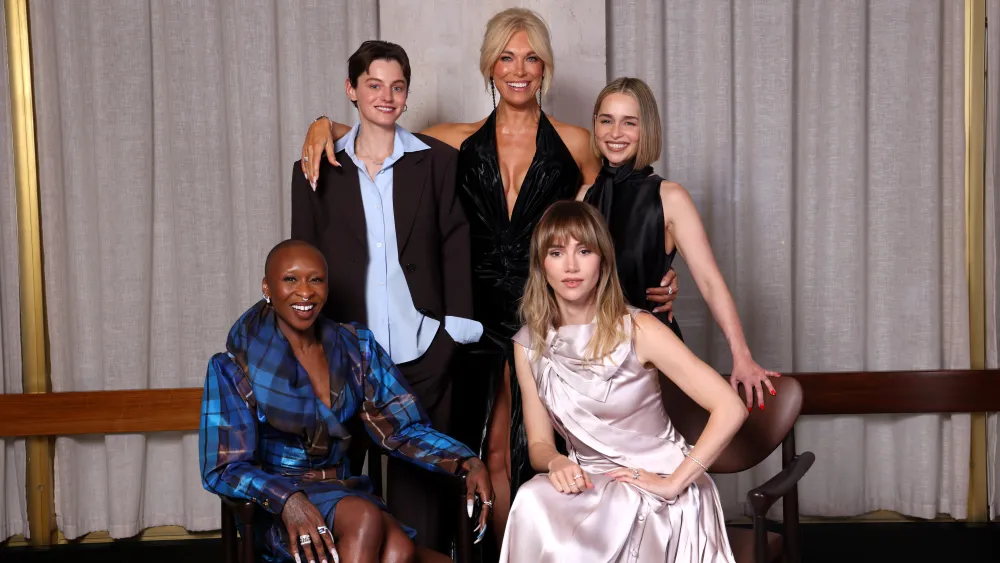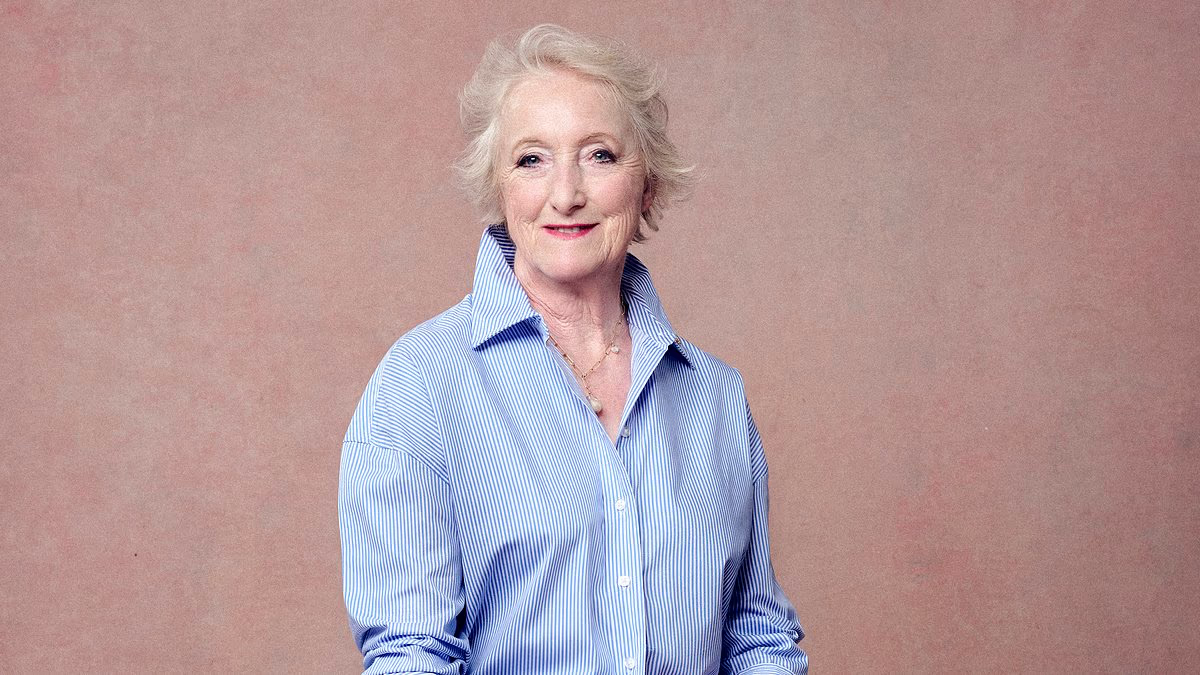
From the woman who changed the law around preserving children’s social media data after their death, to the grandmother whose humanitarian work saving war-torn children spans 25 years, meet our Inspirational Women of the Year.Two months ago, we asked you to nominate the incredible women you know who go the extra mile for others. On Tuesday, our five winners were unveiled at a special Inspirational Women Awards dinner, in partnership with disability charity Sense and sponsored by Marks & Spencer, at the Sheraton Grand Hotel in London.After an overnight stay in Mayfair, the winners were presented with awards by HRH The Princess Royal, Princess Anne, at St James’s Palace. Here are their inspiring stories... From the woman who changed the law around preserving children’s social media data after their death, to the grandmother whose humanitarian work saving war-torn children spans 25 years, meet our Inspirational Women of the Year On Tuesday, our five winners were unveiled at a special Inspirational Women Awards dinner. After an overnight stay in Mayfair, the winners were presented with awards by HRH The Princess Royal , Princess Anne, at St James’s PalaceELLEN ROOME When Ellen Roome (pictured) found her 14-year-old son Jools Sweeney dead in his bedroom in April 2022, she was left grief stricken and tortured by one question: why had he ended his own life?When Ellen Roome found her 14-year-old son Jools Sweeney dead in his bedroom in April 2022, she was left grief stricken and tortured by one question: why had he ended his own life?Earlier that day he’d been playing football and had a friend over for pizza. They’d got a firepit going and toasted marshmallows. There was certainly no hint of depression.An inquest into Jools’s death could not find any evidence the teenager was suicidal. Ellen is convinced her son was exposed to harmful content on social media in his final hour, content she believes directly led to his death.But despite being his mother, social media companies told her she had no legal right to access his data.The quest for answers has led Ellen to become one of the UK’s leading voices calling for greater accountability from social media companies.‘I have fought so hard because I don’t want any other parent to have to live in my reality - not knowing why their child’s not alive,’ says Ellen, 50, from Cheltenham, Gloucestershire. ‘It’s inhumane.’Alongside other grieving families, Ellen has launched legal action against TikTok, accusing them of feeding children harmful material.After Jools’s death, Ellen recalled reading about a 12-year-old who just days before had died from a catastrophic brain injury after taking part in an online ‘blackout’ challenge - deliberately restricting oxygen to the brain until a brief euphoric state is achieved. If miscalculated, it can quickly lead to seizures, brain damage and death.‘I asked police if this could have been the same thing, a blackout challenge,’ says Ellen. ‘I’ll never forget their answer: “It could be but we can’t prove it.”’Meanwhile, they had Jools’s devices, which could surely have given them a better answer, but they remained untouched. They had told Ellen the forensics machine in Gloucester wasn’t working.Ellen says: ‘It felt as if the police response was: “Well, he’s taken his own life.. so let’s move on.”’In 2024, she sold her financial services business and dedicated herself full-time to campaigning for online safety and bereaved parents’ rights.She was awarded an MBE in January for her tireless work, which led to a major breakthrough earlier when the Government agreed to an amendment to the Crime and Policing Bill requiring children’s social media data to be automatically preserved within five days of their death.As one of the parents behind the Raise The Age campaign - calling for tighter social media restrictions for under-16s - she met with Sir Keir Starmer to call for change last week.‘Jools is in everything I do,’ she says. ‘It’s very nice to be acknowledged as a Daily Mail winner. I remember winning Businesswoman of the Year back in 2017 for my work in financial services and Jools being so proud of me. I guess there’s some hope that somewhere, maybe, he’s looking down at me and proud again.’PATRICIA PARKER OBE For the past 25 years, Patricia Parker OBE (pictured) has worked tirelessly from her Surrey home, transforming the lives of more than 600,000 people across Darfur in western SudanIn the shimmering heat of a vast desert, Patricia Parker spotted a small figure struggling with a large jerry can. When she asked if he was lost, he said, ‘No, I am walking for water.’The boy was only nine but had trekked for seven hours in boiling temperatures to reach the nearest handpump to bring water home to his family.‘It was a sight I shall never forget,’ says grandmother-of-three Patricia. ‘It would not only change my life, but affect literally thousands of other people’s lives for years to come.’Patricia was inspired to help Ibrahim and set up the groundbreaking charity, Kids for Kids.For the past 25 years, she has worked tirelessly from her Surrey home, transforming the lives of more than 600,000 people across Darfur in western Sudan - one of the world’s most fragile, dangerous and neglected regions.This remarkable mission began in 2001 during a visit to Sudan to see her son Alastair, then 26, who was working for the diplomatic service there.Her mother having run a charity before her, Patricia says fundraising was in her blood. She had already raised thousands for Marie Curie Cancer Care, earning her an MBE, and, after witnessing Ibrahim’s struggles, lept into action.‘We could have walked away,’ says Patricia. ‘What could a mother and son do to help in such an emergency? Yet the UN stipulates that every child has the right to water. Why were they not drilling handpumps in villages? I realised I had to do something myself.’First, she got local help to install a water handpump in Ibrahim’s village. She then resolved to help communities build a better future for themselves by training local volunteers to run sustainable projects.And so Kids for Kids was born, pioneering goat loan schemes that give families access to milk and income, providing donkeys to carry water and firewood and distributing seed kits to help communities grow food despite drought, conflict and flooding.Kids for Kids then expanded into healthcare training, mosquito net distribution, first aid programmes, environmental regeneration projects and education.It has not been without risk. Take 2005 when Patricia and Alastair came under fire by a rebel group headed by a man who had killed two Save the Children aid workers three weeks before.‘We were taken to a lonely hut near their headquarters, surrounded by men with kalashnikovs in the pitch black,’ she recalls. ‘At one stage the man in charge said, “Do you realise that I could have you killed, and not even your son here could save you?”‘I do not quite know how the right words came to me. I said, “Of course I am aware of that but I also know how hospitable the Sudanese are, and that I am perfectly safe in your hands!”’They were released the next day.Since conflict erupted again in Sudan in 2023, Patricia - who also has an OBE for her work in Darfur - has led Kids for Kids through what is now recognised as the world’s largest displacement and hunger crisis.‘It’s the wonderful volunteers in Darfur that keep us going,’ she says. ‘It’s overwhelming to think that anything I can do, living in Dorking, could save or transform a child’s life. How could I stop? It would be so selfish!’RACHAEL REIGN Rachael Reign (pictured) is one of the UK’s leading survivor experts on breaking free from a cult. Her organisation has now supported more than 2,000 survivors globally, with two to five new referrals every weekRachael Reign was 13 when she happened to pass a West Croydon church. Hearing singing and dancing from the doorway, she was invited to ‘come in for a bit’.Curious, she stepped inside. Within weeks of joining the Universal Church of the Kingdom of God (UCKG), Rachael admits: ‘I was literally under their spell.’For eight years the UCKG told her how to dress, how much money to donate and even who she could marry - a fellow church member who she had a child with and is now divorced from. She claims she experienced physical abuse, coercive control and psychological abuse.Now Rachael is one of the UK’s leading survivor experts on breaking free from a cult.Spiritual and cultic abuse, one of the fastest-growing forms of abuse in the UK, occurs when religion, faith or belief is used to coerce, frighten, manipulate or exploit people.‘The signs were there,’ says Rachael, now 32, from Gipsy Hill, London. ‘At school, I was made to cut off my friends by the Church. Yet I went under the radar because I didn’t fall under the classic safeguarding risks criteria.’After all, Rachael says she had a happy family life with her mum and three siblings. Like many teenagers, however, she felt listless and feels the church exploited this to draw her in.She says she was subjected to ‘deliverance services’ - violent exorcism rituals where she says she was put in a headlock and left bruised as pastors attempted to ‘cast out demons’.Fear was reinforced through warnings that leaving would bring punishment, including stories of former members who had died or been killed after leaving.But in 2014, by then married to a church member, she decided to escape: ‘I was dirt poor, despite working in luxury retail. Over the years I was told that if I gave God would give to me ... but I was miserable.’Realising it felt like an abusive relationship, she says, ‘I started missing a service here and there, not fundraising.’She wrote a message to the pastor saying she wanted to leave and was immediately cut off by all her Church friends: ‘It was the hardest decision I’ve ever made because I knew everyone would turn their back on me.’Her husband also left the church and they went on to have their child, but their relationship broke down.When she and another survivor began sharing their stories on Instagram in 2022, their posts went viral and survivors from around the world began contacting her.Soon after, Rachael reported the abuse to police, but says officers were unable to intervene.‘There was no law to address this kind of abuse,’ she says. ‘I was given a crime reference number and that was the end of it.’By 2023 she had founded Surviving Universal UK - the UK’s only survivor-led organisation dedicated to tackling cultic and spiritual abuse, with a focus on under-represented communities.Rachael now supports people leaving high-control groups, offering peer support, safeguarding advice and signposting. She also created a free ‘Exit Kit’, including templates to request your data so the groups can’t retain contact details and keep harassing you, with contact numbers to call if you don’t feel safe.Together with the Family Survival Trust, she is lobbying for coercive control laws to be extended to group and cultic settings.She is also completing a law degree to further strengthen her advocacy work, as well as writing a memoir.Her organisation has now supported more than 2,000 survivors globally, with two to five new referrals every week.Rachael says, ‘To have recognition through this award is just so brilliant and great for morale.’A UCKG spokesperson said: ‘The Universal Church of the Kingdom of God strongly rejects these allegations. They are historic claims which have been raised previously and have been consistently denied by the Church.‘We categorically reject allegations of physical abuse, coercive control, psychological abuse, or any suggestion that individuals are threatened with consequences for leaving the Church. Such claims do not reflect the practices, governance, or day-to-day reality of UCKG.‘We also reject allegations regarding so-called “violent exorcism rituals”. UCKG does not condone abuse of any kind and operates safeguarding policies designed to protect all those who engage with the Church.’LEANNE LUCAS Yoga teacher Leanne Lucas (pictured) has turned unimaginable personal tragedy into one of Britain’s most powerful campaigns against knife crimeYoga teacher Leanne Lucas has turned unimaginable personal tragedy into one of Britain’s most powerful campaigns against knife crime.Less than two years ago, Leanne organised the Taylor Swift-themed children’s workshop in Southport that ended in horror when teenager Axel Rudakubana launched a frenzied knife attack, killing Alice da Silva Aguiar, Bebe King and Elsie Dot Stancombe.Despite devastating physical injuries and ongoing psychological trauma, she has channelled her experience into extraordinary action through her prevention-led organisation, Let’s Be Blunt.Her campaign, launched in May 2025, with the support of her sister, Chelsie, and brother-in-law, James, has rapidly become a nationally respected movement working alongside police forces, councils, schools and violence reduction units.Shocked to learn the weapon used in the Southport attack was an ordinary pointed kitchen knife, Leanne began campaigning for safer knife design, rounded-tip alternatives and practical prevention measures aimed at reducing harm before violence occurs.Working with communities across the country, Let’s Be Blunt has helped develop knife-swap schemes allowing vulnerable households to exchange pointed blades for safer rounded alternatives.‘At the heart of everything we do is collaboration,’ says Leanne, 37, from Southport, Merseyside. ‘When organisations, communities, lived experience and professionals work together honestly and openly, that is when real prevention happens.’Leanne has also championed Safe Disposal Bins - secure public containers for weapons - working with councils to expand their use nationwide. Her campaigning has already seen thousands of knives safely forfeited.Let’s Be Blunt also supports families affected by domestic abuse and child-on-parent violence, while directing households towards knife-swap services and safe disposal guidance.The organisation also works closely with schools and delivers knife crime prevention training to foster carers, university staff, care homes and retailers, focusing on trauma-informed safeguarding rather than fear-based messaging.Last October, Leanne received the prestigious Binney Award - one of the highest honours for civilian bravery in Britain - and she now serves on the Home Office Knife Crime Coalition, advising government ministers and policing leaders on prevention strategies.Winning the Daily Mail’s award is, she says, ‘deeply meaningful and humbling’: ‘To have this work recognised is a testament to everyone who has supported me, trusted me and stood alongside Let’s Be Blunt.’HOPE VIRGO When Hope Virgo (pictured), then 26, was told by an NHS eating disorder service that her BMI was ‘too high’ to qualify for treatment, she became suicidalWhen Hope Virgo, then 26, was told by an NHS eating disorder service that her BMI was ‘too high’ to qualify for treatment, she became suicidal.‘I was so desperate for the pain to end that I wanted to give up on life altogether,’ she says.After all, she had fought a life-threatening battle with anorexia as a teenager, spending a year in hospital aged 17 after years of starvation and obsessive exercise.Clinical guidance is clear that BMI should never be used as a sole indicator of whether someone needs help - with a BMI of 18.5 classed as underweight. But Hope claims that in practice some clinics do reject people if their BMI is higher than that - and even if considered too low.‘I ended up taking anti-depressants that I’d been offered instead and tried to get through things with the support of my family and friends,’ she says.Following her recovery, the Bristol mum-of-two launched Dump The Scales in 2019, calling for an end to BMI thresholds determining access to eating disorder treatment.Her petition has since gathered more than 126,000 signatures and taken Hope to Parliament and Downing Street multiple times.‘People think of the stereotype of a skinny white girl with anorexia - I’m very aware I fit that stereotype myself,’ says Hope, 35. ‘But in actual fact 94 per cent of people with eating disorders are not underweight.’After voicing her experiences online, hundreds of sufferers and families contacted her with stories of being denied treatment.‘Some are being told to come back for help when they were sick enough,’ she explains. ‘Others were being discharged and sent home from care with a life-threateningly low BMI.‘Then there were those being told they were going to die and just moved onto palliative care if they were too sick. The neglect within services was shocking.’Hope has campaigned for increased NHS funding, earlier intervention, specialist multidisciplinary teams and better training for frontline staff including GPs, teachers and mental health workers.Through years of lobbying, Hope has helped hundreds of families challenge NHS decisions around treatment and palliative care.In 2024, she became Secretariat for the All-Party Parliamentary Group on Eating Disorders and in April started a new national petition calling for a dedicated eating disorder strategy.‘The lack of public outcry that people are still dying from a treatable illness is appalling,’ she says. ‘There are over four million people in the UK living with an eating disorder.‘I don’t want anyone else to go through what I went through. That’s what continues to drive me every day.’
Meet the incredible winners of this year's Inspirational Women Awards
On Tuesday, our five winners were unveiled at a special Inspirational Women Awards dinner at the Sheraton Grand Hotel in London.
2,804 words~13 min read