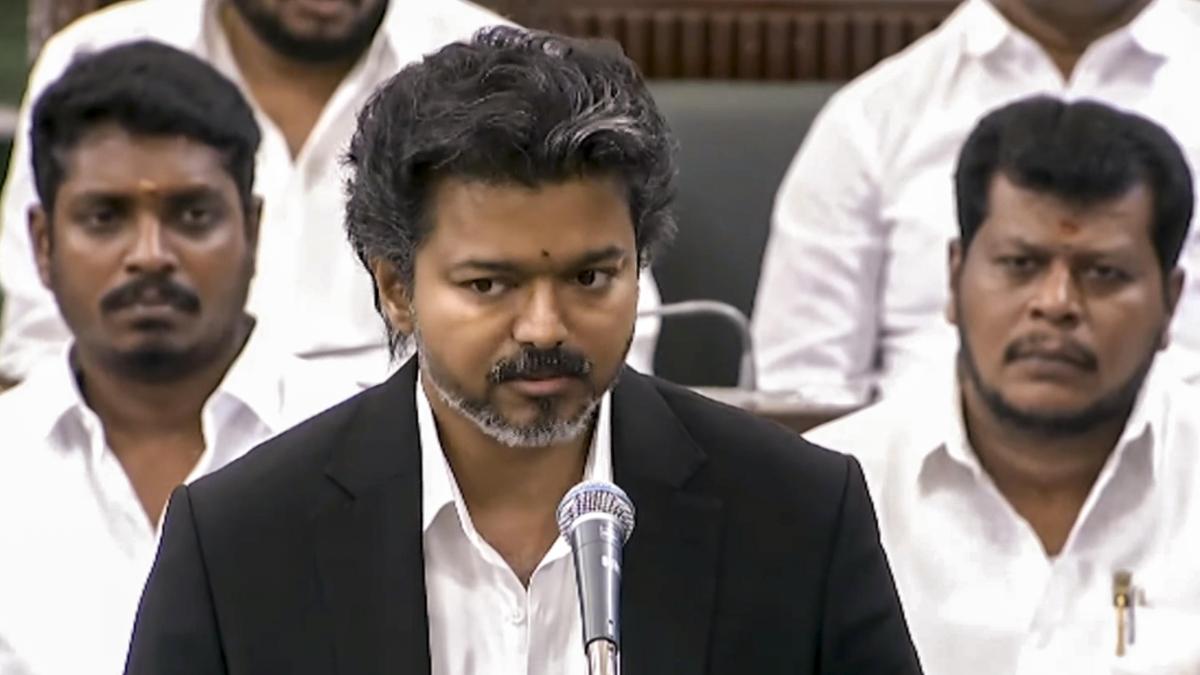
C. Joseph Vijay was sworn in as Chief Minister of Tamil Nadu on May 10
| Photo Credit: B. Jothi Ramalingam
The Madras High Court on Friday (June 5, 2026) permitted a litigant to withdraw her case seeking a direction to the Union Home Ministry and the Tamil Nadu government to condemn the relegation of the Tamil Thai Vazhthu to the third place, after the playing of the national song and the national anthem, during Chief Minister C. Joseph Vijay’s swearing-in ceremony in Chennai on May 10, 2026.The First Division Bench of Chief Justice Sushrut Arvind Dharmadhikari and Justice G. Arul Murugan dismissed as withdrawn the public interest litigation (PIL) petition filed by Ananya Radhakrishnan, 45, of Chennai. They, however, granted her liberty to file a fresh case with better particulars, if so advised.During the course of the hearing, the judges wondered how they could entertain the PIL petition without there being any challenge to the Union Home Ministry’s January 28, 2026, circular, which insists upon the playing/singing of the national song Vande Mataram on the arrival of the Governor at formal State functions within his/her State/Union Territory and also on his/her departure from such functions. The circular also states that whenever both the national song and the national anthem had to be played/sung in State events, the national song must be sung or played first.The litigant, on the other hand, had contended there was no express constitutional, statutory, or executive prohibition of playing the Tamil Thai Vazhthu, declared as a State song in December 2021, first during State government events. She said, the relegation of the State song to the third place during the Chief Minister’s swearing-in ceremony had caused deep anguish and concern among the public.In her affidavit, Ms. Radhakrishnan said, the Union Home Ministry’s latest circular only talks about the inter se order of the playing/singing of the national song and the national anthem whereas her grievance was confined only to the deviation from the long-standing constitutional and ceremonial protocol followed in Tamil Nadu with respect to the playing of the Tamil Thai Vazhthu.“The said the circular is completely silent with regard to officially recognised State Songs, including Tamil Thai Vazhthu. In the absence of any express reference to State songs, the circular cannot be interpreted or expanded to mean that a State song must necessarily be rendered only after the national song and the national anthem,” the affidavit read.She said, for long, government events in Tamil Nadu have always commenced with the playing/singing of the Tamil Thai Vazhthu and ended with the playing/singing of the national anthem. “Executive circulars affecting long-standing constitutional and ceremonial conventions must be interpreted strictly and cannot be extended by implication beyond their express terms,” the litigant contended. Published - June 05, 2026 03:17 pm IST