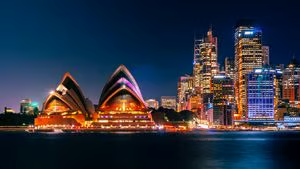
Nishess Shakya / Pexels
Australia occupies a strange position in the global travel imagination. It is an English-speaking country with familiar institutions — a parliamentary democracy, a common law system, a coffee culture, a pub culture, a passion for sport — and that familiarity creates a specific kind of false confidence in first-time visitors from Britain, North America, and other English-speaking countries. They arrive expecting somewhere broadly recognizable, and Australia is recognizable, up to a point. Then it is very much itself.
The surprises tend to cluster around a few categories. Scale is one: Australia is roughly the size of the contiguous United States but has a population of 26 million, and the implications of that ratio — for the distances between cities, for the emptiness of the interior, for the time required to travel anywhere — are not intuitive until you are standing in a Sydney car rental queue realizing that Brisbane is a ten-hour drive away and that the direct flight is the correct choice. Cost is another: Australia has a high minimum wage and a high cost of living, and travelers who arrive expecting a destination comparable in price to Southeast Asia or southern Europe leave having spent considerably more than they budgeted. The wildlife is a third — not dangerous in the way that popular culture suggests, but more present, more varied, and more genuinely strange than any amount of prior reading quite prepares you for.