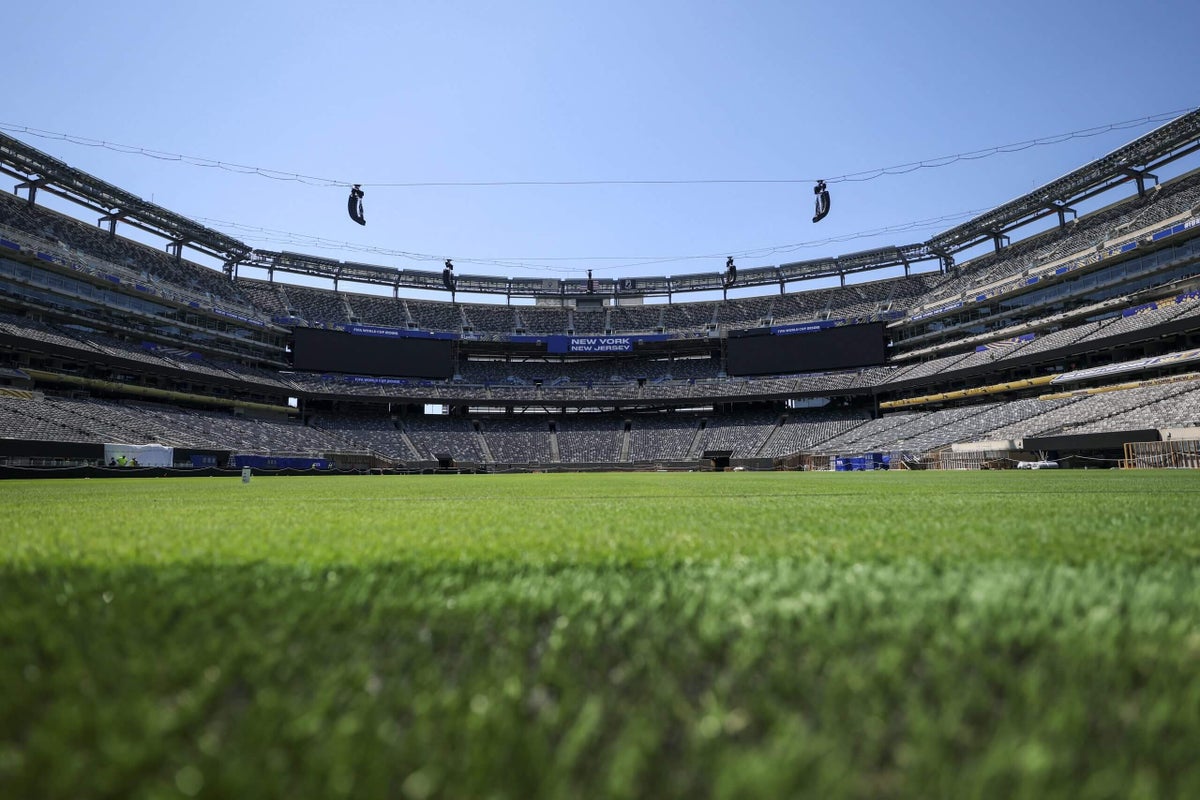
In Miami last June, FIFA had just four days to install a temporary pitch for the opening match of the Club World Cup.Two Shakira concerts had been scheduled for within a week of the fixture and underneath the flooring lay an artificial surface, incompatible with FIFA rules. It meant the last machine only came off the pitch 15 hours before kick-off.It was a similar 11th-hour job at a few other stadiums. While this summer’s World Cup does not face the same calendar pressures, Shakira is once again on the mind of Alan Ferguson, FIFA’s senior pitch management manager.The Colombian singer has been hired as part of an extended half-time entertainment in the World Cup final which, unlike last summer’s final which was confined to the stands, is to occur on the pitch.“If I’m honest, I don’t agree with it but it’s not my decision. It’s my job to facilitate it to the best of my ability,” Ferguson tells The Athletic.“It’s never been done before so we’re a wee bit in the unknown. We have a very close collaboration with our colleagues on the ceremonies team. I’m sure it’ll look amazing.“What does it do to a groundsman’s heart rate? I don’t think there is a scale big enough to measure mine when it was mentioned to me. It does keep me up a little bit at night.”Ferguson would not be human if he did not worry.The World Cup half-time show, featuring Shakira, is a challenge for the team managing the pitch (Rob Kim/Getty Images for Global Citizen)The 66-year-old Scot has poured his heart and soul into FIFA’s four-year Pitch Research Project that culminates in the delivery of 16 pitches, 84 training sites and 178 practice fields across the three host nations U.S., Mexico and Canada.The intense scrutiny will be on the venues, however, following complaints about the standard of surfaces at the Copa America and Club World Cup. The best players on the globe demand the grass to be in perfect condition. Over five billion viewers tune in expecting a spectacle.To ensure they achieve it, Ferguson formed a partnership with the University of Tennessee (UT) and Michigan State University (MSU), two industry-leading institutions.FIFA has backed the science with millions of dollars to ensure that every possible logistic and climatic challenge has been prepared for. Extreme temperatures, altitude, stadium roofs and existing artificial pitches have created the most complex jigsaw of any World Cup. “In Qatar, we had one grass type, paspalum. We knew very early on that couldn’t happen here,” says Ferguson, who has anchored the entire operation.“We have four different grass varieties and each one of them had to be researched and tested as we’re growing 12-14 months out. We’ve fed in climatic data into the programme and done lot of research and detective work to ensure we got the right grasses in the right place at the right time. We’ve factored in everything, the altitude in Mexico City, and spoke to the local sod farmers who have given us a lot of valuable feedback.“There’s a sheet of plastic the grass sits on top of because we didn’t want any contamination to be taken into the stadium. That’s the high level of detail we’ve had to go to.”Ferguson has been aided by the presence of MSU’s Dr John Rogers. He has been here before as the brains behind the first modular, transportable pitch for the 1994 World Cup in the United States.Alan Ferguson, FIFA’s senior pitch management manager (FIFA)Before then, no major sporting event had ever been played on temporary natural grass within an indoor venue. Yet, even though Pontiac Silverdome was built to block 90 per cent of sunlight, they overcame those conditions.Technological advancements allowed them to build a $1million shade house in UT, known as the FIFA Lighthouse, built to mimic conditions in the different stadiums. They also installed a 23,000-square foot asphalt pad at MSU to replicate the procedure for laying turf on stadium floors and in Michigan they actually converted half a car park into a football pitch.“We tried to recreate every issue we faced in every stadium, whether it was a hard floor, dark stadium, no air flow, no water. Feed that into the lighthouse building and identify how much natural light is actually going to get down to the grass.”Ferguson, by his own admission, would have cast himself as an old-school groundsman before this project. An operations guy. Deliver the grass, cut the grass, paint the lines, tidy it up after each game.This experience has broadened his horizons and, he believes, propelled the industry forward.“Some of the work they have done is absolutely mindboggling. It’s been one of the most exciting bits of work I’ve been involved in. I got quite a buzz out of it.“We’ve just released a document in the last few weeks to all the stadiums telling the guys with the artificial grow-light systems how long they need to put them on for, depending which grass variety they have. No plucking figures from the sky. No chances taken. Everything is factual and very well researched.”One of Ferguson’s main objectives is to ensure consistency across all 16 pitches. Whether it is high above sea level in Mexico City, the humidity of Miami, gravel or asphalt under their feet, players should not be able to tell the difference.With the final pitch in Houston installed last Wednesday, does he think that four-year goal of uniformity has been realised?“Yes, I do,” he says. “The early testing already has the hardness, roll, moisture, bounce coming into the optimal ranges, which is excellent. I say it with confidence because it’s something we’ve tested. We haven’t come into this blind.”They borrowed a piece of apparatus used in the NFL called fLex Device, which simulates the foot strike of an athlete performing an acceleration, deceleration or cutting motion to measure grass traction, hardness and wear.Pro Pitch, a company based in Livingston, Scotland, is used on a daily basis to assess hardness, moisture content and ground coverage with over 50 designated areas of the pitch able to display live updates on a smartphone app.Theory is reassuring, but putting it into practice in real conditions is another matter. Ferguson has not had the luxury of a 14-month lead-in like he did at Qatar 2022, when every stadium was brand-new and vacant. With so many moving parts, including timetable constraints, there was always the chance they may have to pivot from the plan.That happened at the final venue of MetLife Stadium — re-named New York New Jersey Stadium for the purposes of the tournament — where the locally grown grass did not make the cut.Research indicated a Bermuda grass was required due to the expected temperatures. It was planted in good time, but mother nature decided to give the Scot’s thermometer a shake.“There are a lot of things I can control in my job but one thing I can’t is the weather,” says Ferguson.“The grass was grown and planted in good time but the north east of the USA had one of the worst winters they’ve had in 17 years. In early March, when the temperatures would usually warm up, they were still getting sub-zero temperatures.“Bermuda is a warm-season grass and doesn’t like cold-season temperatures. Just like we wouldn’t like really cold places as humans, grass is exactly the same. It’s a living plant.“The Bermuda grass just simply didn’t wake up. We had a contingency for that among the eight sod growers across the U.S. and Mexico, if one area was affected by weather. So we took similar grass from Georgia and brought it to MetLife.”It was transported for 14 hours, required almost five days of hybrid stitching and took nearly 10 hours to embed.The original pitch they abandoned was not discarded, however. It is now serving as a backup for any of the other pitches in the north-east.“It would have been really naive of me leading this project to throw my eggs into one basket. When we sat down with the sod farmers, we said to them, ‘If this happens due to heavy rain, freezing cold or baking hot, we might need to mix and match.’“I still have several pitches up my sleeve. If we have an act of vandalism or some catastrophic incident, I can still make the switch. We’re not going to have to but I have to prepare because, if something happens, I still have to respond very quickly.”Only 10 minutes had passed in the opening match of the 2025 Club World Cup last summer when Ferguson received his first alert. The pitch was posing problems for Inter Miami and Al Ahly at the Hard Rock Stadium in Miami.More complaints followed. Paris Saint-Germain manager Luis Enrique said the ball “bounced around like a rabbit” at Lumen Field in Seattle, while England midfielder Jude Bellingham said it barely bounced at all at the Bank of America Stadium in Charlotte. Even FIFA’s global football development chief, Arsene Wenger, conceded that the pitch at Camping World Stadium, Orlando, was not at the level European clubs are used to playing on.“The term trampolining was used by players where they felt the concert flooring underneath was a bit too springy,” Ferguson says. “I 100 per cent agree. I have no arguments against that. But we were quite constrained to what we could do leading into the Club World Cup.”Preparing the Miami pitch for the Club World Cup last summer (Roberto Schmidt/AFP via Getty Images)Five of the 12 venues were indoor or covered stadiums, utilised to combat the extreme heat. But they presented complications as they are stadiums used by the NFL, with synthetic turf and no drainage or irrigation systems underneath.In essence, they were not designed to host international football, certainly not on grass. Ferguson and his team had to build pitches on top of the existing ones, with some venues only handing over the premises days before, due to commercial commitments.“It was really tight and, even with the best will in the world and the best minds working on it, I knew we would come up short in a few places.“We didn’t get the profile in we wanted. We were aiming to get 13 or 14cm of rootzone, the sand bit that the grass actually grows in. The timing meant, in some places, we couldn’t get that volume of material in because you’re talking about shipping over 4,000 tonnes of material per stadium. In some, we only got 2,000 or 2,500 tonnes so we could only go so far. In percentage terms, we got some (pitches) to 80 per cent and two or three we took all the way.”There was timetable pressure on the other end, too. NFL stadiums required their artificial pitch back soon after the tournament. It meant Ferguson could not lay down a full profile of pitch as it could not be lifted back up in time.“We were able to explain that to the players: when you come in 12 months, you’ll have a more traditional profile and it will feel like you’re on their normal pitch in your own country.”In Los Angeles in July 2023, Mikel Arteta delayed Arsenal’s friendly with Barcelona due to concerns over the safety of the surface. At the 2024 Copa America in the U.S., Argentina goalkeeper Emi Martinez described the Mercedes-Benz pitch in Atlanta as a “disaster”.These events were staging posts on a five-year journey to the World Cup, with last summer’s Club World Cup the final dress rehearsal.One of the main points of feedback they received was over dryness, even after applying the standard protocol of heavy watering six hours and three hours out from kick-off, followed by another substantial soaking an hour out and a final wet relief 20 minutes before.The SoFi Stadium in Los Angeles before the turf was laid (Patrick T. Fallon / AFP via Getty Images)“Even with these volumes, the grass was drying out after 25 minutes. The air was just too hot and the evaporation was quicker than what we could handle.“We had feedback from the LA Rose Bowl with PSG that the ball was sticking after 20 minutes. We discussed it and I suggested we water the grass at the same time as the cooling breaks. It only took me a couple of minutes so, by the time the players walked back over, I’d been able to wet the pitch enough to take us through to half-time. “It allowed us to keep a consistency over the whole surface and happily it’s been adopted for this tournament too. It was a valuable lesson.”After spending an average of 220 days per year travelling these last five years, Ferguson is thankful to finally be sitting in one place. It is a chair he will rarely move from over the 39-day duration of this World Cup.Stationed in his Miami HQ, which hosts up to 300 staff, he knows he is living on a volcano. Well, 16 of them.“We’re on level six, the critical level. It has to be manned or on call 24/7,” Ferguson says.It is just as well he has the support of his wife Carol next to him — serving as the link for the 90-strong worldwide team — as she has been for the past 30 years of his career.Ferguson grew up in St Andrews, the town on the east coast of Scotland known as the spiritual home of golf. He worked at Scottish club Rangers, before moving to England with Ipswich Town and then on to a role with the English Football Association where he was in charge of the national training centre, St George’s Park, between 2011 and 2017, and oversaw the pitch at Wembley Stadium in his final two years.“In UK terms, that was probably the most prestigious job to have,” says Ferguson. “In global terms, this (the World Cup) is off the scale. Never in my 50 years in this industry did I imagine for one second that I would be doing something like this.”Alan Ferguson has previously worked with the English Football Association (FIFA)Ferguson has FIFA president Gianni Infantino as his boss now. FIFA have invested millions into the science and research of preparing the best possible grass pitches. Infantino visited Ferguson and his team at one of their research hubs at the University of Tennessee for a progress update last year and ended up staying for half a day, which is nearly as long as Ferguson’s working relationship with former England manager Fabio Capello.“That was two days. Sam Allardyce lasted about a week. Roy Hodgson was a lot better,” says Ferguson of the England managers he worked with at St George’s Park.“The bigger issue was Gary Neville, who thinks he is a groundsman but really isn’t. We had several discussions over heights of cut and things like that. Me and Gary got on great, though. These guys just take an interest, as that’s what they’re playing on.”Ferguson has earmarked one afternoon to decompress. He has paid for his three sons to join them in Miami to watch beloved Scotland face Brazil on June 24 but, much to their disappointment, no bunkers will be strategically placed to disrupt their opponents’ samba flow.Well, not if the last five years of painstaking preparation have gone according to plan.
This expert has to prepare perfect pitches for the World Cup, despite the heat, altitude and… Shakira
FIFA's Alan Ferguson has lead an elite team in preparing the perfect pitches for the tournament
2,534 words~12 min read