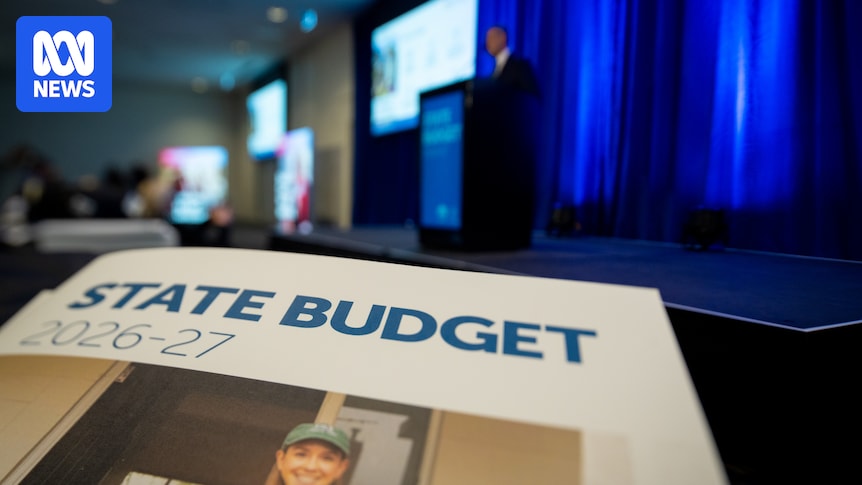
A day after the South Australian budget, Treasurer Tom Koutsantonis has foreshadowed a push to secure the state's share of GST revenue over the long term, calling on MPs across the political spectrum to step up advocacy efforts.But the opposition has criticised the way in which GST money is being used, saying the government should be putting it aside to counter soaring debt.GST is set to account for around 30 per cent of the state's revenue next financial year, but the federal government's "no worse off" guarantee to compensate other states for Western Australia's favourable share is set to expire in 2030.According to the budget papers, South Australia will benefit from a "stronger national GST pool" over the next three years, with GST grant revenue forecasts revised up since the mid-year budget review by $794 million.But the picture is different on a proportional basis, with the budget forecasting SA will receive "around 9.8 per cent" of the total GST pool in the next financial year — "a lower share to that received in 2025-26".The treasurer said the government would be pushing "very hard" to secure the state's slice of GST revenue, and urged his political rivals in SA to do the same."I've seen a lot of advocacy from Western Australia and Western Australian MPs about the importance of GST to Western Australia," Mr Koutsantonis said."Well, it's important to South Australia too — it's important to Victoria, it's important to New South Wales. We want to see more of it."You're going to see a much more prolific attempt by the government to make this known."Mr Koutsantonis has foreshadowed a push to secure the state's GST share. (ABC News: Che Chorley)Asked whether the government would launch a campaign for GST revenue, Mr Koutsantonis replied: "You'll be seeing more about that in the coming days and weeks."The state's net debt is expected to hit $53.6 billion by 2029-30 — a figure the government said was being driven by its "large capital program" including the North-South Corridor and the new Women's and Children's Hospital.But the opposition said debt was out of control and that the current figure did not include the full cost of the hospital, the $3.2 billion current price tag of which has been tipped to blow out."[We've] seen a $700 million GST revenue windfall above forecasts — we haven't seen that being applied to budget repair, we haven't seen that banked to ensure that this debt can start to be ticked down," Shadow Treasurer Ben Hood said.Shadow Treasurer Ben Hood says GST revenue should be used to help pay off debt. (ABC News: Che Chorley)The opposition also said the debt burden was one that would be borne by future generations."We think that using the additional GST revenue windfall would have been an ideal way just to take some of that pressure off the bottom line and keep that debt figure as low as possible," Opposition Leader Ashton Hurn said."The interest bill alone is soon going to be up to $10 million a day which is just not manageable into the future."Mr Koutsantonis downplayed the significance of the debt, saying it was necessary to deliver on infrastructure."The debt we're using is productive — it's being invested back into South Australia to grow our economy," he said.Independent economist Saul Eslake said that while SA had "traditionally done well" out of the distribution of GST revenue, it was also heavily reliant on it."South Australia is more dependent on revenue from the GST than any other jurisdiction except Tasmania and the Northern Territory," he said."It gets a bigger share of the GST revenue than it would if that were distributed on an equal per capita basis."South Australia would be more at risk if the federal government decided not to maintain the 'no worse off' guarantee."Net debt is forecast to exceed $53.6 billion. (ABC News: Che Chorley)Mr Eslake has called for an overhaul of the current GST distribution arrangements, but said the "no worse off" guarantee should be in place for as long as WA retained its favourable share."Because incomes and land values, among other things, are typically lower in South Australia than in most other states … South Australia has less capacity to raise revenue than most other states, especially resource-rich states," he said."South Australia needs a higher share of GST revenue than its share of the national population because it needs to spend more per head to provide South Australians with a similar standard of public services."
GST push to follow SA budget, treasurer says
South Australia's treasurer has foreshadowed a push to secure GST revenue, calling on MPs across the political spectrum to step up their advocacy efforts — but the opposition has questioned why a recent GST windfall is not being used to counter soaring debt.
743 words~3 min read