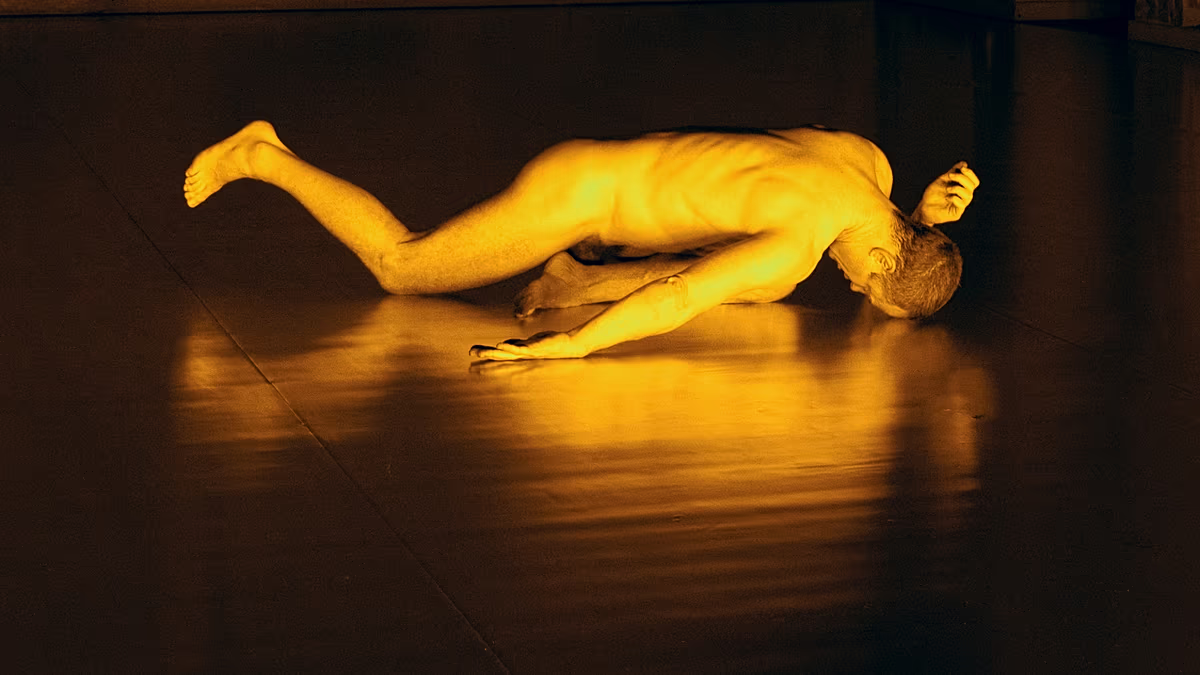
Award-winning choreographer Crystal Pite brings 'Assembly Hall,' where community hall meeting becomes dance theater of human division, solidarity "Assembly Hall" (Kidd Pivot) Why are communities so fragile? And why, despite that fragility, do we continue to long for connection?Those are the questions at the heart of "Assembly Hall," the latest work by Canadian choreographer Crystal Pite, winner of the 2025 Olivier Award for Best New Dance Production.The work arrives in Seoul this week for performances Friday through Sunday at the LG Arts Center Seoul, presented by Kidd Pivot, the company Pite founded in 2002.One of the most acclaimed choreographers working today, Pite has created works for leading companies including Nederlands Dans Theater, The Royal Ballet and Paris Opera Ballet. She has won five Olivier Awards and received the prestigious Benois de la Danse for choreography in 2017.Pite had initially planned to bring her acclaimed production "The Statement" to Korea in 2020, but the tour was canceled because of the COVID-19 pandemic."It's a relief and a joy to finally bring our work to Korea!" Pite said in a recent written interview with The Korea Herald."I want the Korean audience to feel that what they receive from us has been given with love and hope." "Assembly Hall" (Kidd Pivot) "Assembly Hall" unfolds in the seemingly ordinary setting of a community hall, a "pretty banal" space, as Pite puts it. Yet it is also, she says, a place of transformation, hosting all kinds of gatherings, ceremonies and rites of passage: weddings and memorials, sports events and community meetings, dances, graduations and elections.Pite said she wanted to explore both the fractures within communities and the possibility of solidarity through a low-stakes setting that feels familiar.The story follows a group of medieval reenactors who have come together for an annual meeting. The group faces dwindling membership, mounting debt and possible dissolution. As the meeting progresses, the line between real and reenactment begins to blur."When our characters gather in the familiar world of this community hall, we watch the small-scale politics and grievances common to any organization of folks that try to work together, like-minded or not," said Pite."But zoom out and look at the very question of unity and its opposite. Scale it up and see the necessity and fragility of the structures we've built in earnest to house our ideals of togetherness and fairness; structures like Robert's Rules of Order, religion and democracy itself." "Assembly Hall" (Kidd Pivot) For Pite, the disappearance of community engagement is a growing concern, because "without it, we lose sight of what humans are capable of when we are at our best: working together and serving something larger than our individual selves.""(Humans) seem to be hard-wired to crave unity and connectedness. So why is it so hard to maintain?" she asks."We're interested in the challenge of upholding ideals and togetherness within the turbulence and flaws inherent in human beings. We're interested in the pull between unity and division."Perhaps that is why Pite sees the theater as more than simply a place to watch a performance. The act of gathering in a shared space to experience art together carries a civic and communal significance of its own."I am always a little bit amazed and very grateful that audiences show up to the theater at all, that people will come together in earnest to experience an artwork in a shared space and time," said Pite."This feels like a kind of resistance to all the forces out there that keep us isolated from one another. I want to honor that." "Assembly Hall" (Kidd Pivot)
We are hard-wired to crave connection. Why is it so hard to unite?
Why are communities so fragile? And why, despite that fragility, do we continue to long for connection? Those are the questions at the heart of "Assembly Hall,"
593 words~3 min read