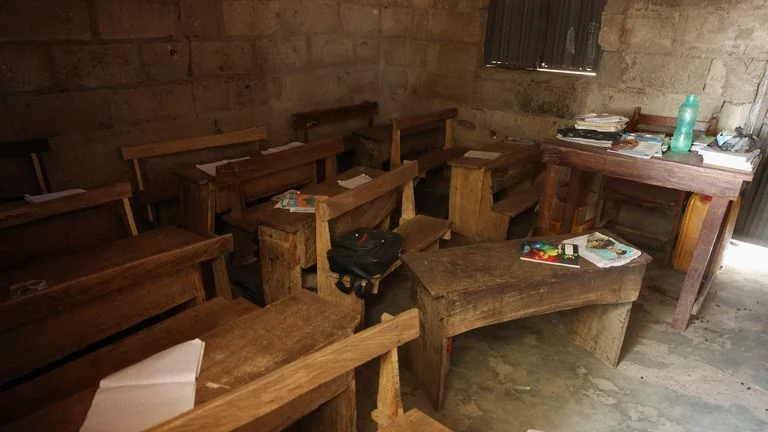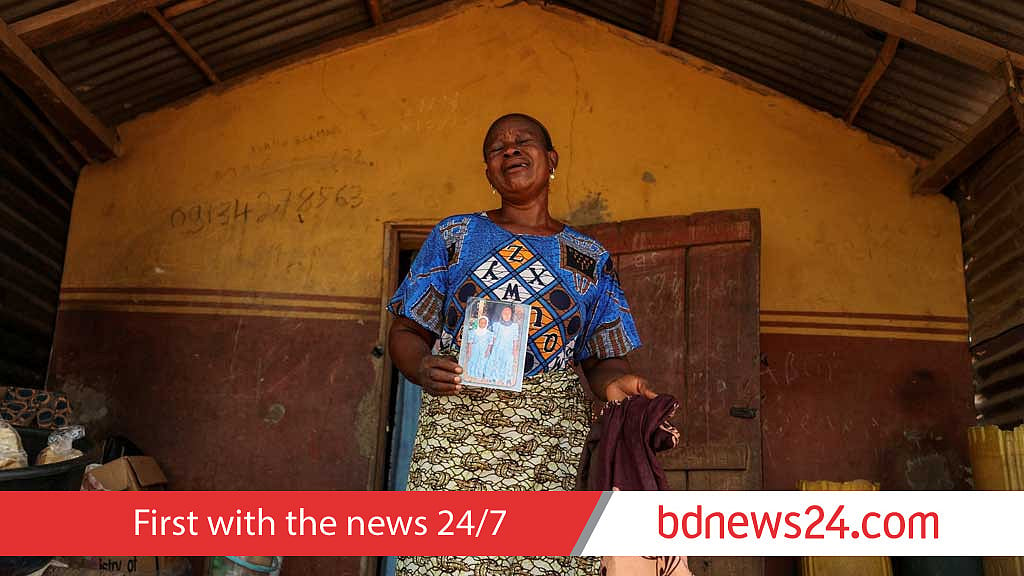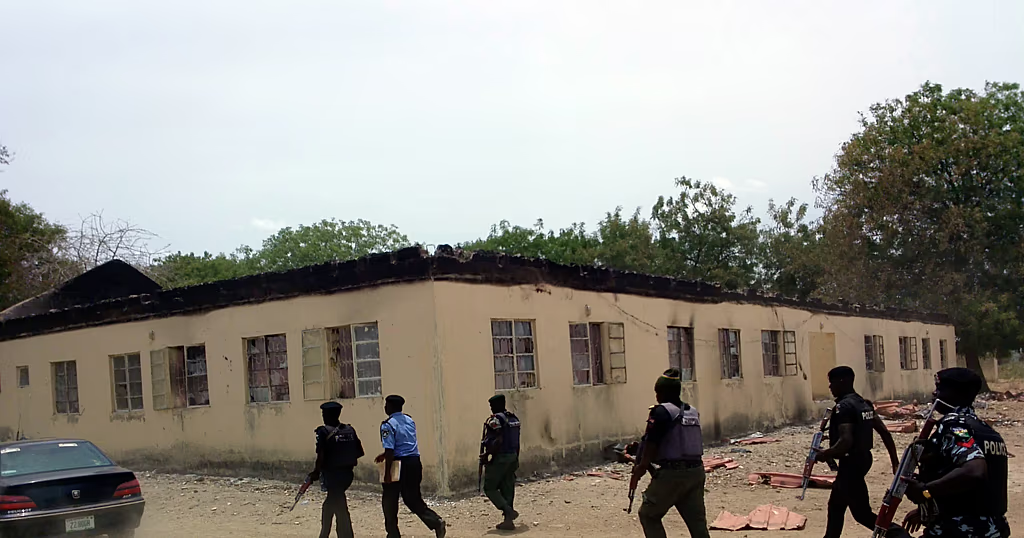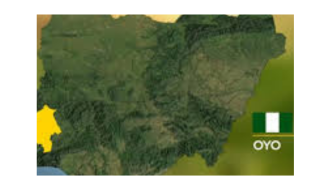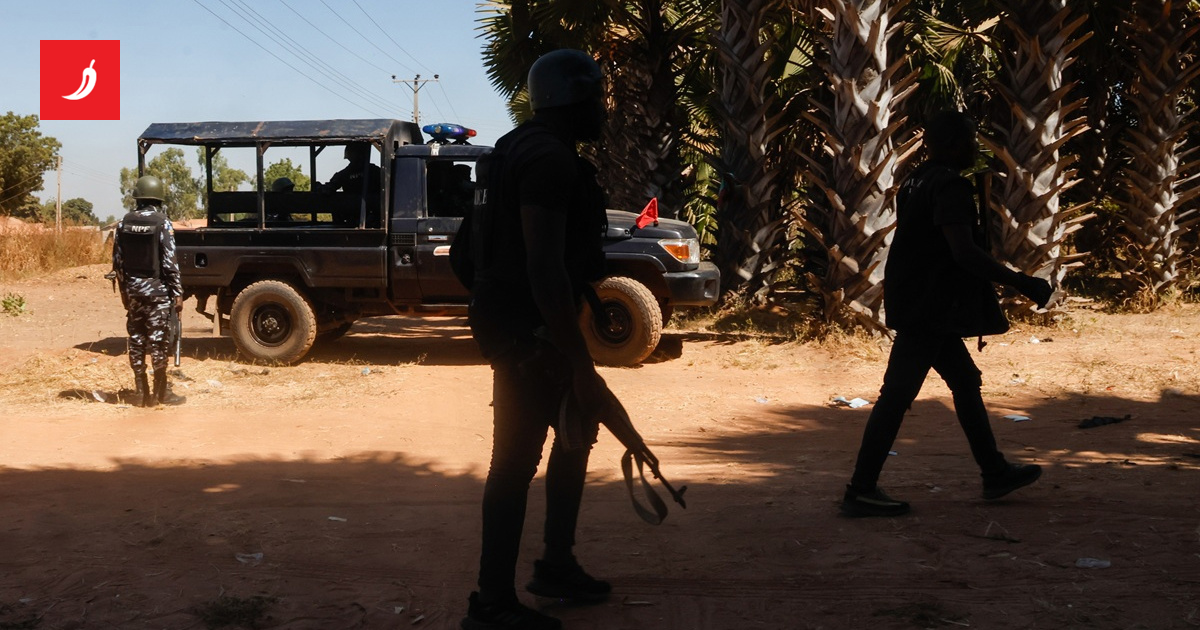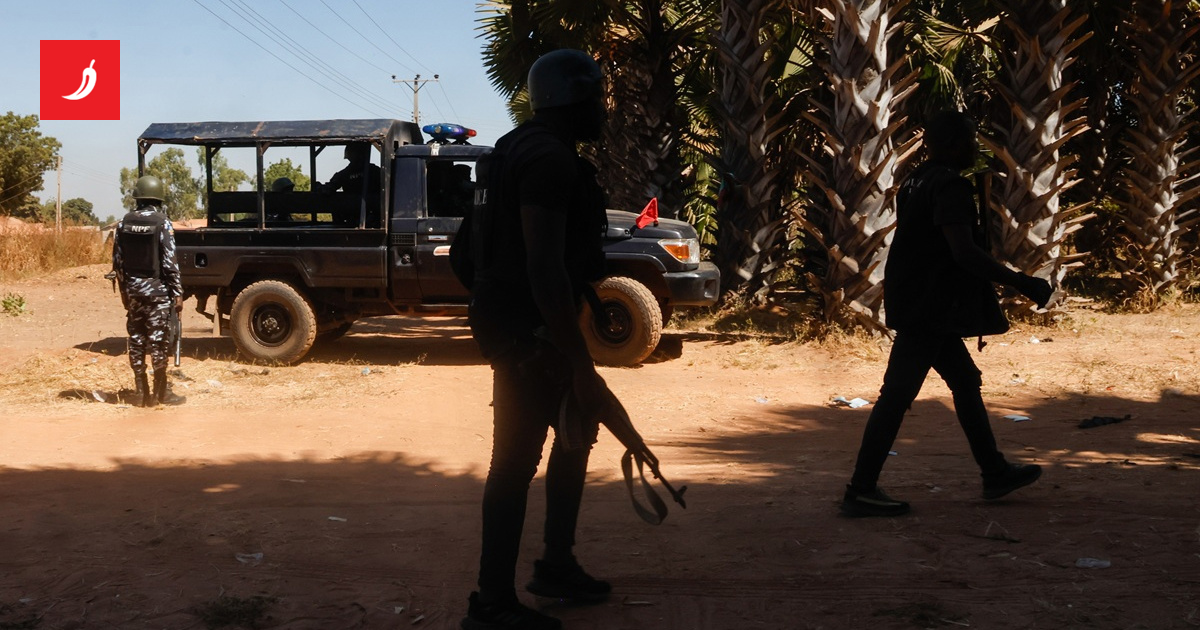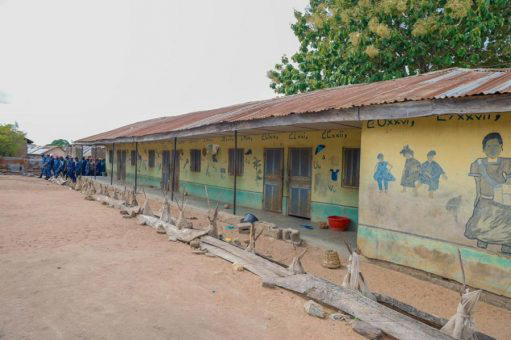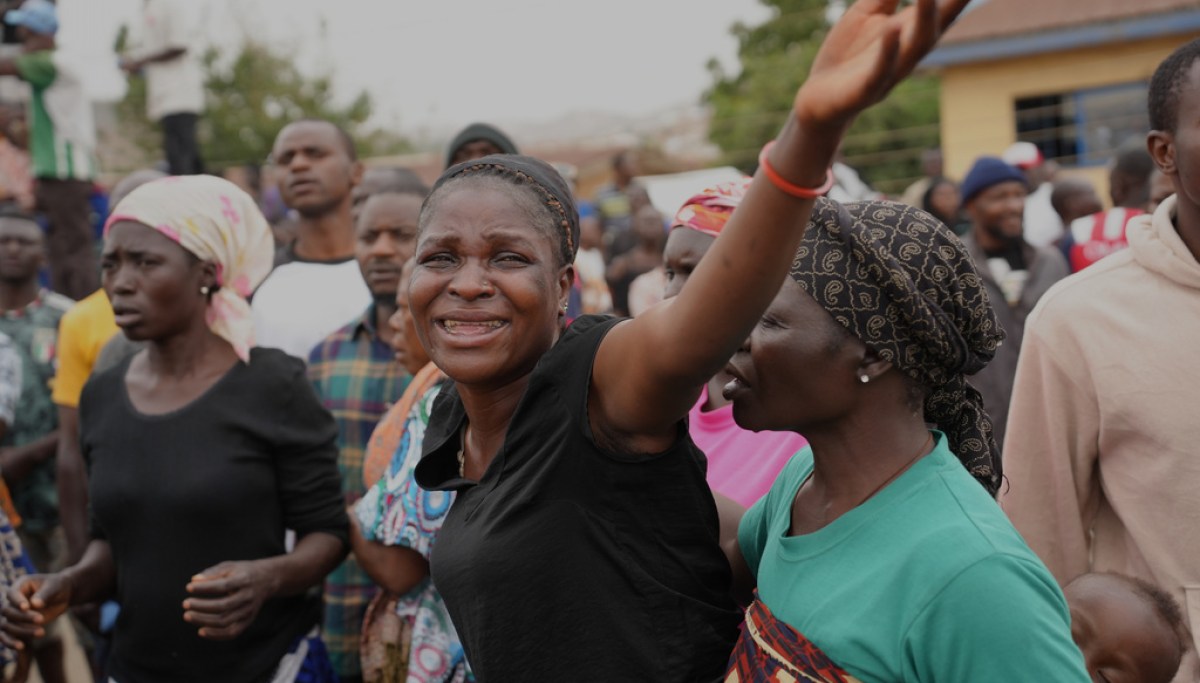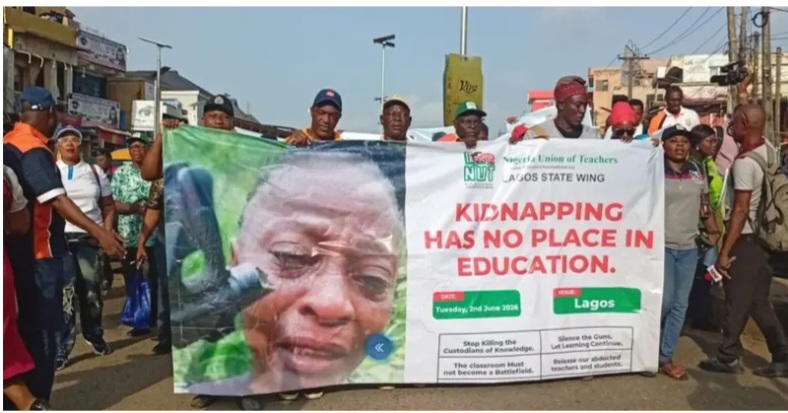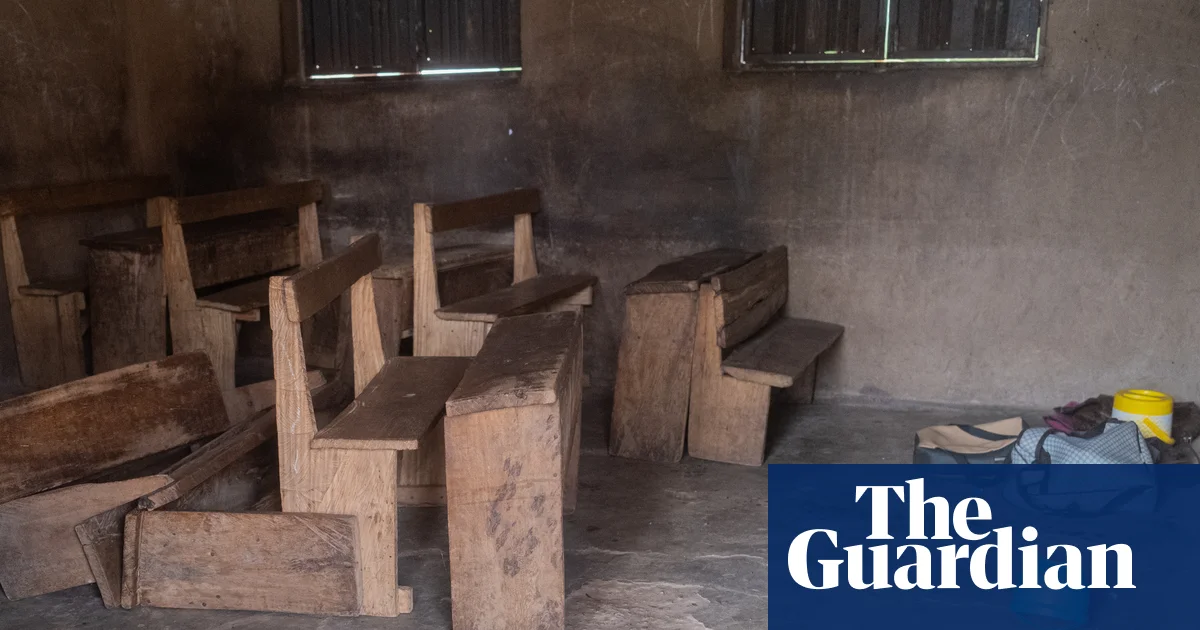
Sitting on a wooden bench under the tree near her home, Aduke Balogun’s gaze is fixed on the road. Her eyes are red from crying and a lack of sleep. Last month her daughter, Kehinde Kasosara, was forcefully abducted from school and has not been seen since.Kaosara, who is seven years old, was taken from the Baptist nursery and primary across the street from their home. The armed men, wearing military camouflage and face masks, rode into the sleepy town of Yawota in Oyo state, south-west Nigeria, on motorcycles.It had been a regular school morning on 15 May until the gunshots began at about 9am. Students and teachers were rounded up from classrooms and marched into the forest. Coordinated raids were going on in two other towns, including Esinele, a 20-minute drive away, in the Oriire local government area, where a teacher, Joel Adegboye Adesiyan, 48, was shot dead trying to protect his pupils.The youngest children taken were two and three years old.In total, 39 pupils and seven teachers, including a school principal, were kidnapped and disappeared into the vast forest of Old Oyo national park, bordering Kwara, another state that has witnessed a surge in activities of armed groups, including dislodged Boko Haram terrorists.Aduke Balogun, whose seven-year-old daughter, Kehinde Kaosara, was abducted. Two days after the kidnapping, Michael Oyedokun, 57, a mathematics teacher and father of two, was beheaded in captivity. The killing was filmed and released on social media, prompting national outrage. This week, a protest march was held in Oyo state’s capital, Ibadan, by parents and teaching unions.Balogun, a 35-year-old palm-wine seller, came here from Benin. “I came to work here so I can make money to care for the children. But look at the misfortune that has happened to me here. How am I going to explain to her father?”She starts to cry, tears rolling down her cheeks faster than she can wipe her face with part of her dress.The local government has shut schools across a swathe of Oyo state. Cheta Nwanze, the chief executive of SBM Intelligence, a Lagos-based geopolitical risk consultancy, says the armed men are probably from remnants of criminal networks originally active in north-west Nigeria.The Baptist nursery and primary school in Yawota. Families of kidnapped children and teachers are still waiting for news. The abduction of schoolchildren and vulnerable populations is a tactic used by ideological and non-ideological terrorist groups, reinforcing Nigeria’s insecurity challenges. The biggest event of this kind happened in April 2014, when 276 schoolgirls were abducted from their dormitory in Chibok. The whereabouts of many of the schoolgirls is still unknown.Since then, abductions have become commonplace, forcing citizens and the government to pay huge ransom demands and spawning a criminal sub-economy. Last year, kidnappers received an estimated 2.57bn naira (£1.4m), according to SBM Intelligence.Although insecurity is not new in Oyo state, the attack in Oriire is symptomatic of the changing reality that terrorists are now operating in south-west Nigeria, which had enjoyed relative peace. Bad actors who were flushed from northern Nigeria and the middle belt have decamped farther south.Ladd Serwatt, senior analyst for Africa at Armed Conflict Location and Event Data, a monitoring organisation, says: “The significance of the Oyo attack lies less in the state suddenly emerging as a major conflict hotspot and more in the symbolic breach of safety in Nigeria’s south-west.”Ahmed Yusuf, right, whose son, Abdulrahman Ahmed, was one of the children kidnapped from Ahoro-Esinele.For Ariyike Adeleke, 47, whose 14-year-old son, Joshua Adeleke, was kidnapped at a school in Ahoro-Esinele on 15 May, it was shocking because this was something she had only heard happening in the far north.“I was surprised. I don’t even know what to think because I did not think it was possible for such to happen here,” she says.The kidnappers have been in contact with the Oyo state authorities, who have assured the families of the victims that they are doing “everything humanly possible” to rescue the victims.But this has failed to calm the public and the families who wait for news. Last week, a video was released by the abductors in which the head teacher of Ahoro-Esinele school, Alamu Folawe, was filmed on her knees, begging the government and teachers’ union to intervene and negotiate their release.“You don’t need force; all they have to do is negotiate with them and release us. We are in the cold, we are under the sun, we are under the rain,” she said. “The children and the adults as well. Please, we are begging you, don’t let them waste our lives; they are getting impatient and frustrated. Please help us. We are begging you in the name of God. Please don’t just leave us, don’t forget us in the bush,” she said.Last week, when the state governor visited the town, Folawe’s husband also fell to his knees in tears as he addressed the official, asking for help in finding his wife and the other abductees.Ahmed Yusuf’s son, Abdulrahman Ahmed, was also taken. “My son is always sick, and we have to take him to the general hospital in Ogbomoso regularly,” he says the 35-year-old cassava farmer. “I can’t imagine what might be happening to him.”Adijat Aliyu, whose eight-year-old son, Muhammed Ibrahim, was abducted, says she has been deeply depressed since the incident, leading her to seek medication. Her family could not join the Muslim Sallah celebration.“A dead child whose grave one can see is better than a missing child,” she says.Adijat Aliyu, whose eight-year-old son was taken in the school attacks in Oriire.Although the ruling party won elections in 2015 on the promise of fixing the security situation, insecurity has worsened. Years of operation have empowered armed groups, which SBM’s Nwanze says are adapting more quickly than state responses.“[They are] exploiting weak coordination and porous borders, and the Nigerian state is increasingly unable to fulfil its most fundamental duty: protecting its citizens. This erodes public trust and forces communities to negotiate their own security with non-state actors, normalising a parallel system where the state is not the primary guarantor of safety,” he says.Meanwhile, in northern Nigeria, communities are already paying taxes and striking agreements with armed groups – who have gained control of trade routes and embedded in local communities – to gain their protection or avoid being attacked, experts say.Nigeria and the US began a joint operation last year after the US president, Donald Trump, accused the country of failing to rein in attacks on Christians and designated it as a country of particular concern. It is unclear whether the collaboration can really help with insecurity in the west African country.Nwanze says it has potential for specific tactical gains but that it will not resolve the crisis, arguing that containing instability in the Sahel region ultimately hinges on governance reform, economic expansion and political will.“The US partnership is a tactical tool, but it cannot substitute for the strategic political and economic reforms needed to address the drivers of the violence,” he says.Esinele town in Oriire has emptied out after some families left for fear of further abductions.The situation affects everybody, but experts say ordinary students, teachers and small-scale farmers are bearing the brunt of the crisis.The national government has deployed soldiers and more police to the area and the president has ordered 1,000 forest guards to be recruited in the state, but nevertheless the towns are emptying. Most of those who remain are families of victims, those close to them and chieftains.Adeleke, who lives in Esinele, says: “This town was filled with people. If you came here before the abduction, you’d know it was a lively town.”In Yawota, Balogun continues to hope for her daughter’s safe return and says she will keep on waiting under the tree.“Her younger sister cries every night since the incident. Sometimes she refuses her food and says she will only eat when Kaosara returns.”
Gunshots at 9am. Then they rounded up the children: how Chibok-style school abductions are spreading in Nigeria
Families have been left in despair after 39 pupils and seven teachers were kidnapped from classrooms in Oyo state, a part of the country previously considered relatively peaceful
1,307 words~6 min read