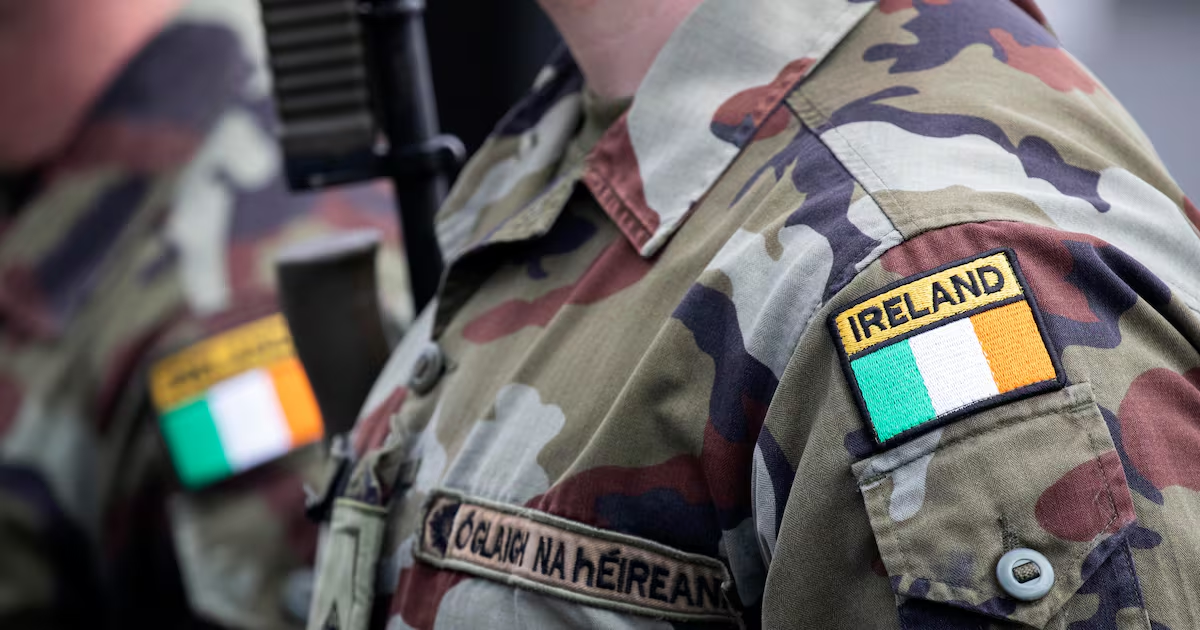
Some 4,000 members of the Defence Forces have undergone sexual ethics and respectful relationships training in recent years, a tribunal investigating how complaints were dealt with by the organisation heard on Thursday. The tribunal was established in response to concerns raised by an RTÉ Radio 1 documentary, titled Women of Honour, broadcast in 2021. It alleged sexism and bullying in the organisation was widespread and that these issues, as well as cases of sexual assault and rape, were inadequately investigated.The tribunal began public hearings this week. A total of 312 witnesses have responded to a call for information and the tribunal has generated 226,000 pages of materials to date. On Thursday it heard that as part of an independent review on workplace culture in 2022, some 4,000 members have since undertaken workshops on sexual ethics and healthy relationships, as well as bystander intervention and other related issues. That figure represents about half of the members of the force nationwide who have taken part so far. It was an “evolving piece of training”, a leading member of the personnel support service (PSS), which provides internal support for members navigating the complaints system, told the tribunal. Tribunal barrister Michael Cush said there has been a perception that complaints made to the PSS were not confidential and questioned the contradiction of the term “comprehensive but limited confidentiality” in PSS assistance to members. However, the head of the PSS David Lyons said confidentiality was comprehensive except in cases where a person was a risk to themselves or others or where a crime had been disclosed. He said he “hadn’t heard serious consideration of making it fully external” and felt there was value in the PSS assisting members with complaints as they were also colleagues in uniform who could “make it more approachable” while a third party “wouldn’t have that lived experience”. [ Women of Honour to challenge Minister’s decision not to financially assist group in tribunalOpens in new window ][ Over 300 people come forward with information on Defence Forces allegationsOpens in new window ]The tribunal’s sole member is Judge Ann Power, who is to look at complaints procedures in the Defence Forces from January 1st, 1983, to June 2024.Asked by the judge if there was “any way we can find the percentage of complaints that actually get resolved through the PSS as opposed to other compliant processes”, Lyon’s said there was not, as complaints to the PSS could be “a discrete conversation over a cup of tea and those instances may not be recorded”. Instead, those instances would be recorded as supporting a member, while a complaint would be recorded if the member spoke to a social worker. “We are one complaint option of many. There is such a wide choice of agencies to make a complaint,” he said. The change that has taken place in relation to the welfare of defence forces personnel over the last number of years was “enormous”, he told the court. “There’s never been so many options for support,” he said, adding that the systems were “unrecognisable” compared to the 1980s – the decade from which the scope of the tribunal covers. There was a “generation joining now who are more educated on mental health and consent” among other matters, “and the structures are in place to support them”, he told the tribunal. The tribunal is also examining other historical complaints within the Defence Forces, such as complaints about the conditions in the Army Apprentice School in Devoy Barracks, Naas, between 1989 and 1992, and about responses to the prescription of Larium, an antimalarial drug given to members of the organisation for overseas deployment.
Defence Forces tribunal hears generation joining ‘are more educated on mental health and consent’
Some 4,000 members have undergone sexual ethics and respectful relationships training in recent years
606 words~3 min read