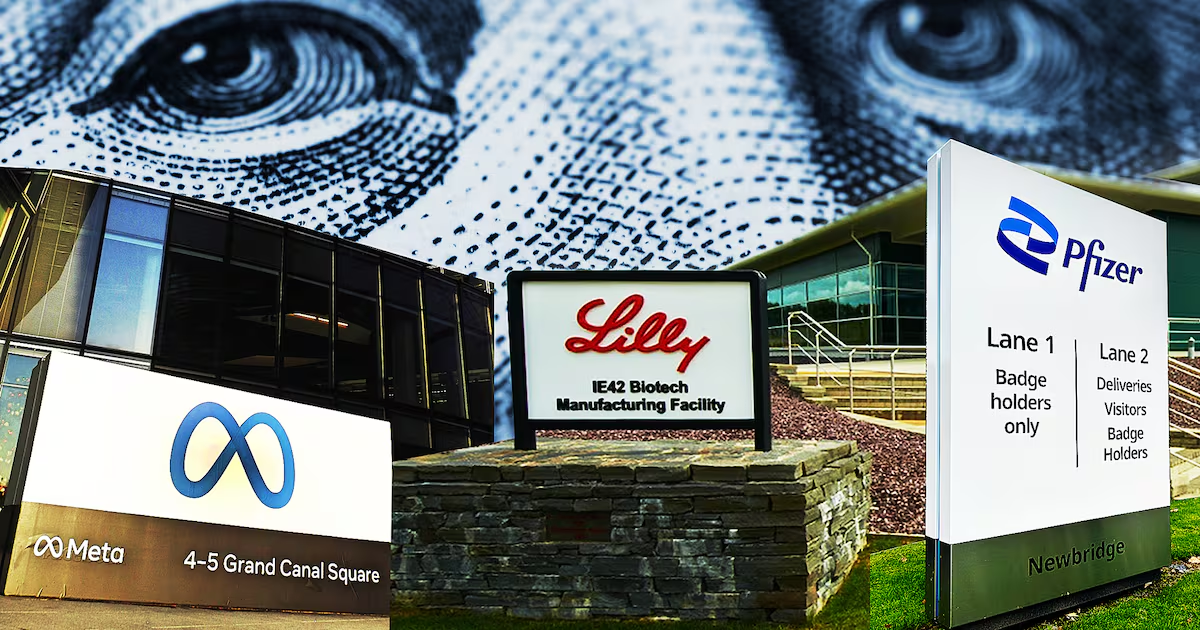
United States companies have disclosed billions of euro in tax payments to the Republic for the first time, casting new light on the Government’s increasing reliance on enormous cash revenues from big tech and pharma groups.The figures, disclosed in public filings to the US authorities, show drug group Pfizer paid $1.02 billion (€870 million) in corporation tax in 2025 while Facebook owner Meta paid $567 million. Other pharmaceutical sector filings show Johnson & Johnson paying $600 million in 2025, with AbbVie paying $431 million and Bristol Myers Squibb paying $179 million. Such figures come on top of a $6.6 billion Irish payment by pharmaceutical giant Eli Lilly, the manufacturer of blockbuster anti-obesity drugs. The company’s 2025 corporation tax bill in Dublin was twice as large as the $3.3 billion it paid to the US federal tax authority. Another drug group, Regeneron, paid $645 million in corporate tax to the Republic in 2025 and $576.5 million to the US federal government. Regeneron said it paid all legally required taxes in every country where it has a presence. It added that the Republic was its largest base outside the US with operations in Limerick and Dublin. “As a US-headquartered company and given our large investments in our American operations, Regeneron qualifies for US tax incentives such as R&D [research and development] and orphan drug tax credits, which reduce US cash tax obligations,” said the company. “Deductions for R&D expenses such as salaries, stock-based compensation, materials, and equipment also contribute to a lower US cash tax profile.”There was no comment from many other companies on their Irish tax payments. Neither was there any comment from IDA Ireland, the State inward investment agency, whose 1,800 client companies directly employ more than 310,000 workers in the State.The public disclosure of such figures has led to some concern in Government and business circles about the potential for large Irish payments to be singled out by US president Donald Trump. Trump is advancing an “America first” policy during his second White House term, hitting out repeatedly at trade practices he perceives to be contrary to US interests. With more figures to come later this year from big Irish taxpayers such as Apple and Microsoft, individual company returns are likely to draw further attention to the State’s tax regime. Apple, Microsoft and Eli Lilly are widely held to be the three largest taxpayers in the State, with collective contributions comprising some 46 per cent of the Republic’s corporation tax returns. In a report this week, the European Commission said the high degree of concentration on large taxpayers “exposes Ireland’s revenue to significant sectoral and even firm-specific risks”. The public disclosure of specific cash payments to the Irish exchequer comes after new accounting rules came into force in the US, compelling American companies to set out large liabilities in foreign jurisdictions on a country-by-country basis.The Republic is a significant European and global hub for hundreds of US companies, whose activities and profits in the State have fuelled a quadrupling of corporate tax revenue since 2016. Corporation tax returns rose 17.2 per cent last year to €32.9 billion, excluding the impact of back-tax payments from Apple after a 2024 European court ruling in a big state aid case. New monthly figures released on Thursday from the Department of Finance show corporation tax receipts advanced by 9.1 per cent to €6.2 billion in the first five months of 2026. Payments in May reached €2.7 billion, up €200 million on the same month last year. Separate data from the Central Statistics Office show the State reported the sharpest quarterly decline in economic output on record in the first three months of 2026. Gross domestic product declined 12.1 per cent in the quarter. This was attributed to an “unwinding” in the pharmaceutical sector after companies boosted US exports in early 2025 before Trump introduced new tariffs on trade.
US companies disclose huge Irish tax payments
Multinationals reveal extent of remittance to Ireland for first time, exposing reliance on big tech and pharma
645 words~3 min read