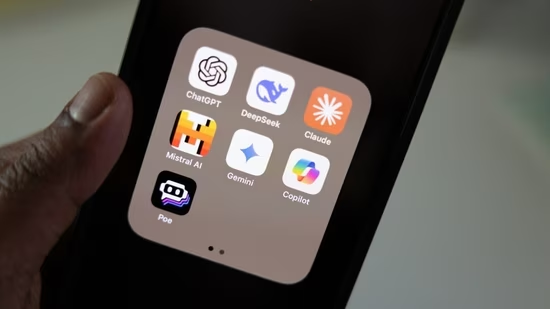
Artificial intelligence company Anthropic has rolled out Claude Opus 4.8, the latest version of its flagship AI model, as competition in the AI race intensifies against rivals such as OpenAI and its GPT-5.5 model. The new release focuses heavily on coding, reasoning, transparency and long-running AI agent tasks. Alongside performance upgrades, Anthropic has introduced new controls that allow users to decide how much effort the model should spend on solving a problem, a feature many developers are calling "Ultracode mode" because of its ability to work through complex coding challenges for extended periods.What's New In Claude Opus 4.8?Anthropic says Opus 4.8 is designed to be smarter at software development, research and analytical tasks while also reducing one of AI's biggest weaknesses: confidently providing incorrect answers.According to the company, the model is significantly more likely to acknowledge uncertainty when it lacks enough evidence and less likely to present assumptions as facts. Early testers reported that the AI behaves more like a collaborator, asking clarifying questions and identifying potential issues before delivering answers.The upgrade also improves long-duration coding sessions, allowing the model to stay focused on large software projects for extended periods. Anthropic positions the model as a tool for professional developers, enterprises and researchers handling complicated workflows.What's The So-Called Claude Opus 4.8 Ultracode Mode?One of the biggest additions is user-controlled "effort" settings.Instead of giving every task the same amount of computational attention, Claude Opus 4.8 lets users decide whether the model should provide a faster response or spend more time reasoning through a problem. Higher effort levels use more tokens and processing, but can improve performance on coding, debugging and complex planning tasks.The feature has informally been dubbed "Ultracode mode" by developers because it allows Claude to dedicate significantly more reasoning power to software engineering tasks.Anthropic has also introduced Dynamic Workflows, a research-preview feature that enables Claude to coordinate hundreds of AI sub-agents simultaneously while working on large projects. The system can divide tasks, verify outputs and combine findings before presenting a final result.Claude Opus 4.8 vs GPT-5.5The battle between Claude Opus 4.8 and GPT-5.5 is increasingly centred on coding performance and AI agents.Anthropic claims Opus 4.8 delivers stronger reliability, improved reasoning and better transparency about uncertainty. Some early benchmark reports and tester feedback suggest the model performs exceptionally well in programming-related tasks and may outperform competing models in selected coding scenarios.GPT-5.5, meanwhile, remains one of the most widely used frontier AI systems and continues to compete aggressively in reasoning, multimodal capabilities and enterprise applications.For many users, the choice between the two models may come down to priorities: developers focused on long coding sessions may prefer Claude's latest upgrades, while users seeking a broader ecosystem of AI tools may continue to favour GPT-5.5.Claude Opus 4.8 pricingAnthropic says Claude Opus 4.8 is available at the same price as its predecessor despite the performance improvements. The company has also launched additional controls aimed at reducing costs by allowing users to choose lower-effort responses for simpler tasks.Claude is currently offered through multiple plans, including Free, Pro, Max, Team and Enterprise subscriptions.Claude Opus 4.8 Jailbreak ResistanceAs AI models become more capable, safety remains a major concern. Anthropic has highlighted Opus 4.8's improved honesty and transparency, arguing that the model is less likely to make unsupported claims or overlook flaws in its own work. Company testing suggests it is around four times less likely than its predecessor to ignore coding errors without warning users.However, independent academic research continues to show that advanced AI systems remain vulnerable to sophisticated jailbreak techniques. Recent studies indicate that stronger models can still be manipulated through complex prompts, multilingual attacks and other red-teaming methods, even though safety protections have improved.Why Claude Opus 4.8 Launch MattersThe release of Claude Opus 4.8 signals a shift in the AI industry's focus. Instead of only chasing higher benchmark scores, companies are increasingly competing on reliability, transparency and the ability to complete long-running real-world tasks.With new effort controls, expanded coding capabilities and a stronger emphasis on honesty, Anthropic is positioning Claude Opus 4.8 as a serious challenger in the race against GPT-5.5. Whether it becomes the preferred choice for developers and businesses will depend on how these improvements perform in everyday use rather than benchmark tests alone.
Claude Opus 4.8 vs GPT-5.5: What's Anthropic AI's new Ultracode mode, pricing, honesty claims and jailbreak debate
Anthropic has launched Claude Opus 4.8, a new AI model. It offers better coding and reasoning abilities. Users can now control the model's effort for tasks. This feature is called Ultracode mode. Claude Opus 4.8 aims to be more reliable and transparent than previous versions. It competes directly with OpenAI's GPT-5.5 model.
701 words~3 min read