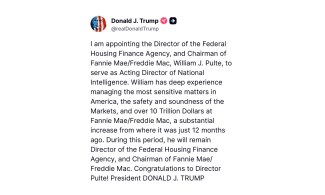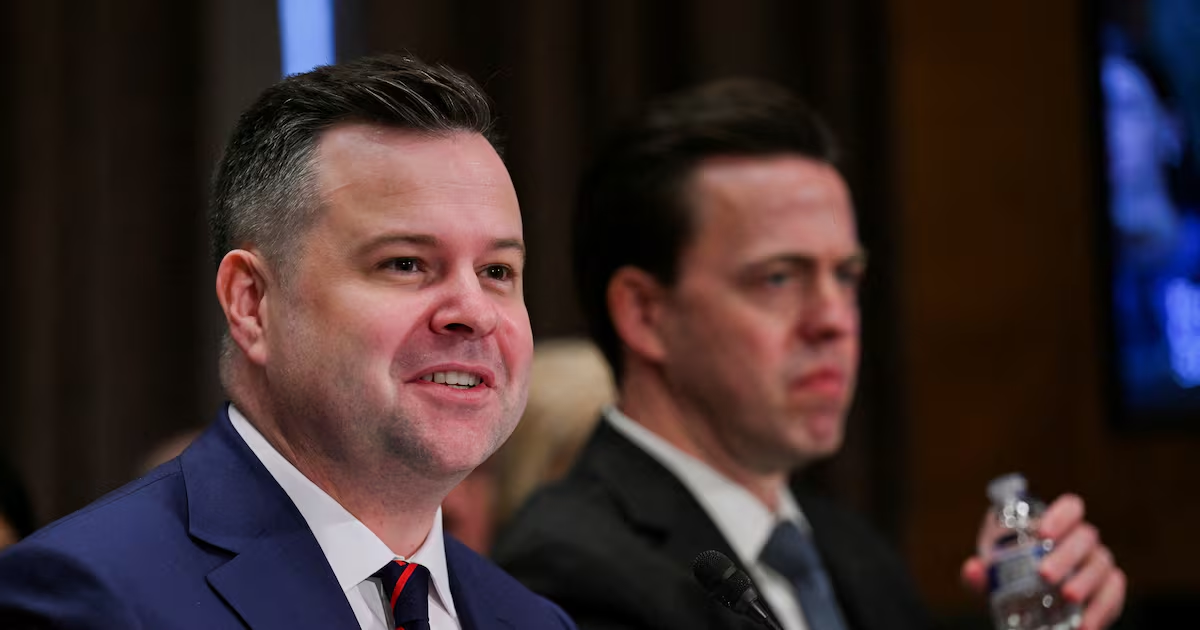
On Tuesday, June 2, President Trump announced that William Pulte will serve as the acting director of national intelligence (DNI). Pulte is the director of the Federal Housing Finance Agency and has no prior national security experience. Concerns have already been raised that his selection was based on loyalty to Trump rather than his qualifications to serve in an intelligence role. Pulte’s installation in a critical position highlights several flaws in the law that authorizes acting appointees of the executive branch. Congress can and should fix these problems to ensure that acting officers are qualified and constitutionally authorized to serve in their positions.When a vacancy occurs in a federal office that normally requires Senate confirmation, the president is authorized to temporarily fill the office with an acting officer, who can begin serving immediately without Senate confirmation. The rules for these acting officers are set by the Federal Vacancies Reform Act of 1998, which defines both who is eligible to serve and how long they may serve. In addition, roughly 40 federal offices have their own unique statutes setting various parameters for acting service, and the DNI is one of them. Like most of these officer-specific statutes, the DNI’s statute identifies the deputy to the position as the authorized acting officer (in this case, that would be Principal Deputy DNI Aaron Lukas).The Vacancies Act states that it is “the exclusive means” for appointing an acting officer “unless” another “statutory provision expressly” authorizes and sets parameters for acting service in a particular office. Courts have consistently held that this language means the Vacancies Act remains an option for the president to use even when another officer-specific statute applies. As the U.S. Court of Appeals for the Ninth Circuit put it, neither statute in such a situation is the “exclusive means” of appointing an acting officer and the president is thus “permitted to elect between these two statutory alternatives.” But two aspects of the DNI’s statute distinguish it from other officer-specific statutes and make it slightly less certain whether the Vacancies Act remains an option for Trump. Unlike many other offices with their own acting statutes, the DNI was established after the Vacancies Act was passed in 1998. That means that if there were an irresolvable conflict between the two statutes, the DNI statute would win out under the rule that the more recently enacted statute takes precedence. And unlike some other acting statutes that state the deputy to a position “may” serve as an acting, the DNI’s statute says the principal deputy DNI “shall” serve as acting DNI in the case of a vacancy. These differences have led some scholars to conclude that the DNI statute supersedes the Vacancies Act and thus is the only option. Yet the Department of Justice’s Office of Legal Counsel has disagreed, advising in 2019 that the Vacancies Act could be used to fill a previous vacancy in the position when DNI Dan Coats resigned and was replaced by acting DNI Joseph Maguire (who himself was replaced by acting DNI Richard Grenell). And the U.S. District Court for the District of Columbia, in a case about the Consumer Financial Protection Bureau director (which was also created after 1998 and also uses “shall”), held that the two statutes can be read as alternatives rather than in conflict.If the Vacancies Act is indeed available to appoint an acting DNI, Pulte’s appointment demonstrates that the statute’s eligibility rules are far too broad. Under the current rules, if the president does not wish for the deputy below an appointed position to serve as the acting officer, he can instead choose anyone from two categories. The first category includes all Senate-confirmed officials across the federal government. And the second category consists of all civil servants at the top of the government pay scale who served in the same department as the vacancy for at least 90 days. The category of Senate-confirmed officials could, in theory, encompass about 1,300 people. In practice, not every Senate-confirmed position is filled at any given time: More than 350 are currently filled. When the Senate vets and confirms a nominee, it does so with a particular position in mind. So while a confirmed official can be presumed qualified for their own office, there is no reason to think they would also be qualified to serve, even temporarily, in an entirely separate department. The undersecretary for farm production and conservation in the Department of Agriculture should not serve as acting secretary of state, the assistant administrator for toxic substances in the Environmental Protection Agency should not serve as acting secretary of the treasury, and the director of the Federal Housing Finance Agency should not serve as acting DNI.The solution is simple: Congress should amend the Vacancies Act to require that all acting officers, including those from the category of Senate-confirmed officials, must be from the same department or agency as the vacant office they temporarily fill. That is already the statutory rule when the president chooses a civil servant to serve as an acting officer; Congress need only extend this limitation to Senate-confirmed officers. Or in the case of relatively small agencies such as the Office of the Director of National Intelligence (ODNI)—which currently has four Senate-confirmed officials besides the DNI herself, who will remain in office through June 30—Congress could extend eligibility to officers from related intelligence agencies such as the CIA and the National Security Agency. Preventing appointments such as Pulte’s is not just good policy; it also may be required by the Constitution. Officers with no supervisor except the president are “principal” officers, who must be confirmed by the Senate under the Constitution’s Appointments Clause. The DNI has no supervisor except the president and is thus a principal office. But the Vacancies Act allows acting officers to serve immediately, without Senate confirmation, which means there is an inherent tension with the Appointments Clause when the act is used to fill principal offices. The Supreme Court held in 1898 that acting officers who serve in principal offices are not themselves principal officers, and lower courts have considered themselves bound to follow that opinion. That is why the U.S. Court of Appeals for the Fourth Circuit rejected a challenge to the service of acting Attorney General Matthew Whitaker. But in my view, the Supreme Court’s 1898 opinion cannot be reconciled with a more recent opinion from 1997, which held that an officer’s principal status depends only on their level of supervision, not their length of service. Under modern Supreme Court doctrine, the only officers who are plausibly eligible to temporarily act in principal roles are those who have already been confirmed by the Senate to a closely related position. The question is whether the Senate was on notice (when it confirmed the official) that the official might be called on to later serve as the acting officer for the position in question. The Senate can reasonably expect that officials confirmed to positions in the ODNI might go on to serve as acting DNI, but it would not reasonably expect the same for officials confirmed to positions in the Federal Housing Finance Agency. So limiting eligibility for acting service to positions in the same agency would also bring the Vacancies Act in harmony with the Constitution.Finally, Pulte’s appointment demonstrates another problem with the Vacancies Act’s broad eligibility rules. By statute, anyone nominated for Senate confirmation as DNI must have “extensive national security expertise.” When a nominee is put before the Senate, the Senate can judge in good faith whether the nominee meets that criterion. But ironically, such statutory qualification requirements likely do not apply to acting officers, even though acting officers are not vetted by the Senate and thus even more prone to the risk of unqualified appointees. As Anne Joseph O’Connell has explained, a statutory qualification requirement for a position would not apply to an acting officer in the position unless the statute explicitly mentions that it does so apply (and I am not aware of any that do). To fix this loophole, Congress could amend the Vacancies Act to clarify that all statutory qualification requirements also apply to acting officers in the same positions. But simply mandating that all acting officers must come from the same agency as the vacant position would go far toward achieving the same end. Acting officers are important to keep the vital offices of government functioning during periods of transition. But they are also dangerous because they avoid the Senate confirmation process that the framers designed as a check against presidential cronyism. Congress reformed the Vacancies Act in 1998 to rein in presidential abuses of the act; it is past time that Congress do so again.
Pulte’s Appointment Shows Flaws in the Vacancies Act
Under current law, the president can choose from more than 350 federal officials to fill any vacant office, regardless of qualifications.
1,445 words~7 min read