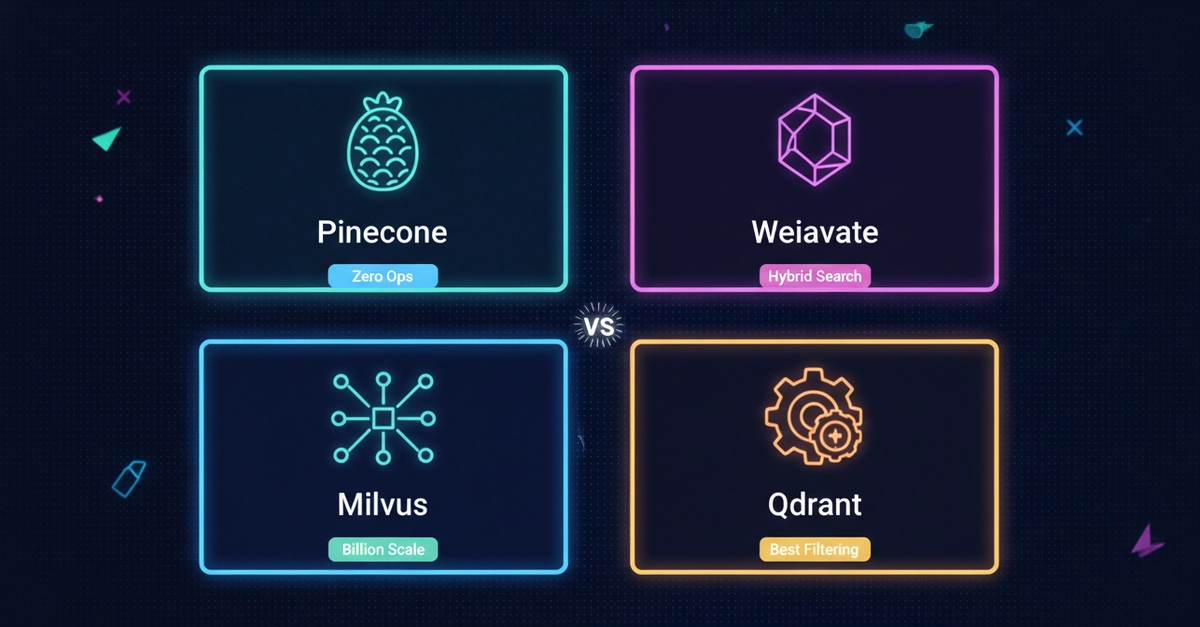
The vector database market has grown alongside the rise of LLMs, RAG systems, semantic search, and AI agents. MarketsandMarkets projects the market will grow from $2.65 billion in 2025 to $8.95 billion by 2030, at a 27.5% CAGR, while Grand View Research estimates growth from $1.66 billion in 2023 to $7.34 billion by 2030, at a 23.7% CAGR. CAGR is compound annual growth rate and is the average annual growth rate over a period, assuming the market grows at a steady compounded rate each year.And this growth isn’t happening for no reason. Vector databases store, index, and search high-dimensional vectors (embeddings), which is why they became essential infrastructure for semantic search, recommendation systems, vector databases for RAG, and LLM applications. In 2026, vector databases’ role is expanding again. They are no longer only passive retrieval layers that return relevant chunks to a model; they increasingly support iterative search, memory, hybrid retrieval, metadata filtering, and agentic workflows.Updated for 2026, this guide lists:open-source vector database optionsadjacent tools for semantic searchdatabase platformsmost advanced knowledge engines and agentic retrieval toolsIf you want a deeper explanation of vector embeddings, the vector database pipeline, vector database alternatives, and how to choose an open source vector database, read our guide to vector databases in FMOps. For the newer agentic layer, see our article on agentic vector databases and how retrieval changes when AI agents become the primary users of knowledge infrastructure.Now, to the list!MilvusMilvus is built for large-scale embedding similarity search in AI applications, supporting unstructured data search. It is widely used for RAG, semantic search, recommendation systems, multimodal retrieval, and production AI applications that need to search across millions or billions of vectors.Best for: large-scale vector search, production RAG, multimodal retrieval, high-throughput AI systems.ChromaIt is a search infrastructure for AI applications and fast solution for Python or JavaScript LLM applications with efficient memory management. It is popular with developers building LLM apps, local RAG prototypes, semantic search tools, and retrieval workflows that need a simple developer experience.Best for: local RAG, fast prototyping, LLM apps, agentic search experiments.WeaviateSupports vector search, keyword search, hybrid search, metadata filtering, and RAG-oriented workflows. It is useful when teams want semantic search together with structured metadata and higher-level AI application features.Best for: hybrid and complex search, RAG, intuitive AI-powered applications, agent memory infrastructure.QdrantThis open source vector database is tailored for extended filtering support, offering a production-ready service. It is written in Rust and is especially strong for production RAG systems that need metadata filtering, payload-based search, hybrid retrieval, and reliable performance.Best for: filter-heavy RAG, semantic search, agentic retrieval tools, production AI applications.VespaA search and serving engine that supports vector search, text search, structured data, ranking, and low-latency retrieval. It is useful for large-scale systems that need both classical search and semantic search.Best for: large-scale search, ranking, hybrid retrieval, production search infrastructure. Ideal for low-latency computation over large datasetsLanceDBLanceDB is built on the Lance columnar data format. It is designed for multimodal AI data, including text, images, video, embeddings, and large-scale AI datasets. It is also built with persistent storage for simplified retrieval and management of embeddings.Best for: multimodal search, AI data management, embeddings over large datasets.Deep LakeDeep Lake is for storing datasets, embeddings, and deep learning data. It is useful for teams working with LLM applications, computer vision, multimodal workflows, and ML pipelines where vectors are part of a larger data layer.Best for: Deep learning, supporting data and vectors for LLM applications. Use it for storing AI datasets, embeddings, multimodal pipelines, deep learning and computer vision workflows.Vector Search Libraries and EnginesFaissFaiss is a library for efficient similarity search and clustering of dense vectors. It is not a full vector database, but it is widely used for building custom retrieval systems and fast nearest-neighbor search over large vector collections.Faiss supports CPU and GPU search, batch queries, range search, maximum inner product search, binary vector indexing, and different trade-offs between speed, memory usage, and accuracy.Best for: custom ANN pipelines, large-scale dense vector search, experimentation, GPU-accelerated similarity search.ValdVald is a highly scalable distributed vector search engine for fast approximate nearest-neighbor (ANN) search over dense vectors. It is built with a cloud-native architecture and supports automatic indexing, index backup, and horizontal scaling for large-scale vector search.Best for: distributed ANN search, cloud-native vector search, large-scale retrieval over billions of vectors.ScaNN (Scalable Nearest Neighbors)It is a library for efficient vector similarity search at scale. It supports maximum inner product search, Euclidean distance, and other distance functions, using techniques such as search space pruning and quantization.Best for: high-speed nearest-neighbor search, large-scale vector retrieval, research, custom retrieval systems.HnswlibHnswlib is a lightweight C++/Python library for fast ANN search using the HNSW algorithm. It is useful for custom vector retrieval systems where teams want high-speed ANN search without the overhead of a full vector database.Best for: HNSW-based ANN search, lightweight vector retrieval, custom search pipelines, research and experimentation.PgvectorAn open-source PostgreSQL extension for vector similarity search that integrates with the Postgres ecosystem. It supports HNSW and IVFFlat indexes, multiple distance functions, hybrid search with Postgres full-text search, and standard Postgres features like ACID compliance, JOINs, replication, and point-in-time recovery.Best for: Postgres-native RAG, semantic search on existing SQL data, hybrid search, teams that want vector search inside their current Postgres infrastructure.VectorChordAnother PostgreSQL extension for scalable, high-performance vector similarity search inside the Postgres ecosystem. It is designed for large-scale and billion-scale retrieval, using compression, quantization, and reranking to reduce storage costs while preserving search quality. It is compatible with pgvector data types and syntax.Best for: billion-scale Postgres-native vector search, cost-efficient semantic retrieval, teams that want pgvector-compatible scaling inside PostgreSQL.General-Purpose Search and Database Platforms with Vector CapabilitiesElasticsearchIt is a distributed, RESTful search and analytics engine optimized for speed, relevance, and production-scale workloads. It supports full-text search, vector search, filtering, aggregations, near real-time indexing, and RAG workflows within the Elastic Stack.Best for: enterprise search, hybrid keyword-vector search, log and observability search, production RAG systems.ClickHouseThis is a column-oriented database management system built for real-time analytical reporting. It is designed for high-performance queries over large datasets and is a strong fit when teams need fast analytics on structured data.Best for: real-time analytics, analytical reporting, large-scale structured data processing, high-performance OLAP workloads.RedisSupports vector search through Redis Search, which indexes vectors stored in hash or JSON documents. It can run vector similarity queries together with full-text search, geospatial filters, ranking, and aggregations. It is a good fit for real-time semantic caching, RAG retrieval, LLM memory, semantic routing, recommendations, and personalization, especially when the application already uses Redis for caching or session data.Best for: sub-millisecond retrieval, semantic caching, RAG retrieval, LLM memory, real-time recommendations.OpenSearchEnterprise-grade search and observability suite for working with unstructured data at scale. It combines lexical search, vector search, hybrid retrieval, analytics, anomaly detection, log analysis, and security analytics.Best for: open-source enterprise search, hybrid keyword-vector retrieval, observability, analytics plus vector search.Apache CassandraA distributed NoSQL database built for massive-scale data, high availability, and fault tolerance. Its masterless architecture, multi-datacenter replication, and linear scalability make it a strong fit for mission-critical systems that need low-latency reads and writes without single points of failure.Best for: distributed storage, high-availability applications, large operational datasets, fault-tolerant cloud and on-prem systems.MongoDB Atlas Vector SearchIndexes embeddings stored in MongoDB documents and queries them alongside application data. It supports semantic search, hybrid search with full-text search, field filtering, ANN with HNSW, exact nearest-neighbor search, and embeddings up to 8,192 dimensions. Automated Embedding can generate and update text embeddings using Voyage AI models at indexing and query time.Best for: RAG on MongoDB data, semantic search over document collections, hybrid full-text and vector search, AI applications already built on MongoDB Atlas.Knowledge Engines and Agentic Retrieval ToolsPinecone NexusA knowledge engine for agents. Nexus prepares task-specific knowledge representations in advance and serves them to agents when needed. This reflects a broader shift from simple RAG toward knowledge infrastructure for agentic workflows.Note: Pinecone itself is not an open-source vector database, but Nexus is important to include because it represents where the vector database category is moving.Best for: agent knowledge infrastructure, compiled context, enterprise agentic AI.Chroma Context-1 An agentic search model that acts as a specialized retrieval subagent. It separates two tasks – search and reasoning, focuses on decomposing complex queries, searching iteratively, managing context and, and returning only relevant documents for a stronger model to synthesize.Best for: agentic search, multi-hop retrieval, cheaper and faster search subagents, advanced RAG.Weaviate EngramThis is a memory layer for AI agents built on on top of Weaviate vector database. It turns interaction data into memory records that can be searched, updated, organized around topic, merged, or deleted over time.Best for: agent memory, dynamic retrieval, user preferences, task history, long-running agents.❝If you’ve found this list valuable, please subscribe to our newsletter for free.We post helpful lists and bite-sized explanations weekly on our X (Twitter). Let’s connect!FAQWhat is an open source vector database?An open source vector database is a database built to store, index, and search high-dimensional vectors, or embeddings, with publicly available source code. These systems are commonly used for semantic search, recommendation systems, RAG pipelines, multimodal search, and LLM applications.What are the best vector databases for RAG in 2026?Some of the strongest vector databases for RAG in 2026 include Milvus, Qdrant, Weaviate, Chroma, LanceDB, and Vespa. The best choice depends on the use case: large-scale search, local prototyping, metadata filtering, hybrid search, multimodal retrieval, or production deployment.How are vector databases used in semantic search?Vector databases power semantic search by storing embeddings that represent the meaning of text, images, code, audio, or other data. When a user asks a question, the system converts it into a vector and retrieves the most similar stored vectors, even when the exact keywords do not match.Vector database vs knowledge engine: what is the difference?A vector database stores and retrieves embeddings for similarity search. A knowledge engine goes further: it can prepare, structure, update, and serve task-specific knowledge for AI agents. In agentic systems, knowledge engines help agents retrieve information in a form they can use for planning, reasoning, and action.Do AI agents need vector databases?Yes. AI agents often need vector databases for semantic search, memory retrieval, metadata filtering, hybrid search, and multi-step RAG workflows. As agents move beyond single prompts, vector databases increasingly support iterative retrieval, long-term memory, and access to changing external knowledge.
Best Open-Source Vector Databases for LLMs (2026)
Milvus, Qdrant, Weaviate, Chroma, LanceDB, Faiss, pgvector, Vespa, and adjacent retrieval tools for RAG, semantic search, LLM applications, and agentic AI systems.
1,700 words~8 min read