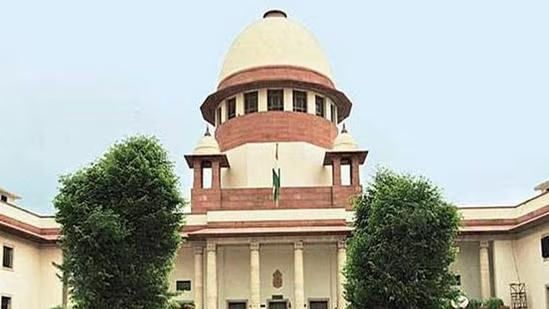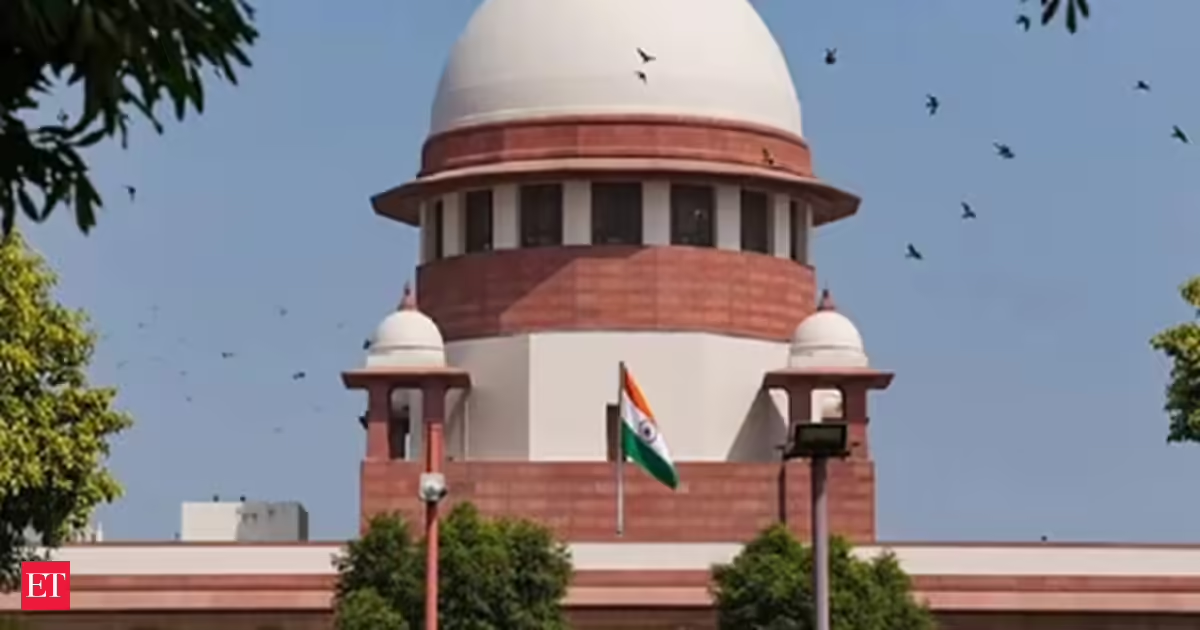
The Supreme Court on Thursday (June 4, 2026) observed that the “inordinate delay” in the investigation exemplified the maxim that justice delayed is justice denied.
| Photo Credit: Shashi Shekhar Kashyap
Pulling up the Gujarat Police for failing to file a chargesheet in a two-decade-old criminal complaint involving allegations of forgery and manipulation of revenue records, the Supreme Court on Thursday (June 4, 2026) observed that constitutional courts cannot remain “mute spectators” to such prolonged investigations and must step in to provide relief. The court directed the Gujarat Police to complete the investigation within six weeks.A Bench of Justices Sanjay Karol and Augustine George Masih observed that the “inordinate delay” in the investigation exemplified the maxim that justice delayed is justice denied.“The right to a speedy trial is intrinsically linked to Article 21 of the Constitution. In the present factual matrix, nearly two decades have passed since the initiation of the complaint by the original complainant. However, it is a matter of serious concern that despite the lapse of such an inordinate period of time, the investigation is yet to reach any meaningful conclusion... This court is of the view that it is incumbent upon constitutional courts not to remain mute spectators when such prolonged investigations are brought to their notice,” the Bench said.The top court was hearing an appeal filed by a man whose father had lodged a criminal complaint alleging that four individuals forged his signature and executed fabricated property documents while he was away on a Haj pilgrimage in 2002. According to the complaint, the forged documents were later used to secure entries in the revenue records.Since 2014In 2014, the Gujarat Police submitted a report before the trial court concerned. The report was rejected, and further investigation was directed to be completed within 60 days. When no progress followed, the appellant approached the Gujarat High Court in 2017, which directed the investigating agency to conclude the probe within six weeks. During the proceedings, however, it came to light that evidence collected during the investigation had gone missing from police custody.With the investigation still pending, the appellant again approached the Gujarat High Court in 2022 seeking directions to the police to file a chargesheet. The High Court, however, declined to issue any such direction and disposed of the plea, noting that a similar application was pending before the trial court. Aggrieved by the order, the appellant moved the Supreme Court.The top court expressed serious reservations about the High Court’s failure to intervene despite the complainant having to “run from pillar to post” for the filing of a chargesheet. It also castigated the Gujarat Police for losing vital case records, observing that the missing evidence had effectively stalled the probe.“...we are of the view that incidents such as this, wherein case records are lost during an active investigation, have to be taken with utmost seriousness. Moreover, such incidents strike at the very core of the criminal justice system, rendering bona fide complaints inactionable,” the Bench said.No closure reportThe judges also pointed out that if the police had been unable to conclude the probe due to the missing records, it ought to have filed a closure report before the trial court concerned instead of allowing the matter to remain pending for decades.Accordingly, the Bench directed the police to complete the investigation within six weeks. It also called upon the State government to file an affidavit detailing the disciplinary action initiated against the errant officials and explaining why the trial court was not informed that the missing records had hampered efforts to reconstruct the case and trace witnesses.The court listed the matter for hearing next on July 14 to review compliance with its directions. Published - June 04, 2026 07:33 pm IST