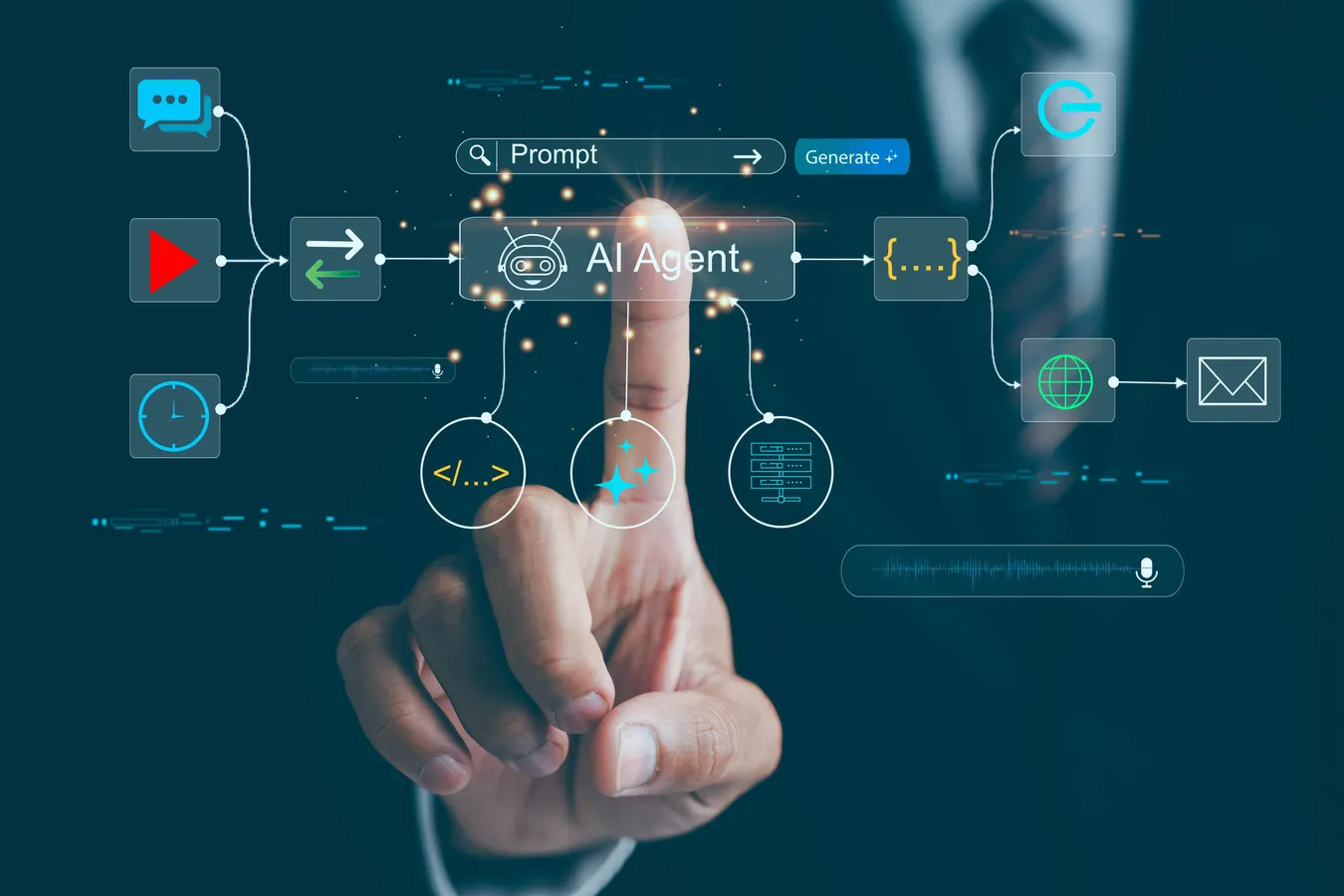
Larry Bradley is CEO & cofounder of SolasAI, an AI SaaS platform fixing model bias for Fortune 50 firms across finance, tech & healthcare.gettyYou’ve no doubt heard the term "agentic AI" by now. It’s heralded as the next evolution of artificial intelligence—not just a tool to be used but a collaborator that works alongside you. Gartner researchers predict that by 2028, agentic AI will autonomously make 15% of all routine work decisions.The potential of this technology could be described as revolutionary, but so are the risks. As agentic AI continues to evolve, mistakes can be costly, fast-moving and difficult to contain. Just ask the developer who lost his wife’s photos when he had Claude “organize” her computer, or the Meta security researcher who nuked her own inbox with OpenClaw.To truly harness this technology, we must understand both how it works and where it can (and can’t) be effectively implemented.How Does Agentic AI Work?Think of a large language model (LLM) as a brain. Generative AI like ChatGPT or Microsoft’s Copilot can use that brain to respond to questions. Those answers may be in the form of text, images or video. But the whole process is reactive. You ask for a thing. It gives you a thing. That’s it.But agentic AI has not only a brain to respond to questions but metaphorical arms and legs to take action based on those responses. By referencing a set of rules, goals or guidelines, agentic AI can execute multistep workflows, adjusting its duties to achieve success. If GenAI is a production assistant, agentic AI is more like a deputy or an entire supporting team.Similar to humans, AI agents can be taught skills to perform certain tasks. We provide them resources to help them navigate decisions, and they use tools similar to or exactly the same as their human counterparts. Also like humans, they may be implemented within systems or organizations that can provide checks and balances. This greatly increases the value and ability to manage them compared to GenAI by itself.Where We Can Make Agentic AI Work For UsAgentic AI opens enormous opportunities across industries. Take banking, for example. Agentic AI can greatly speed up administrative work, like reading client support emails and determining which department those requests should be forwarded to. When you receive 1,500 client request emails a day like Scotiabank, the time savings really add up, allowing those requests to be dealt with much sooner rather than waiting in an inbox for someone to sift through.In healthcare, responsible internal use cases are also emerging. Stanford Health Care is deploying agentic systems to help researchers and clinicians access and organize personalized real-world evidence (RWE), reducing administrative time and costs while surfacing insights more efficiently for medical professionals.These are good examples of where agentic AI can add value: internal operations, bounded environments and tasks with both clear parameters and strong human oversight.The Riskier Side Of Agentic AIWhere things become dicier is when agentic AI is placed in customer-facing or high-stakes decision-making roles. Back to the banking example, that might mean using autonomous agents in investment trading or financial advice, where errors could create unrealistic wealth expectations or expose institutions to regulatory scrutiny. That’s partly why the American Bankers Association and Bank Policy Institute have asked the National Institute for Standards and Technology to develop guidance for safe agentic AI use—to keep these riskier uses from seeing widespread adoption.Healthcare has its own minefields to contend with. Customer-facing agents that guide patient decisions without sufficient safeguards could introduce serious safety and liability concerns. We’ve already seen this happen with patient data of nearly 500,000 Catholic Health members being exposed by agentic AI management software.Where Does That Leave Us?The core challenge agentic AI must overcome is trust. This technology will make mistakes, and because it operates with fewer human touchpoints, those mistakes compound quickly. A single flawed assumption can create devastating consequences through an entire workflow or network before anyone notices.That’s one reason Gartner analysts also predict that "over 40% of agentic AI projects will be canceled by the end of 2027, due to escalating costs, unclear business value or inadequate risk controls." These factors, along with legal liability, make it difficult to determine whether the juice is truly worth the squeeze. It will all depend on the industry, the use case and the organization’s tolerance for complexity and volatility.Services that review and monitor your AI and machine learning will be an absolute necessity to mitigate these risks, ensuring both compliance with existing laws and regulations while also maintaining consumer trust and confidence. This must follow a “governance in depth” architecture, with layers of controls, including dedicated governance agents, tools and skills agents can reference, as well as orchestration mechanisms to help humans provide oversight to those agents and manage these complex systems.Agentic AI is likely the future of enterprise AI, but getting there responsibly will require strong guardrails, careful monitoring and ongoing compliance oversight. Although generative AI defines the present, agentic AI will shape what comes next—but only if we apply it where it belongs. Forbes Technology Council is an invitation-only community for world-class CIOs, CTOs and technology executives. Do I qualify?
The Future Is Agentic, But Only When Applied Correctly
To truly harness this technology, we must understand both how it works and where it can (and can’t) be effectively implemented.
856 words~4 min read