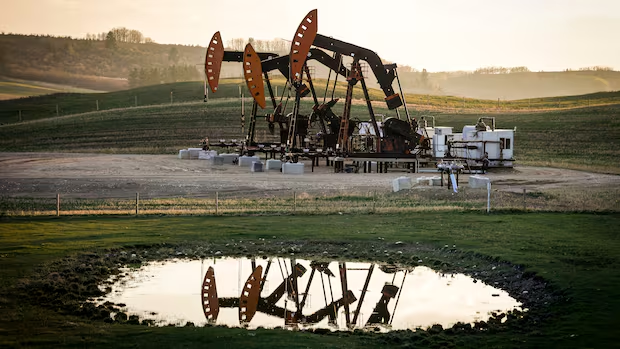
BusinessEnergy executives and analysts are warning that oil and gas prices will likely rise significantly as the Strait of Hormuz remains closed and stubborn demand burns through strategic reserves.Summer travel could get a lot more expensive as Strait of Hormuz remains closed and oil reserves dwindleRichard Raycraft · CBC News · Posted: Jun 04, 2026 4:00 AM EDT | Last Updated: 2 hours agoListen to this articleEstimated 6 minutesThe audio version of this article is generated by AI-based technology. Mispronunciations can occur. We are working with our partners to continually review and improve the results.Pumpjacks draw out oil and gas from a well head near Calgary in May 2024. Energy executives are warning that global reserves of oil are at concerningly low levels as the Strait of Hormuz remains close, which could lead to higher prices soon. (Jeff McIntosh/The Canadian Press)Energy executives and analysts are warning that oil and gas prices will likely rise significantly as reserves deplete and the Strait of Hormuz remains closed.The price of Brent crude futures was $98.20 US a barrel midday Wednesday. But experts say it could balloon to $150 US or more in the coming weeks, largely due to fading hopes for a U.S.-Iran deal to reopen the Strait, as well as unchanging demand in some markets as reserves are quickly running dry."We're approaching unheard-of inventory levels," Neil Chapman, an ExxonMobil senior vice-president, told a conference in New York last week. "You can debate whether it's going to hit those really low levels in two weeks or three weeks. But once you get to that point, then you'll see [the] price shoot up."Chapman said the price could go up to $150 US to $160 US in that time frame.In an interview with the Bloomberg Talks last week, Chevron CEO Mike Wirth also expressed concern about reserve levels.“We are steadily drawing inventories down on products, on crude, in locations around the world,” he said, mentioning that inventories could bottom out "before long."“I think June and July are going to be critical months."VideoSoaring gas prices push inflation to highest rate in 2 yearsFarmers confront rising cost of fertilizer and fuel as spring seeding underwayReserves running lowIn response to the conflict in the Middle East, 32 members of the International Energy Agency agreed in March to release 400 million barrels of oil from their emergency reserves.The U.S. Strategic Petroleum Reserve is at 357.1 million barrels of oil as of May 29, according to the Department of Energy’s latest report, more than 50 million barrels lower than before the war in February 2026. It’s the lowest level since December 2023, and approaching numbers from the early 1980s, just after the reserve was created, when it was still filling up.Chevron's Wirth stopped short of calling the situation a crisis, but said the market is in a difficult position.“The inertia in the system is very, very strong, and turning that is not easy."U.S. President Donald Trump has repeatedly suggested that his country and Iran are close to a deal to reopen the Strait of Hormuz, through which around 20 per cent of the world’s oil is shipped. Iran has disputed those claims, and the Strait remains closed to the vast majority of commercial shipping. The war, which the U.S. and Israel started in February, has shown few signs of abating. On Wednesday, Iran fired missiles at U.S. military bases in the Gulf region, which the U.S. said had failed. Oil prices rose following the news.U.S. House votes to curb Trump's war powers in strongest rebuke yetU.S. says it intercepted Iran missile attacks on regional alliesAl Salazar, head of macro oil and gas research at Calgary energy analytics firm Enverus, called the situation “mind-numbing” and “frustrating” as the price of oil hasn’t matched the circumstances.“We concur with what the Exxon and Chevron executives are saying — we think the price should be higher; we think it’s artificially low,” he said. “If you twist my arm, I think we’re probably $20 [US] below where we should be on Brent.”Heather Exner-Pirot, energy director at the Ottawa-based Macdonald-Laurier Institute, says the strategic oil reserves have done their job so far, but they won’t last forever.“We are about to hit the bottom of those inventories, and there’ll be nothing left to buffer this," she said. “So certainly it looks like $150 [US] is very realistic in the coming weeks.”WATCH | How some O&G companies are handling higher prices:High oil prices have some companies ready to boost productionApril 27|Duration 1:31After reducing spending last year, Saturn Oil and Gas chief executive John Jeffrey describes confronting volatile commodity and share prices, and how the firm is ready to increase production as oil prices are expected to remain relatively high for the rest of the year.The analysts warn that prices are likely to remain higher through to at least 2027, partly because of the difficulty of reopening the Strait. Wirth mentioned that there are six ships in the Strait carrying Chevron cargo, but that they can’t go through until their owners give the order — and that partly depends on whether they feel it’s safe to do so.“If Trump announces or the Iranian regime announces it’s open, I don’t think there’s any confidence that, by the next day, you’re sure that it’ll still be open,” Exner-Pirot said.“We’ve had so much jawboning; we’ve had so much talk about ‘in negotiations,’ trying to keep oil prices low, frankly, that there isn’t a lot of trust.”People paddle along the shoreline as cargo ships are anchored in the Strait of Hormuz off Bandar Abbas, Iran, on June 1. Energy executives and analysts say that even if the Strait opens to commercial traffic soon, the effects on oil prices could last well into 2027. (Amirhosein Khorgooi/The Associated Press)Salazar said a return to normal flows through the Strait in 2027 isn’t guaranteed.“That’s based on the assumption that they do come up with a peace deal, and they have to clear the mines after 60 days, and they have to resume the production and clear the tankers."Soaking up the sun — and the gasDemand for fuel hasn’t abated in Canada even as supply has tightened and prices have shot up, a situation Salazar calls "fascinating."“It’s actually up in Canada,” Salazar said. “High prices have done nothing to dissuade consumers from consuming jet [fuel] or gasoline.”But gas prices could soon become even higher, just as Canadians are hitting the road and skies. Summer is when demand for gasoline peaks, Exner-Pirot said, and if oil starts to hover at $120 US to $140 US a barrel, she thinks gas in Canada could increase to more than $2 a litre.WATCH | Why a Middle East oil blockage affects Canadian gas prices:Why does a Middle East oil blockage affect Canadian gas prices? | About ThatMarch 16|Duration 1:55Andrew Chang explains how Iran's blockage of the Strait of Hormuz — a critical oil-shipping route in the Middle East — affects the cost of energy here in Canada.
Higher oil and gas prices coming soon, industry and analysts warn | CBC News
Energy executives and analysts are warning that oil and gas prices will likely rise significantly as the Strait of Hormuz remains closed and stubborn demand burns through strategic reserves.
1,311 words~6 min read