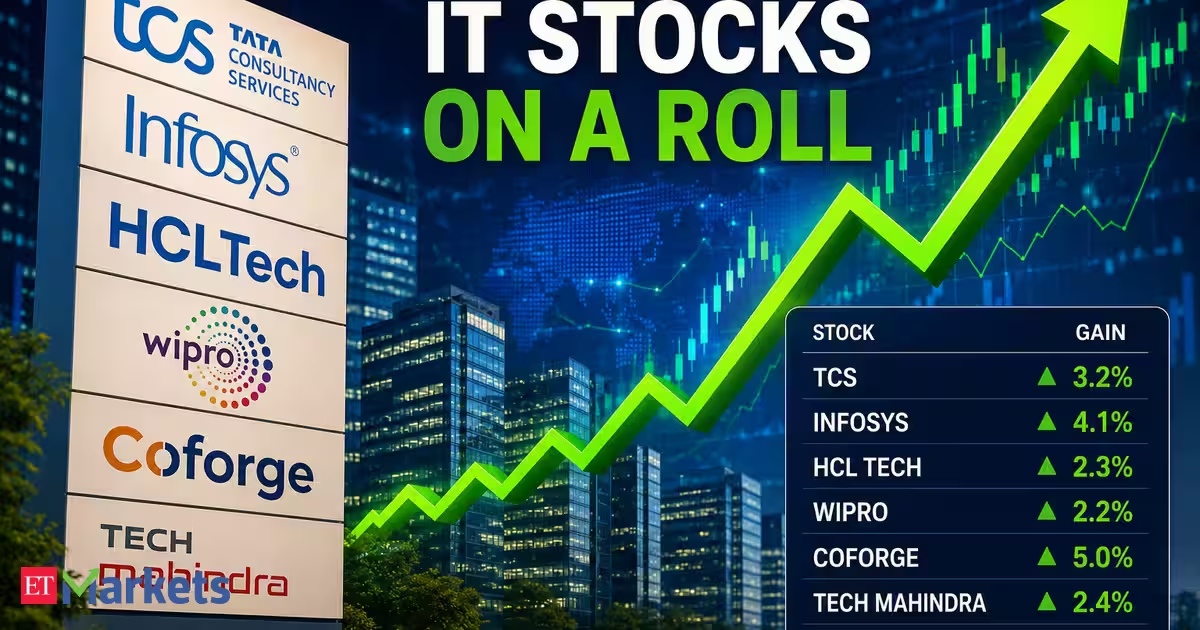
Amit Khurana, Group CEO and Head of Institutional Equities at Dolat Capital, has upgraded India's IT sector and named four specific stocks he is backing, even as the broader market wrestles with Middle East uncertainty, a weak monsoon outlook, and muted near-term earnings growth.Speaking to ET Now, Khurana said Dolat Capital upgraded the IT sector in April, driven by a combination of depressed valuations and a rupee depreciation tailwind that he believes the market is underpricing.Why now, and why IT?The timing is deliberate. Khurana pointed out that large-cap IT valuations had been sliding toward multi-decade lows, and that even at near-zero constant currency revenue growth, the sector's top companies were continuing to generate strong cash flows. "Can we go negative? I do not think so," he said, drawing a floor under growth expectations.The bigger driver for his upgrade, however, is the rupee. A weaker currency directly boosts net profitability for IT exporters, and Khurana projects that net earnings for companies in Dolat's coverage universe will trend toward double digits in FY27, even if constant currency growth stays in the 0–4% range. Combined with dividend yields, he sees total returns of 10–15% as achievable depending on the franchise.On AI concerns, the most debated overhang on the sector, Khurana's view is pragmatic rather than dismissive. The risks are real, he said, but they are already priced into current valuations. The upgrade is explicitly tactical, not a structural conviction call.You Might Also Like:The four names Dolat Capital is backingOn the large-cap side, Khurana singled out LTIMindtree as his top pick. The company's recent investor day reinforced his view that it has been consistently outperforming sector averages over recent quarters, with total contract value figures trending higher and growth visibility remaining intact.For the large-midcap segment, OFSS, Oracle Financial Services Software, is the preferred name, given its niche dominance in banking technology software and resilience to the broader IT services slowdown.In the small-cap space, Khurana flagged eClerx Services and Intellect Design Arena as his two picks — both specialist operators with focused domain depth rather than the broad-based exposure that makes larger IT firms more vulnerable to AI-led project compression.The broader market call: bottoms-up winsBeyond IT, Khurana's macro read is cautious. His FY27 earnings estimates have already been trimmed by 100–250 basis points across coverage sectors, reflecting the Q1 impact of the ongoing conflict. Downgrades are running at roughly 2:1 over upgrades in Dolat's universe.You Might Also Like:His core market thesis is that a macro-driven rally, triggered by any Middle East resolution, is possible but unlikely to be durable. The more reliable playbook for the next few quarters, he argues, is stock-specific and sector-specific allocation rather than broad index positioning.Chemicals emerging from the troughOne sector where Khurana sounded more constructive than the consensus was specialty chemicals. He cited two factors driving a potential upcycle: inventory destocking appears sharper and more complete this time, and select Chinese product supplies have tightened due to molecule-specific constraints. With most Indian capex now being commissioned and utilisation rates set to improve, companies like SRF and Navin Fluorine came up as examples of the trend turning.Consumption and monsoon: wait and watchOn consumer sectors, Khurana noted that Q4 commentary held up better than feared, partly because the conflict escalated toward the end of the quarter, allowing lower-cost inventory to pass through margins relatively intact. However, he was careful not to extrapolate that into optimism, flagging an expected below-average monsoon and its potential impact on food price inflation and rural demand as variables that need watching over the coming months.For IT investors specifically, his advice is equally measured: the valuation floor looks solid, the rupee is a genuine tailwind, and consensus upgrades, if they come, won't arrive until the October earnings season at the earliest.You Might Also Like:
Amit Khurana backs LTIMindtree, OFSS and eClerx as tactical bets
Amit Khurana of Dolat Capital has upgraded India's IT sector, citing depressed valuations and rupee depreciation as key drivers. He believes the market is underpricing these tailwinds, projecting double-digit net earnings growth for IT exporters by FY27. Khurana also highlighted four specific IT stocks he is backing, including LTIMindtree, OFSS, eClerx Services, and Intellect Design Arena.
626 words~3 min read