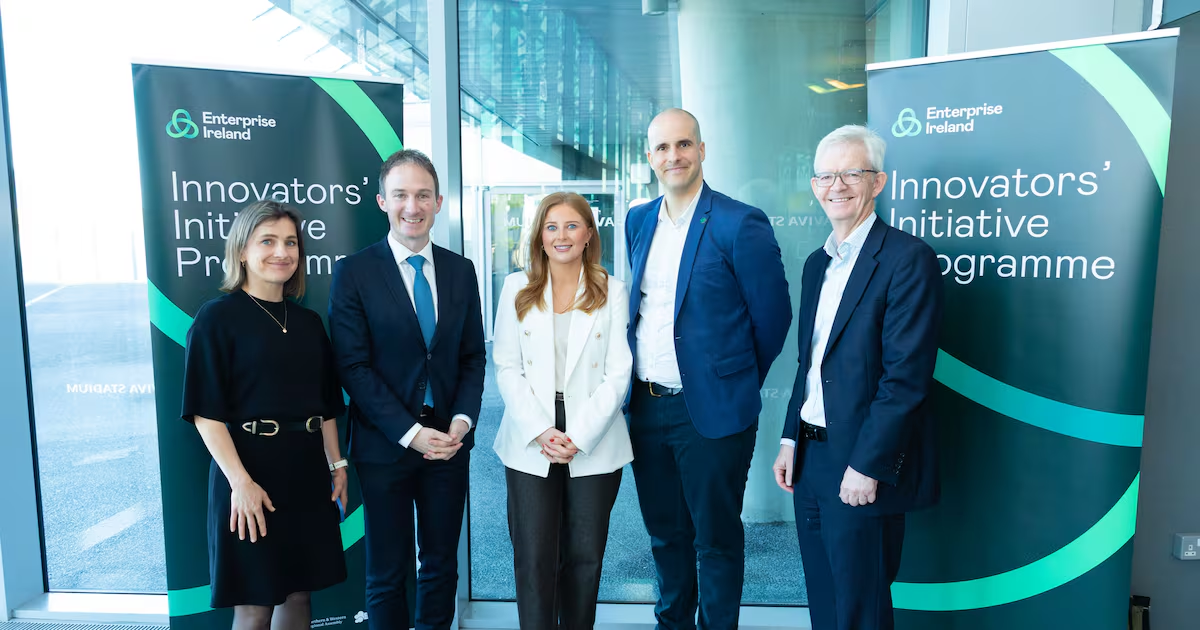
Ireland has no shortage of entrepreneurs and is blessed with a first-class enterprise support system aimed at providing the guidance and financial assistance required to turn start-ups into successful businesses.But what about the earliest stages of the start-up journey, when the entrepreneur doesn’t even have an idea on which to base a business? Andres Mori, programme manager for the Innovators’ Initiative, describes this as “the first mile of innovation”.“Ireland has very strong research capability and entrepreneurial ambition,” he says. “But historically, there has been a gap at the early stage in identifying market needs and translating them into commercial outcomes.”That’s where the Innovators’ Initiative comes in. Aimed at mid-career professionals who want to turn their expertise into new ventures and high-impact solutions, the initiative is a national immersive needs-led training programme delivered by leading Irish research‑performing organisations (RPOs) and supported by Enterprise Ireland. The programme is built on needs‑led innovation where participants start with real‑world problems and then move on to develop solutions with commercial and societal impact.The programme is managed by Enterprise Ireland, in partnership with the Northern and Western Regional Assembly and the Southern Regional Assembly, providing national co-ordination alongside regional delivery.Training is practical and team based, and participants receive funding, mentoring, and clear routes into commercialisation and start-up supports, Mori explains.“Participants come in and are trained in identifying needs where there is a market gap,” he adds. “Part of the programme is visiting the market environment to see if their idea might have paying customers. Then they go back into training where they analyse the market, the competitive environment, and what would be required to bring the product to market. The aim is to develop solutions to real-world problems; it is not an academic or theoretical exercise. We want to see the ideas move into commercialisation.”On completion of an Innovators’ Initiative programme, participants may also access further commercialisation supports through Enterprise Ireland’s Commercialisation Fund and Pre-Seed Start Up awards, which may in turn support progression toward the formation of a high-potential start-up (HPSU), directly contributing to job creation and economic growth.Four programmes have been funded so far under the initiative: BioInnovate (Medtech); Fast-IP (Food and Agriculture Sustainable Technology Innovation Programme); Cyber Innovate (cybersecurity); and DigiBio (digital health).Enterprise Ireland has launched a new call under the Innovators’ Initiative inviting applications from publicly funded RPOs to design and deliver new innovation training programmes. The call will expand the initiative through the delivery of three additional programmes, strengthening innovation capability across regions and sectors. A total fund of €10.5 million will be allocated across three new education and training programmes, each of which will receive €3.5 million over a four-year term.This phase of the initiative has been designed to align with and support the Strategic Technologies for Europe Platform (Step) priority areas, including digital and deep tech innovation, clean technologies and biotechnologies. The Step platform is an EU initiative established in 2024 to boost investment in critical technologies within Europe, aimed at enhancing industrial competitiveness and reducing strategic dependencies. It supports deep and digital tech, clean technologies, and biotechnologies by leveraging, reinforcing and steering existing and new EU funds.A number of success stories have already emerged from the existing programmes.Two sustainable agriculture research projects from the Fast-IP programme hosted by University College Dublin and supported by Teagasc, BiCO and Mehal, have secured a total of just over €1.2 million in commercialisation funding from Enterprise Ireland.BiCO is working on a way to transform microalgae growth into a viable carbon utilisation process for sustainable protein production while Mehal is developing a smart pest-intelligence platform to address escalating pressures on the horticulture sector from destructive pests.Meanwhile, the next generation of cybersecurity entrepreneurs and leaders is being developed at Munster Technological University (MTU) through the Cyber Innovate programme.Mulcahy Ward founders Clodagh Mulcahy and Paul Ward met and worked together on the Cyber Innovate Programme. As cybersecurity advisers, Mulcahy Ward aim to maximise a company’s resilience and minimise risk.Resilium specialises in safeguarding operational technology for the industrial sector. Unlike general IT security, the core focus of the company is on keeping factories running and ensuring physical safety on the shop floor.A third start-up from the MTU programme, Ailtire, which is the Irish word for architect, is founded on the belief that security must begin with the architecture. The company provides an AI-native threat modelling platform that helps businesses understand the security risks in their system design in minutes rather than months and take action before problems arise.“Ailtire was selected to pitch at the Enterprise Ireland Start-up Day last month,” Mori notes.The ultimate ambition is to scale the pipeline of innovative new ideas that can be translated into commercial outcomes. “We want to see more start-ups, more jobs and the translation of innovation into commercial outputs at scale,” he concludes.The closing date for applications to the Enterprise Ireland Innovators’ Initiative call is Wednesday, July 8th, 2026, at 12pm.
Innovation pipeline strengthened with €10.5m funding initiative
Innovators’ Initiative is aimed at mid-career professionals who want to turn their expertise into new ventures and high-impact solutions
812 words~4 min read