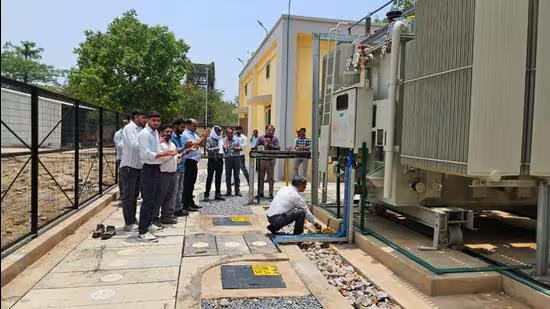
GREATER NOIDA: The Noida Power Company Limited (NPCL) has commissioned a new 12.5 MVA, 33/11 kiloVolt (kV) substation in Site-4 area, and is set to operationalise another substation in Ecotech-3 later this week to boost power infrastructure across Greater Noida amid a record electricity demand in this ongoing summer.The new substation, which operational this Monday, is expected to improve power supply reliability and network flexibility in Site-4, Swarn Nagri and Sector-36 area (HT Photo)Greater Noida’s peak power demand touched a record 866 MW on May 28 this year, surpassing the previous all-time high of 832 MW recorded on June 12, 2025.The new substation, which operational this Monday, is expected to improve power supply reliability and network flexibility in Site-4, Swarn Nagri and Sector-36 areas. The additional capacity will help reduce the load on the existing Sector-36 substation, said NPCL officials.Another 12.5 MVA capacity substation at Ecotech-3, currently undergoing final testing, is expected to be commissioned later this week. Once operational, it will cater to industrial consumers as well as residents of Jalpura, Habibpur, Haldoni and nearby villages, they added.According to NPCL, the power distribution company, the projects are part of its ongoing capacity augmentation programme aimed at meeting rising electricity demand and improving supply reliability across its distribution area.“The network augmentation works have been undertaken to strengthen the power distribution system in Greater Noida and cater to the growing demand from residential, commercial and industrial consumers. These upgrades will help improve supply reliability and ensure the system is better equipped to handle peak loads during the summer months,” said Manoj Jha, spokesperson of the NPCL, in a statement on Wednesday.Apart from new substations, NPCL has upgraded the capacity of three power transformers at Alpha-1, Gamma-1 and Sector-37 from 5 MVA to 12.5 MVA.The utility said the upgrades have improved load management and service reliability across Alpha, Beta, Gamma and Delta sectors, as well as Sector-36, Sector-37 and Achheja village.In another initiative, the company raised the capacity of four power transformers from 12.5 MVA to 16 MVA at Site-B and Ecotech-6.Officials said the upgrades have strengthened supply to consumers in the Site-B Industrial Area, Kasna village and Kasna Industrial Area, while improving the network’s ability to cater to increasing demand.The latest works build on a series of network expansion projects undertaken by the utility in recent months.Last month, the power discom commissioned two new 12.5 MVA substations at Sector-16B and Site-5. While the Sector-16B facility improved power supply in residential areas of Greater Noida West and adjoining sectors, the Site-5 substation enhanced electricity distribution for industrial units, Luksar village and the Kasna Industrial Area.To ensure uninterrupted power supply during the peak summer season, the discom has also deployed field teams for monitoring. “34 dedicated field teams for round-the-clock monitoring of the power network, 24 maintenance teams for preventive and corrective maintenance work, and 10 engineers on 24x7 field duty for emergency response and coordination have been deployed,” Jha said.Jha said the company was combining infrastructure expansion with operational preparedness to improve network resilience. “The infrastructure upgrades have helped enhance the network’s capacity and reliability to meet rising electricity demand in Greater Noida. The additional capacity is also expected to support future residential, commercial and industrial growth in the area,” he said.Officials said the addition of new substations, higher-capacity transformers and dedicated field teams is expected to improve network reliability and support uninterrupted power supply during the summer months, when electricity demand typically peaks.
Amid record summer demand, discom expands power network in Greater Noida
NPCL commissions new substations in Greater Noida to meet record electricity demand, improve supply reliability, and boost power infrastructure.
572 words~3 min read