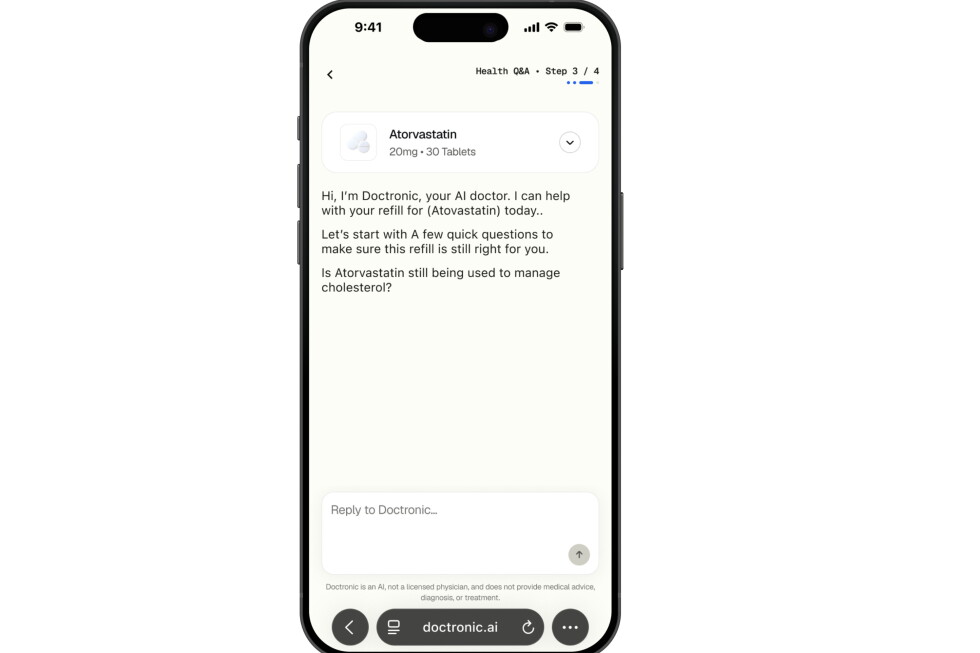
Utah is in the midst of an experiment to let AI renew some prescriptions. A company, Doctronic, promises easier and cheaper care but some doctors fear patients may get hurt. Patients on medicine for high cholesterol, diabetes, birth control, depression or a host of other conditions, answer a few questions, verify their identity, and voila! The prescription is refilled. Doctronic co-founder Matt Pavelle said since this experiment is so novel, in addition to billboards and commercials, the company is turning to humans.“We have a street team we have people who walk around inside Salt Lake [City],” Pavelle said. “They go up to strangers and, ‘Hey do you have a prescription? Do you want to try this?’”The yearlong experiment is supposed to make it easier and cheaper to get medicine. It can take weeks or months to get into the doctor, and can cost over $100. In the first phase, doctors reviewed each renewal. In the next phase, only 10% of prescriptions will be reviewed by a human. Utah’s Office of Artificial Intelligence Policy which was created in 2024, waived normal licensing rules to allow the AI to make clinical decisions. The state’s medical licensing board was blindsided. They pressed the state to pause the program, fearing patients could get hurt. But regulators are pushing ahead. Dr. Brooks Bahr, a dermatologist and president-elect of the Utah Medical Association has mixed feelings about it.“We're excited about cost savings and efficiency savings and all that, but we want to be able to preserve the physician-patient relationship,” Bahr said. “I think that's the thing we're most worried about.”Doctronic is not charging for the service now. Patients just have to pay the cost of the medicine. Most of the company’s revenue still comes from a televisit service available across the country with human doctors.What’s still a bit murky is Doctronic’s accountability for mistakes. Normally, the doctor signing the scrip is responsible for any problems the patient has. Michelle Mello, a health law professor at Stanford University, said it’s unclear whether the company behind the AI will have the same responsibility.“The courts have not worked that out, mostly because they have not been asked to yet,” Mello said. “We don't have evidence of a lot of those kinds of claims percolating.”Doctronic says it has a first-of-its-kind AI malpractice policy. Mello said while there's a lot of uncertainty, most of the 190 medications the pilot covers are low risk. She does warn that it’s important to watch out for scope creep.“Something I see is that we say ‘yes’ to a particular AI deployment,” she said. “And pretty quickly, we end up admitting a much larger presence of AI in healthcare than we originally envisioned.”Expansion is already happening fast. Utah just gave the greenlight for another AI company — Legion Health — to renew some psychiatric medications. And Doctronic is in talks to move into Arizona and Wyoming.
Utah is experimenting with a new role for AI: renewing prescriptions
Utah is drawing attention for piloting an AI program that promises faster and cheaper prescription renewals, while raising questions about patient safety and liability.
480 words~2 min read