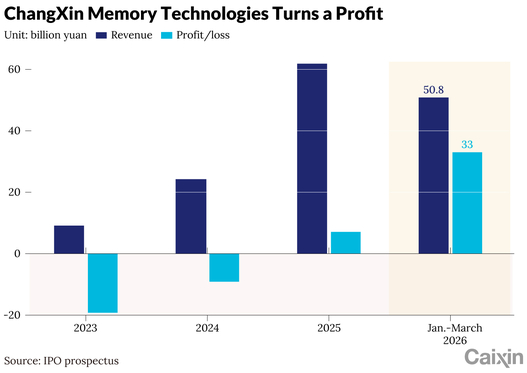
1. Two Chinese memory chipmakers, ChangXin Memory Technologies (CXMT) and Yangtze Memory Technologies (YMTC), are preparing initial public offerings (IPOs) on Shanghai’s STAR Market. [para. 1][para. 3] CXMT, a leading DRAM producer, aims to raise 29.5 billion yuan ($4.3 billion). [para. 2] YMTC, known for NAND flash memory, is also moving toward a listing. [para. 3] Their IPOs come amid a memory chip shortage driven by surging AI demand, which has sent prices and profits soaring. [para. 4] CXMT and YMTC are seen as China’s best hopes to compete with dominant South Korean and American firms like Samsung, SK Hynix, and Micron. [para. 4] However, the back-to-back IPO plans raise liquidity concerns for the mainland stock market, potentially siphoning funds from other technology stocks. [para. 6]2. After years of losses and heavy capital spending, both companies have turned profitable thanks to the AI-driven upswing. [para. 7] In the first quarter of 2026, CXMT reported 33 billion yuan in net profit on revenue of 50.8 billion yuan—a sharp turnaround from a 2.8 billion yuan net loss in the same period of 2025. [para. 8] YMTC’s first-quarter revenue doubled year-over-year to over 20 billion yuan, lifting its NAND flash market share above 10%. [para. 11] CXMT’s performance reflects the frenzied global demand; DRAM contract prices nearly doubled in Q1 2026 from a year earlier, and TrendForce forecasts another 58%–63% increase in Q2 2026. [para. 9] In Q4 2025, CXMT held 7.67% of the global DRAM market, making it the fourth-largest by sales. [para. 10]3. The planned IPOs have sparked a valuation debate. [para. 12] Based on its fundraising target and new shares, CXMT’s implied IPO valuation is slightly below 300 billion yuan. [para. 12] Some investors argue this understates its earnings potential, citing an estimated first-half profit of up to 57 billion yuan. [para. 13] A public fund manager predicts annual profit could exceed 100 billion yuan, supporting a market value of 3–4 trillion yuan, which would make CXMT China’s most valuable listed company. [para. 14] However, skeptics note the semiconductor industry’s historical cyclicality and doubt that CXMT’s blockbuster results can be sustained as the cyclical peak fades. [para. 15] Shanghai Yunji Private Equity Fund Management estimates CXMT’s market capitalization at 800 billion to 1.2 trillion yuan, based on traditional PE and PB ratios. [para. 16]4. International investment banks have traditionally used the price-to-book (PB) ratio to value chipmakers. [para. 17] But in a May 2026 report, JPMorgan switched to a price-to-earnings (PE) ratio-based approach, citing the current semiconductor cycle. [para. 18] Yunji founder Liang Li says CXMT’s valuation looks stretched due to the industry’s cyclical nature, Beijing’s push for semiconductor self-sufficiency, and high premia awarded to new mainland listings. [para. 19] Optimists argue the AI surge has fundamentally changed the memory chip cycle, while measured production expansion makes a supply glut unlikely in the near term. [para. 20] Liang acknowledges this but cautions against ignoring cyclical risks. [para. 20]5. Whether CXMT can maintain a high valuation depends on its ability to achieve breakthroughs in advanced products like third-generation high-bandwidth memory (HBM), which is critical for AI computing. [para. 21] The company also remains vulnerable to supply chain disruptions due to reliance on imported high-tech lithography machines, a risk that must be factored into its valuation. [para. 22]6. The crowding out of capital is a growing concern. Semiconductor stocks have become the dominant destination for leveraged money in the mainland stock market, attracting 91.8 billion yuan in net margin-financing purchases this year. [para. 23][para. 24] Private equity analysts warn that CXMT’s 29.5-billion-yuan IPO, combined with post-listing market value surges, could reduce investment funds available for other tech stocks by 5%–10%. [para. 25] The rally is almost entirely driven by technology stocks, meaning any squeeze on liquidity has no outlet for relief. [para. 26]AI generated, for reference only
In Depth: Big Questions Loom as China’s Memory Chipmakers Prepare Blockbuster IPOs
An AI-driven shortage has turned CXMT and YMTC into profit machines, but investors disagree about how to value them
635 words~3 min read