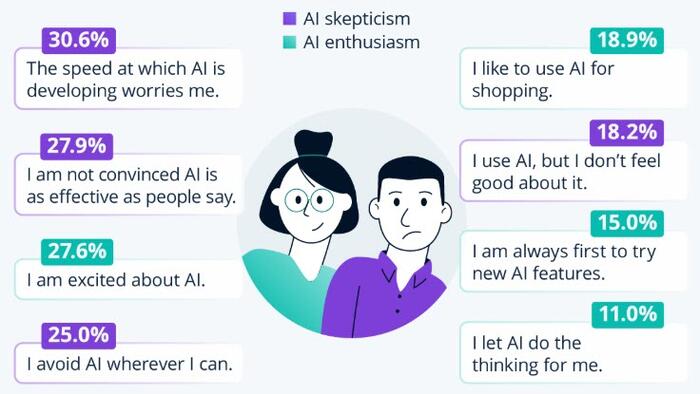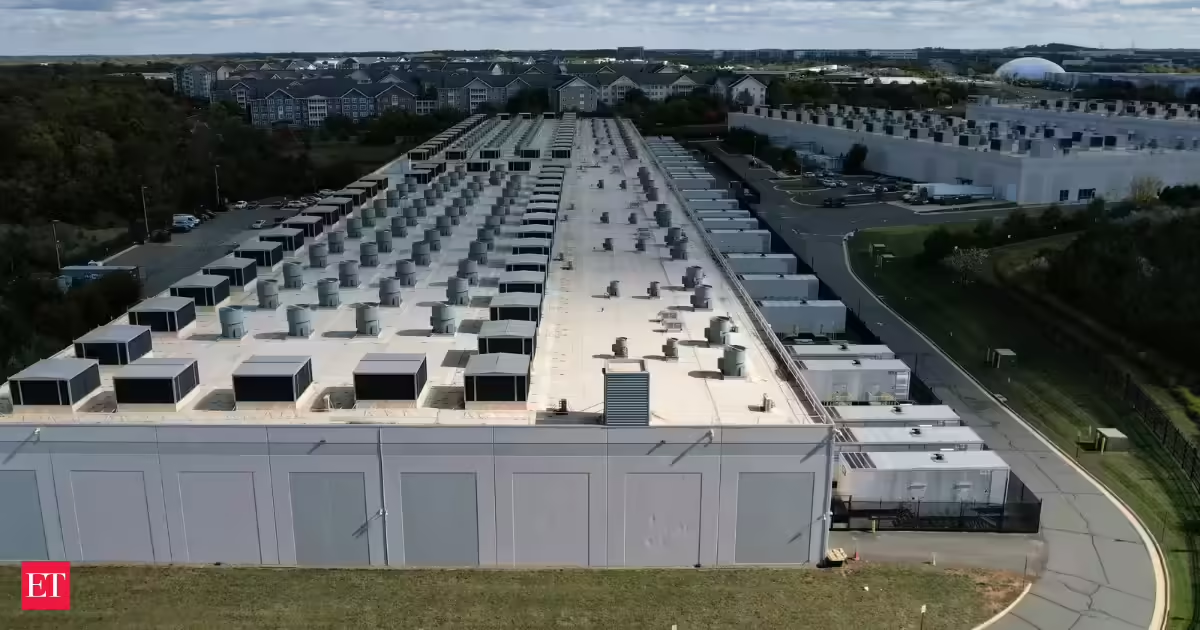
The AI boom, namely the hundreds of billions of dollars being spent to build data centers, is driving U.S. economic growth at the moment. So of course Americans are all excited about this technology, right? Well … not exactly. The tech industry is racing toward a future that doesn’t sound great to a lot of people. Recent data from the Pew Research Center shows Americans are much more concerned than excited about AI. They worry the technology will erode our ability to think creatively and form relationships.Enid Baxter Ryce counts herself in that camp. For 20 years, she’s taught cinema and technology at California State University, Monterey Bay, and for a while now she’s noticed troubling changes in her students as smartphones, social media, and short form video have become ubiquitous.“I saw a huge amount of distraction,” she said. “I saw that they weren't socializing as much, and I saw that they had more anxiety.”Now she’s contending with the latest disruption — AI.“One day, I turned on my computer and there was ChatGPT available on the dashboard for free,” she said.Last year, the Cal State system made a $17 million deal with OpenAI to provide ChatGPT to half a million students and faculty, whether they want it or not.“We're being told, ‘If you don't teach these kids this technology, it's just going to be another way that everything's working against them succeeding,’” Baxter Ryce said.But she’s already noticing unsettling effects — students cheating on papers, of course, but also a sense that people on campus are struggling psychologically with the new technology.“I'm concerned. I'm really scared,” she said. “What's happened to young people over the past 15 years is scary enough, and then adding this technology to the conversation is really frightening.”In communities across the country, data centers, too, have become lightning rods. Local opposition has already shut down dozens of projects.Residents in Hobart, Indiana, outside Chicago have been protesting a proposed Amazon AI data center for months. Organizer Angelita Soriano lives across the street from the 700-acre site and Barbara Koteles lives about a quarter mile away. They’ve been distributing yard signs, going door to door, and even helping sponsor a billboard at a busy intersection in town.“It's definitely uniting people together, regardless of party lines for sure,” Soriano said.Barbara Koteles, who identified herself as Republican, said she’s unhappy with the way her state’s Republican governor has promoted data centers. “I've met many nice Democrats doing this,” she said. “It's a quality of life issue, really.”They worry about noise, pollution, traffic, declining property values and strain on the power grid. Electricity prices in the area have already gone up an average of 26% in the last year. They doubt the benefits of AI will make up for those tradeoffs.“It's kind of being forced down our throats,” Soriano said. “I open Google, there goes automatically AI. I open Microsoft Word on my computer, AI is on there. You can't opt out of it. It's like, what do you do? Just stop using your phone?”Koteles suggested going back to non-AI search engines. “How hard is that? That’s what we can do,” she said.She’s also cancelled her Amazon Prime membership, and advised neighbors to do the same.In early January, after an hour and a half of public comment universally opposing the Amazon data center, the Hobart City Council voted to move forward with the plan, which includes a $47 million “community enhancement payment” to the city, and a promise to cover the additional energy infrastructure the facility would need.“I don't believe that for a second,” Soriano said.Big Tech has a pretty big trust deficit with Americans after the social media era, said Daniel Schiff, an assistant professor of technology policy at Purdue University.“Your perceptions of Meta, your perceptions of X, you know, these are going to be very much tied in with how you you might start to think about these chat bots,” he said. Many Americans don’t have positive perceptions of those platforms even as they flock to them, he noted.“There's a term called the trust paradox,” Schiff said. “The idea here is people will want to use these tools even when they don't trust them and don't like them. I feel it myself.”It sure doesn’t seem like the industry is trying too hard to disabuse consumers of these fears. Whether they’re hyping products to investors or earnestly concerned, leaders have speculated about AI obliterating jobs, substituting for relationships, or wiping out human civilization.“I feel like a lot of the people in the field, in San Francisco don't really understand how different the world is from the Bay Area,” said Spencer Kaplan, an anthropology PhD candidate at Yale who studies the culture of the AI industry. He said the industry is more philosophical than other corners of technology. Many researchers are deep into intellectual movements that value reasoning out loud about big existential questions, like how to save the species from rogue AI. “I mean, one could just say, ‘Well, why not just not work on the technology if you think it's going to destroy the world?’” he said. “I do think there is a sense of inevitability in the field about AI, that if, if I don't work on it, then someone else will. “He clarified many who come off as AI doomers are also extremely excited about the tech. It’s a contradiction that feels natural in their world, even if it doesn’t always feel that way to outsiders, like Baxter Ryce in Monterey.“I'm rooting for natural intelligence,” she said. “That's what I'm rooting for.” But she might want to root for artificial intelligence, at least a little. She’s vested in California’s public employee pension which is heavily exposed to AI, from index funds to individual stocks, to infrastructure funds and real estate trusts tied to data centers.Does it concern her that her personal future is so invested in the success of AI?“I mean, it's just really distressing,” she said. “Now I'm part of another system that I haven't had any input into, and is going to possibly drastically affect people's lives.” That holds whether the AI industry keeps booming, or not.
More Americans concerned about AI, even as it drives economy
While people may find the tools useful and impressive, many simultaneously worry about job displacement, deskilling, the breakdown of human connection, and the rise of data centers.
1,022 words~5 min read