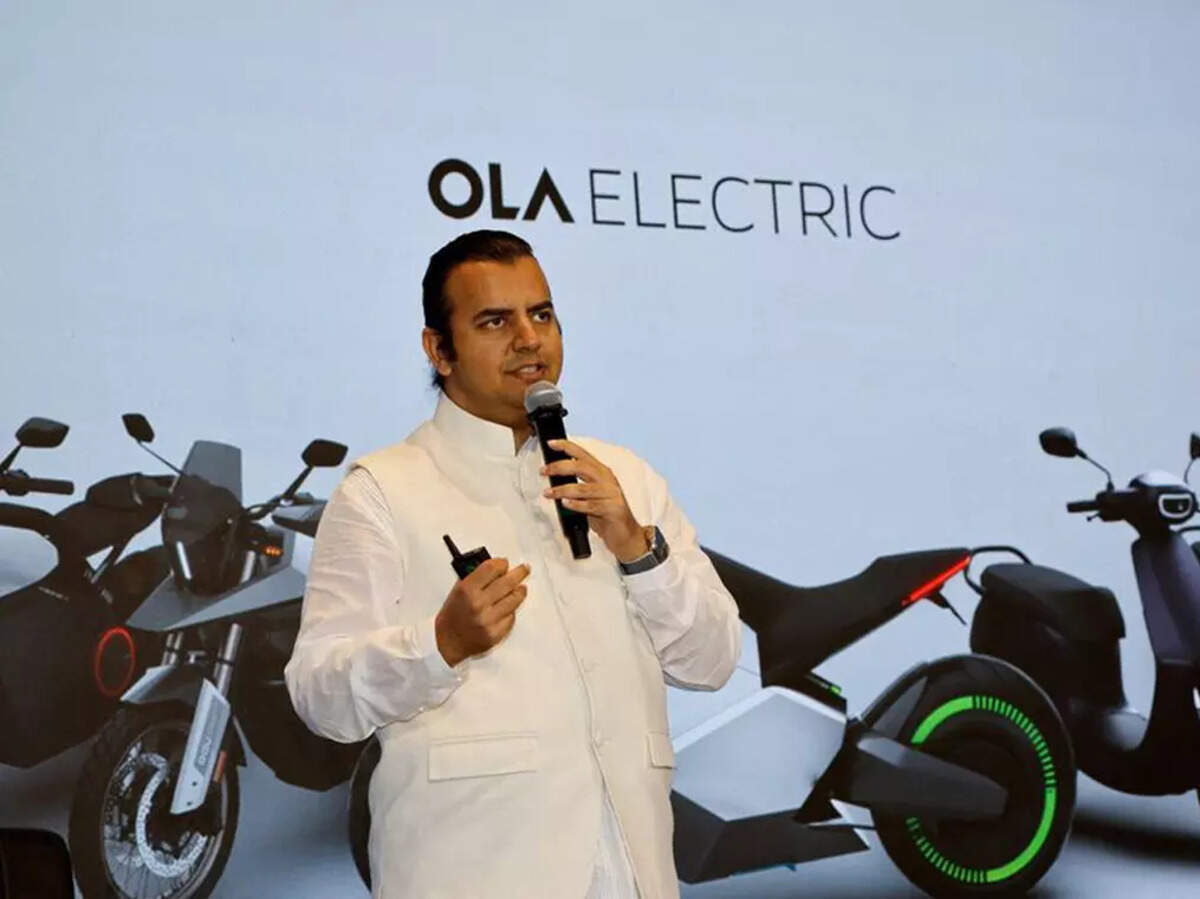
American investor Vanguard has sharply cut the fair value of Ola's parent company. This and more in today’s ETtech Top 5.Also in the letter:■ Mythos lands in India■ India powers Microsoft AI■ AI hardware talent crunchVanguard marks Ola valuation down to $70 million, 99% lower from peak US investment firm Vanguard has hacked the fair value of Ola parent ANI Technologies to just $70 million as of February 28, as per its latest filing with the US Securities and Exchange Commission (SEC).Why this matters: That number is about 99% below Ola’s peak $7.3 billion valuation, a near-total wipeout. The cut comes as Ola continues to lose ride-hailing market share to Rapido.Why now? Funds such as Vanguard routinely reprice their private bets based on business performance, market conditions, and how comparable listed firms trade.Tell me more: ANI Technologies’ revenue fell 42% to Rs 1,171 crore in FY25, while net loss nearly doubled to Rs 662.4 crore from Rs 328.7 crore a year earlier.Vanguard now values ANI Technologies at less than its stake in Ola Electric: the firm’s 3.6% holding in the listed EV maker is worth about $73 million at Wednesday’s market price and exchange rate.Déjà vu: In November 2025, Moody’s downgraded ANI Technologies and slapped it with a negative outlook, flagging weak operating performance, liquidity stress and worries over its loan obligations.PCB makers seek 50% price hike as Iran war crushes supply chains India's printed circuit board (PCB) makers are seeking a 45-50% price hike and lower import duties on key inputs, blaming runaway costs on the West Asia conflict.Jargon buster: PCBs are the boards that hold components in place and create the electrical pathways that let them talk to each other.What's happening? The India Printed Circuit Association (IPCA) has warned that localisation in the $7.27-billion domestic PCB industry could stall if manufacturers continue to swallow losses.It says prices of some raw materials have jumped as much as 150% in the past six months, and has urged members to push for at least a 45-50% price increase from OEMs, EMS players and electronics brands.Why now? Supply chains remain snarled more than 90 days into the Iran-Persian Gulf conflict. Air freight costs are up 40-50%, while delivery times for copper-clad laminates have stretched to 20 weeks from about four.What next? IPCA plans to approach the commerce and electronics ministries, seeking tougher curbs on PCB imports and action against alleged evasion of anti-dumping duties on goods from China and Hong Kong, along with duty relief on imported raw materials.Anthropic expanding Mythos AI model access to India: Report Dario Amodei, CEO, AnthropicAI startup Anthropic is expanding access to its advanced AI model, Mythos, to companies and institutions in more than 15 countries, including India, the Financial Times reported.Access expansion: Anthropic said on Tuesday that about 150 organisations worldwide now have access to Mythos, a model known for quickly spotting cybersecurity vulnerabilities.The rollout spans India, Japan, South Korea, France, Germany, Italy, Spain, the Netherlands, Belgium, Sweden, Switzerland, Canada, Australia and New Zealand.Background: The programme, called Project Glasswing, started with around 50 mostly US-based partners who tested the model’s capabilities and guardrails before a broader launch.Early participants included Amazon, Google, Nvidia, Apple, Microsoft, CrowdStrike and Palo Alto Networks. By late May, they had used Mythos to uncover more than 10,000 serious security flaws that attackers could have exploited.Also Read: Palo Alto Networks warns AI-powered cyberattacks could overwhelm enterprises within months: Meerah RajavelIndia leading the pack in AI adoption: Microsoft's Puneet Chandok Puneet Chandok, president, Microsoft India & South AsiaMicrosoft senior executive Puneet Chandok told us India is now one of the fastest-growing markets for Copilot, the company’s AI assistant. Copilot deployments grew 250% year-on-year globally, reaching 20 million seats, he said.Making way for AI: “The question now is not if AI is coming. The question is how do you really architect for it,” Chandok said. “Frontier firms (are) thinking about a business which is human-led, but agent-operated… Humans in command, but agents doing all of the execution (of) transactional work.”IT in the lead: “IT services are obviously leading the pack because that’s (AI) core for them,” Chandok said. “But I’m seeing this reinvention at scale. The shift that’s happening is a lot of experimentation and lab projects to add scale, development and impact.”Microsoft is set to announce that Infosys, TCS and Wipro will each scale Microsoft 365 Copilot licences to more than 100,000 employees.Also Read: IT firms spend big on acquisitions as AI hits growthSetting context: The company kicked off its annual Build developer conference on Tuesday in San Francisco, unveiling a new Surface RTX Spark Dev Box powered by an Nvidia chip.Companies face hardware talent crunch amid AI boom The AI boom isn't just short on model builders. Indian firms are also scrambling for AI hardware specialists who design, run and maintain the physical infrastructure behind these systems.Number-wise: Recruiters and analysts report a surge in demand for robotics technicians (up 178% over three years), HVAC engineers (up 90%) and industrial automation technicians (up 45%). Randstad estimates there are about 11,664 HVAC openings, more than 4,000 industrial automation roles and nearly 2,000 robotic engineer positions currently vacant.Significance: Roughly a third of this demand comes from global capability centres (GCCs), data centre operators and advanced manufacturers. Data centres, smart factories, EV plants and robotics deployments all need precision cooling, rock-solid power and deep automation expertise. Also Read:India’s AI edge will come from talent, not compute, says Snowflake CEO
Vanguard slashes Ola value; War chokes PCB supply
American investor Vanguard has sharply cut the fair value of Ola's parent company. This and more in today's ETtech Top 5.
902 words~4 min read