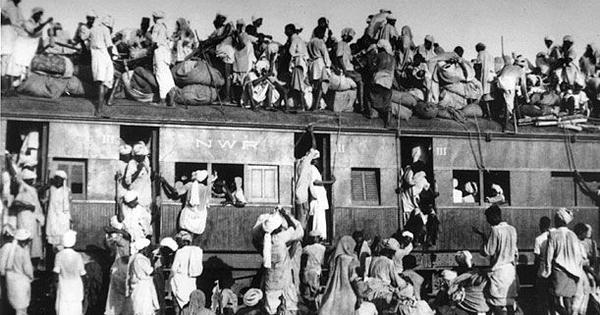
The only memory he had of leaving their old haveli was of the day he had said goodbye to it with his mother forever in 1964, never to return. Most agonising of all was the shock he received on moving in with his brothers at their rented-out rooms in Dhaka Patty, in central-northern Calcutta. They suspected him of pilfering the large heavy silver plate from his mother’s luggage and pawning it off somewhere for cash. Whereas what had really happened in the hurly burly of the Kushtia train station, with hundreds of others also desperate to flee, was a blur.He could not be sure if he had accidentally dropped that bundled plate along the railway line somewhere while hauling their baggage in and out of a train car, or whether one of the officials who had led them to the border had stashed it away when he wasn’t looking. He had even gone back to Sealdah railway station the very next day, hoping to trace the plate’s whereabouts. But it had just seemed to dissolve into thin air.Bhai had stopped talking and fell to brooding. Bhushan knew the course of his thoughts. He was stewing over the missing silverware – though Bhushan himself had long ago been exonerated of the theft. If he had been the one to take it, would he have eked out such a meagre existence, way back then? But it seems that once a doubt enters a man’s mind, like a virus, it’s bound to reactivate.To be honest, Bhushan would admit that after moving to Calcutta for good, he had peddled a few of Ma’s forgettable heirlooms to cover his daily expenses. He did not think there was anything especially surprising about this: everyone had to hustle to survive with depleting coffers. What’s more, despite already being of marriageable age by the time he moved in with his brothers, none of them thought to bring up the subject of finding him a wife. All three of his brothers had put down new roots in India nearly a decade earlier and were busily running shops and blissful households. But unlike his felicitous siblings, he was left high and dry, without a country, a home or even a soul to call his friend.In Kushtia, he always had plenty of friends, like Shyama Dhobi or Mohammad Islam from school. What a swell time he used to have, loping about with his gang during Lalon Shah Fakir’s festival beneath the brightly coloured pavilions erected for five days at the saint’s tomb. Lalon Fakir, a native-born son of Kushtia, had professed almost a century ago his renunciation of religious affiliation in his signature tongue-in-cheek lines of verse that still resonate today:“The neighbours gossip, ‘That Lalon Fakir, Muslim or Hindu?’Lalon says, ‘Fret not, I haven’t got a clue!’The people of Kushtia never treated Bhushan as a pariah just because he was Hindu. This same delusion – the hope that this culture of tolerance between Hindus and Muslims in East Pakistan would sustain – had stayed his hand from severing his ties with the city. But the unthinkable occurred. Seven years before Bangladesh was to attain its independence, the fear of riots in 1964 had left him with no choice but to flee with his mother and seek shelter with his brothers in Calcutta. His father, in order to sell their large house at the price he felt was his due, had refused to budge until he was adequately compensated. And so Bhushan was left all on his own, to adjust to a land where no one wanted him, and his family was squirming to throw him out.One morning, at his brothers’ rooms in Dhaka Patty, his younger sister-in-law – who plopped the same stale old leftovers onto his plate every day – had accused him of stealing her gold chain. His youngest brother had then thrashed him for it. That was the last straw! Bhushan had shoved his brother hard against the wardrobe and run away from home, lost to one and all. For almost two months, his mother had cried her eyes out for him – and would not stop sobbing until her child was returned to her safe and sound at home.Driven mad by news of her grief, his father posted a message for Bhushan in the Bengali newspaper through a friend in India: “Go back home immediately, wherever you are. Your mother is gravely ill.”From the train station where Bhushan came across his father’s message in the paper, he had dashed off a terse reply: “I am fine where I am. Ma is sick with worry because of you. Better that you went to her in Calcutta.”But his father remained ensconced in the illusion of the price he thought he could fetch from the sale of his house and shop – not that he could make a farthing off of his properties. When the Pakistani military began raining down bombs and shells in 1971, he too, joining a caravan of a hundred thousand other refugees, was forced to march for days nonstop to the Indian border, forsaking that grand East Bengali manor and taking with him nothing more than the tattered lungi he wore.Bhushan held to his feet as his brother dredged up a long-buried past, scrutinising his face for empathy. Suddenly hit by a fit of dizziness, he had to pull up a chair and sit. His arms folded, Bhai seemed to be turning over a question in his mind, as if mulling over whether to ask it or not. Bhushan glanced down at the floor. Even at their age, with their feet dangling over the grave, that lost silver plate refused to give them any peace.Bhai had arranged for another facsimile plate to be made, exactly like the lost one. Every Diwali, he asked him to polish it and pour sesame oil into each of the 21 lamps with which it was festooned. When Bhushan’s eyes first passed over the plate’s glittering surface, his mouth had dropped open in shock. So the plate had been with Bhai the entire time! Bhai’s childhood friend Deepak Bharatiya had been on the same train he and his mother took to Calcutta after the 1964 riots; Deepak was also present later that same evening when he had handed over all the belongings they carried with them to the family. When the big silverplate could not be located in the luggage, they had levelled the blame on Kulbhushan’s head – to carry for a lifetime. He had supposed Deepak must have passed the silver plate to Bhai on the sly when it mysteriously resurfaced.Bhai was maybe half suspecting that the plate would elicit just such a response from him. “It’s not the old plate,” he explained, studying Bhushan’s expression cryptically. I had it made new, according to the old design. I figured it would turn up eventually and visited the silversmiths Jalanand Bhattar every Diwali to pick through their stock. Last year, I spotted a small plate with the same pattern of vine trellises that our old one had from Kushtia. I made them furnish a replica. Look – it’s the spitting image, no?”Bhushan had wobbled his head. The two bore an uncanny resemblance. The plate in question no doubt shone like new. But he knew that after rubbing on enough toothpaste or Silvo oil, any dull silver could be made to shine. He held up the plate to inspect it, but then, wary of some cruel trick being played on him, dropped it with a clatter. Bhai may have guessed what was going through his mind. “It weighs two kilograms,” he added, “Our family plate from Kushtia couldn’t have weighed less than three!”Bhushan’s mind would not stop spiralling as he had fixed the earthen laps into circles on the plate. What if the weight of the old plate, which seemingly weighed three kilograms in my hands some 40 years ago, is only a figment of my imagination? This plate, for all I know, weighs no less than our old one! Bhabhi had noticed Bhushan’s drooped head and forlorn look and intervened to rally his spirits. “Bhushan Babu! I’ve also had a miniature of the same plate designed for you! It fits as many as seven lamps. I hope you’ll use it for your prayers this year at home. Did you think that your Bhabhi wouldn’t know that you don’t own a single gram of silver, let alone a silver plate for the Diwali Puja?”Bhushan glanced at his sister-in-law with tears in his eyes, his heart bursting with feeling. Why had God not crafted the rest of creation in the image of women’s hearts? All signs pointed to the likelihood that the plate was new. All doubt vanished from his mind. Without being aware of it, his hand crept towards the button of forgetting, so that he would never have to recall this episode againExcerpted with permission from Register Me As Kulbhushan, Alka Saraogi, translated from the Hindi as John Vater, Penguin Random House India.
Fiction: Bhushan, a refugee from East Bengal, wanders about Calcutta’s streets searching for himself
An excerpt from ‘Register Me As Kulbhushan’, by Alka Saraogi, translated from the Hindi as John Vater.
1,512 words~7 min read