This blog is a preview of our report, “The New Rails: How Digital Assets Are Reshaping the Foundations of Finance.” Download your copy!Summary
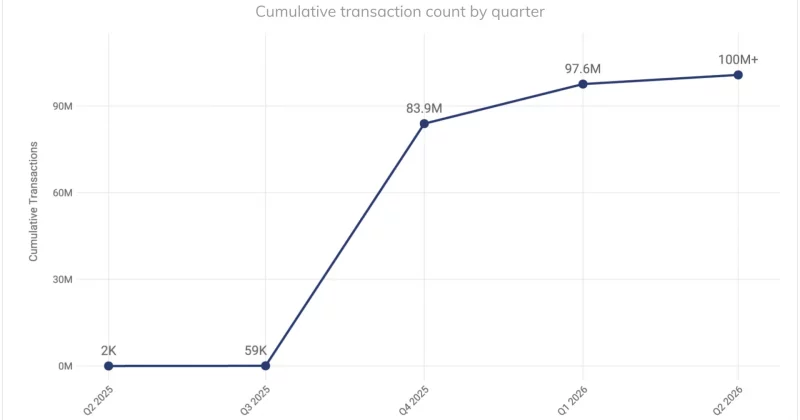
Agentic payments on Base crossed 100 million transactions in approximately three quarters, surging from near-zero in Q3 2025 before moderating in early 2026. Much of the growth was driven by meme coin farming activity.
Transactions of $1+ now represent 95% of total volume transferred, up from 49% in early 2025.
Agentic payment operators are typically younger wallets, hold 550% more asset types, and carry smaller balances than typical Base users.
Machine-to-machine payments have been discussed for years, but mostly as a future state. The logic is simple: AI agents operating across commerce, financial services, and data analytics will eventually need their own payment rails, transacting autonomously at volumes and price points that legacy systems were not built to handle.Currently, AI agents can analyze market data, assess credit risk, and monitor compliance at speeds no human team alone can match. But when those agents need to access a premium data feed, run a sanctions screening, or pull a credit bureau query, they stop and wait for human authorization. When an agent identifies a millisecond-long arbitrage window, for example, it waits for payment approval while the opportunity disappears. Traditional systems require account setup, API key management, and billing relationships that are incompatible with the speed of AI operations.The x402 protocol offers one of the first live attempts to close this gap. Developed by Coinbase and named after HTTP status code 402 (“Payment Required”), x402 allows machines to pay for resources directly within web requests. When an agent requests a resource, the server responds with a payment specification. The agent evaluates the cost, executes a stablecoin micro-payment on-chain, and resubmits the request with a receipt. We identify agentic transactions by their on-chain signature: wallets interacting directly with the x402 protocol.While x402 is compatible with other blockchains, such as Solana and Polygon, Base currently hosts the most active deployment. After three quarters of live activity, there is now enough on-chain history to evaluate early traction.The adoption curve: 100 million transactions and countingThe most immediate signal is volume. x402 agentic transactions on Base went from near-zero in mid 2025 to well over 100 million cumulative transactions through Q1 2026.Early quarters reflected low transaction counts and small transfer sizes. By Q4 2025, transaction volumes surged, driven in large part by meme coin activity, particularly PING. Launched as a “pay-to-mint” experiment, PING required users to query a URL, receive an HTTP 402 response, and pay 1 USDC to mint tokens. The mechanic turned x402 into a speculative game: transactions skyrocketed over 10,000% in a single week, with PING alone processing over 150,000 transactions in its first month. Base’s near-zero gas fees allowed users to repeat the payment loop hundreds of times, stress-testing the protocol at scale.By Q1 2026, as shown in the above chart, growth moderated as speculative activity cooled. The current plateau, combined with rising concentration of volume in larger transactions, suggests that usage patterns are shifting. Whether this reflects sustainable adoption or simply a different cohort of users remains to be seen. What PING did demonstrate is that x402 can handle high-concurrency transaction loads, a prerequisite for any infrastructure aiming to support autonomous agent commerce.From micro-payments to meaningful value transferWhile x402 transactions largely remain low-value, they’re growing in size fast.Take transactions of $1+, which represented 49% of volume in early 2025; by early 2026 they had 95% share. Meanwhile, transactions of between 10¢ and $1 collapsed from 46% to just 4% over the same time period.The protocol still processes a large number of sub-cent transactions, but the economic weight has shifted decisively toward larger transfers. This concentration suggests that users are funding wallets to cover higher-value transactions and that agentic payments are finding use cases beyond micro-payment experimentation.Testers are converting to spenders more than ever beforeShifting behavioral spending patterns show that x402 users are sticking around. This can be measured by examining tester-to-payer conversion: the percentage of wallets that made a single “send to self” transaction (testing the feature) and then converted to making real payments to other wallets within the same calendar month.While early cohorts converted slowly, testers are now finding value faster than ever. The tester-to-payer conversion rate improved 4x in six months, suggesting that the friction to adoption has dropped.Retention is drifting higherWeekly wallet retention, defined as the percentage of wallets active in a given week that returned the following week, has been volatile but is trending upward.Retention matters because it is the clearest signal that agentic payments are becoming infrastructure rather than a novelty. Transaction volumes and tester conversions show that the pool of users is growing wider, but retention shows whether adoption is growing deeper. High week-over-week return rates suggest that users are building agentic spend into recurring workflows rather than just kicking the tires.The volatility is partly due to the newness of x402. In the protocol’s earliest days, there were too few wallets to draw meaningful conclusions, and singular events skewed overall results. In October 2025, for example, a rush of traders chasing PING temporarily inflated the wallet count. These memecoin farmers stuck around for a week (pushing the retention bar to 87%), then fell dormant, cratering weekly retention to 5%.The recent drift higher is more telling. Wallets returning week-over-week, despite the absence of a speculative catalyst, suggests ongoing utility. Users do not fund wallets repeatedly unless they are getting value in return. For skeptics of agentic payments, this is the metric to watch.A distinct demographic profileCompared to the overall population of Base users, x402 payers are newer, more exploratory, and more actively funded.