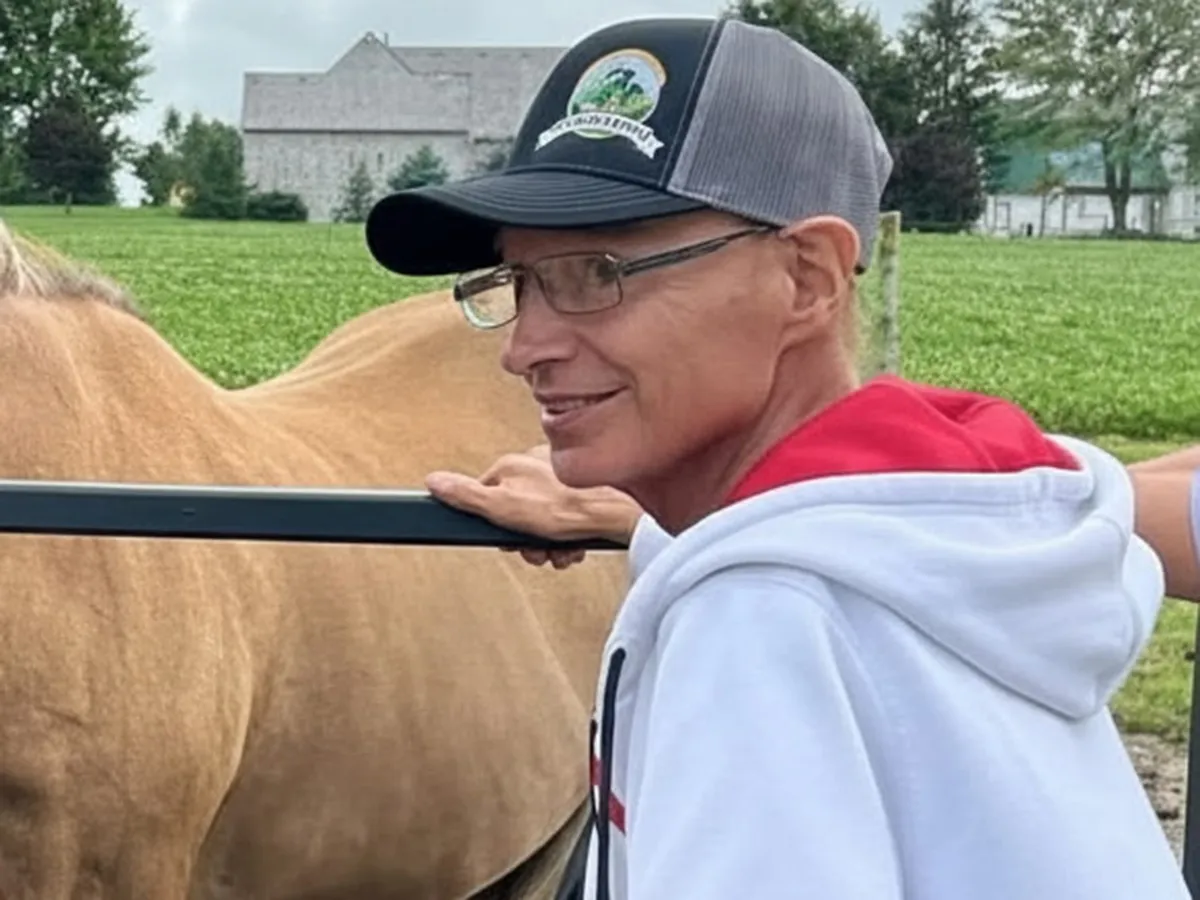
Skip to Content Subscribe Our Offers My Account Manage My Subscriptions FAQ Newsletters Canada Canadian True Crime Canadian Politics Health World Israel & Middle East Financial Post NP Comment Longreads Puzzmo Diversions Comics NP News Quiz New York Times Crossword Horoscopes Life Eating & Drinking Style Sponsored Play for Ontario Travel Travel Canada Travel USA Travel International Cruises Travel Essentials Culture Books Celebrity Movies Music Theatre Television Business Essentials Advice Lives Told Tails Told Shopping Buy Canadian Home Living Outdoor Living Tech Style & Beauty Kitchen & Dining Personal Care Entertainment & Hobbies Gift Guide Travel Guide Deals Savings National Post Store More Sports Hockey Baseball Basketball Football Soccer Golf Tennis Driving Vehicle Research Reviews News Gear Guide Obituaries Place an Obituary Place an In Memoriam Classifieds Place an Ad Celebrations Working Business Ads Archives Healthing Epaper Manage Print Subscription Profile Settings My Subscriptions Saved Articles My Offers Newsletters Customer Service FAQ Newsletters Canada World Financial Post NP Comment Longreads Puzzmo Diversions Life Shopping Epaper Manage Print Subscription HomeNewsCanada'Help me': These MAID complications challenge the 'good death' narrative'They witnessed their father suffering with physical and psychological distress and these final memories stay with them'Last updated 11 minutes ago You can save this article by registering for free here. Or sign-in if you have an account.Bradley Stewart, of Beachville, Ont., shown in 2024, had liver cancer. He spontaneously resumed breathing after he was initially declared dead by a London, Ont. MAID provider, who did not follow the full MAID medication protocol. Photo by Family photo/HandoutDoctor-assisted death is portrayed as a rapid, peaceful and comfortable death, yet potential complications are a recognized risk that some experts worry are not being fully discussed with people as a routine part of obtaining informed consent.Enjoy the latest local, national and international news.Exclusive articles by Conrad Black, Barbara Kay and others. Plus, special edition NP Platformed and First Reading newsletters and virtual events.Unlimited online access to National Post.National Post ePaper, an electronic replica of the print edition to view on any device, share and comment on.Daily puzzles including the New York Times Crossword.Support local journalism.Enjoy the latest local, national and international news.Exclusive articles by Conrad Black, Barbara Kay and others. Plus, special edition NP Platformed and First Reading newsletters and virtual events.Unlimited online access to National Post.National Post ePaper, an electronic replica of the print edition to view on any device, share and comment on.Daily puzzles including the New York Times Crossword.Support local journalism.Create an account or sign in to continue with your reading experience.Access articles from across Canada with one account.Share your thoughts and join the conversation in the comments.Enjoy additional articles per month.Get email updates from your favourite authors.Create an account or sign in to continue with your reading experience.Access articles from across Canada with one accountShare your thoughts and join the conversation in the commentsEnjoy additional articles per monthGet email updates from your favourite authorsSign In or Create an AccountorThe possibility of “failed MAID” was highlighted last week in media reports of the 2024 death of Bradley Stewart, an Ontario man who resumed breathing after being pronounced dead by a London, Ont., family doctor and MAID provider — a traumatic experience his siblings who witnessed his mishandled death are still recovering from.The doctor, James MacLean, didn’t administer the customary sequence of drugs, and left before Stewart resumed breathing.Get a dash of perspective along with the trending news of the day in a very readable format.By signing up you consent to receive the above newsletter from Postmedia Network Inc.A welcome email is on its way. If you don't see it, please check your junk folder.The next issue of NP Posted will soon be in your inbox.We encountered an issue signing you up. Please try againThe case has raised questions about what happens when medical assistance in dying doesn’t proceed as planned.No medical procedure has zero risk of complications or unexpected outcomes, said Dr. Ramona Coelho, a family physician and former member of the Office of the Chief Coroner of Ontario’s MAID death review committee. “Yet some MAID clinicians publicly portray MAID deaths as uniformly peaceful, beautiful and free of complications.”“This does not present an accurate picture of reality and risks influencing decisions about MAID” based on an idealized portrayal of assisted death, Coelho said.Another case reviewed by the Ontario coroner’s office and obtained by National Post describes the anonymized death of “Mr. D.,” an 87-year-old man with congestive heart failure who uttered “help me” while undergoing MAID in 2023.Two assessors agreed that Mr. D met all eligibility for MAID, that it was a voluntary request and that he was suffering a grievous and irremediable medical condition.The MAID provision took place at his home, the same day he was transferred home from hospital.Once settled, two intravenous sites were established.The doctor administered the first drug, midazolam, a Valium-like sedative. Next lidocaine was injected to numb the vein and prepare it for the next injection, propofol, a coma-inducing drug that can burn and sting upon injection.Midazolam is meant to put people in a deep state of relaxation. People often fall asleep.However, “During the first three minutes. Mr. D experienced signs of physical and psychological distress, including groaning, guarding (tensing muscles) and grimacing,” reads the case review.“Mr. D did not experience expected sedation” from the midazolam. Instead, he remained conscious.“His behavioral signs of distress escalated to repeated verbalizations, including ‘help me’ that continued until sedation was achieved with propofol and a comatose state was confirmed,” according to the case report.“These unfortunate end-of-life circumstances created profound distress for the family. They witnessed their father suffering with physical and psychological distress and these final memories stay with them.”The MAID provider reported Mr. D’s death to the coroner’s office. A coroner’s investigation concluded that the most likely explanation was an unexpected response to midazalom which, in rare cases, instead of sedating people causes a paradoxical reaction: stiffening of the limbs, elevated heart rate, twitching, jerking or muscle spasms.The family wanted their father’s death shared with MAID providers to ensure all possible adverse drug reactions are discussed with patients prior to MAID.A paper published by CAMAP (the Canadian Association of MAID Assessors and Providers), titled “Complications with MAID in the Community in Canada,” explicitly recommends a discussion of possible complications with patients.“That recommendation would make little sense if there were no meaningful complications to discuss,” Coelho said.None of the protocols for intravenous MAID fail, if administered properly, the CAMAP document states. The most significant complications are the inability to obtain intravenous access, or losing it once the procedure has started.In a survey of 335 Canadian emergency doctors, three reported having seen MAID patients come to emergency because of IV failure.A 2022 study of 3,557 MAID deaths in Ontario and Vancouver between 2016 and 2020 found complications in 41 cases (1.2 per cent). Most fell into one of two categories, the authors reported: obtaining or maintaining IV access, or prolonged time to death requiring a second kit of MAID medications.Overall, death occurred within three to 15 minutes in most cases. The shortest documented time to death after the first injection was one minute; the longest, 127 minutes. “But the authors did not analyze how often significantly prolonged deaths occurred or what factors predicted them — questions that matter deeply to patients and families,” Coelho said.It shocks me because, in a lot of jobs, that’s the kind of action that would have got someone fired and yet they are literally saying it’s remediationThe Ontario coroner’s office routinely speaks with families after a MAID death, the researchers noted. Any major complications unrecognized by doctors may be reported by families. “Therefore, it is reassuring that complications were uncommon or were insufficiently troubling to clinicians, patients and families to even be recognized as such.”However, a complication that might not be captured is the possibility of consciousness due to “sub-therapeutic doses of anesthetic agents,” meaning the possibility that some may be aware during the MAID procedure.In an email to National Post, CAMAP co-founder Dr. Stefanie Green said she wasn’t available for an interview before deadline, but said that “99% of cases have no complication and the vast majority of the 1% that do are related to IV access (or challenges with this).”However, in a November 2025 interview with Chatelaine, Green said, “The patient feels nothing other than comfort and sleep. There is no gasping, there is no choking, there is no coughing. It’s a peaceful, comfortable witnessed death.”One in 100 isn’t insignificant, given more than 16,000 people died of MAID in 20024 alone, Coelho said.Another small study involving five family members who had complex MAID bereavement experiences found that while some witnessed a peaceful death, other accounts challenged the narrative “that MAID unequivocally leaves a legacy of a dignified, good death.”Bradley “Stewie” Stewart — one of six kids, a community-minded man and active member of the little Baptist church and local Legion in Beachville, Ont., who’d rarely missed a day’s work in 47 years with the same company — was diagnosed in 2023 with liver cancer.He ultimately chose to die by MAID to avoid the death his father endured. “He thought there was a better way with MAID,” his sister, Cathy Stewart-Mott said.Stewart, 67 when he died in September 2024, squeezed every moment he could into the months, even days, leading up to his death.He collapsed on a Sunday after attending a car show at the local museum where he’d manned the barbecue every summer for 20 years before he became ill. “That’s when he said to his brothers, ‘I think this might be it,'” Stewart-Mott said.There was shock. There was numbness. People tried to remove themselves from itMacLean was called to the house three days later, after Stewart had become unresponsive. Stewart was surrounded by his siblings, family members and friends. His three chihuahuas were perched on his bed. MacLean injected midazalom and propofol. But missing from his briefcase was a third drug that paralyzes the muscles and stops breathing. After injecting the propofol, and unable to hear a heartbeat, he pronounced Stewart dead and left.Only Stewart resumed breathing. Some in the room noticed “what looked at first like almost imperceptible” breaths that grew stronger, Stewart-Mott said.She was in the kitchen when her daughter found her. “Uncle Brad isn’t gone,” she said. “He’s breathing again.”MacLean had used a back-up MAID kit; a new one he’d ordered wasn’t ready when he arrived at a pharmacy to collect it.Tracey Townsend, another sister, said that when MacLean returned to the house after being called back, “He said something to the effect of, ‘Wow, this has never happened to me before. He’s still breathing?’”MacLean administered more medication, including the neuromuscular-blocking drug, and again declared Stewart dead.The death had a profound effect on the family. At first, “we couldn’t talk about it,” said Townsend, who had to take a few months leave from work. “Going through MAID and losing somebody twice in a matter of a couple of hours. (It was) too much.”“There was shock. There was numbness,” said Stewart-Mott. “People tried to remove themselves from it. ‘Maybe this didn’t happen.’”They’re angry that despite finding serious concerns with Maclean’s MAID practice — including a second complaint involving his assessment of a MAID patient outside a Tim Hortons — MacLean wasn’t brought before a disciplinary hearing by his licensing college. Instead, he agreed to a minimum of six months’ clinical supervision, among other voluntary undertakings. He is permitted to continue practising MAID.“It literally was a slap on the wrist,” Townsend said.“It shocks me because, in a lot of jobs, that’s the kind of action that would have got someone fired and yet they are literally saying it’s remediation,” Stewart-Mott said.“They had the ability to suspend his doing MAID but never went down that road.”MacLean declined to comment when contacted by National Post last week, citing rules regarding privacy and confidentiality of complaint investigations.National PostOur website is the place for the latest breaking news, exclusive scoops, longreads and provocative commentary. Please bookmark nationalpost.com and sign up for our newsletters here. Get the latest from Sharon Kirkey straight to your inbox Join the Conversation This website uses cookies to personalize your content (including ads), and allows us to analyze our traffic. Read more about cookies here. By continuing to use our site, you agree to our Terms of Use and Privacy Policy.
'Help me': These MAID complications challenge the 'good death' narrative
Assisted dying is portrayed as peaceful, calm and quick. While rare, complications can be traumatizing for patients and family.
TL;DRAI
Bradley Stewart resumed breathing after MAID in 2024 due to incomplete protocol; another case showed inadequate sedation and distress. Experts warn MAID complications aren't disclosed in informed consent, challenging "good death" narratives and patient decisions.
2,047 words~9 min read