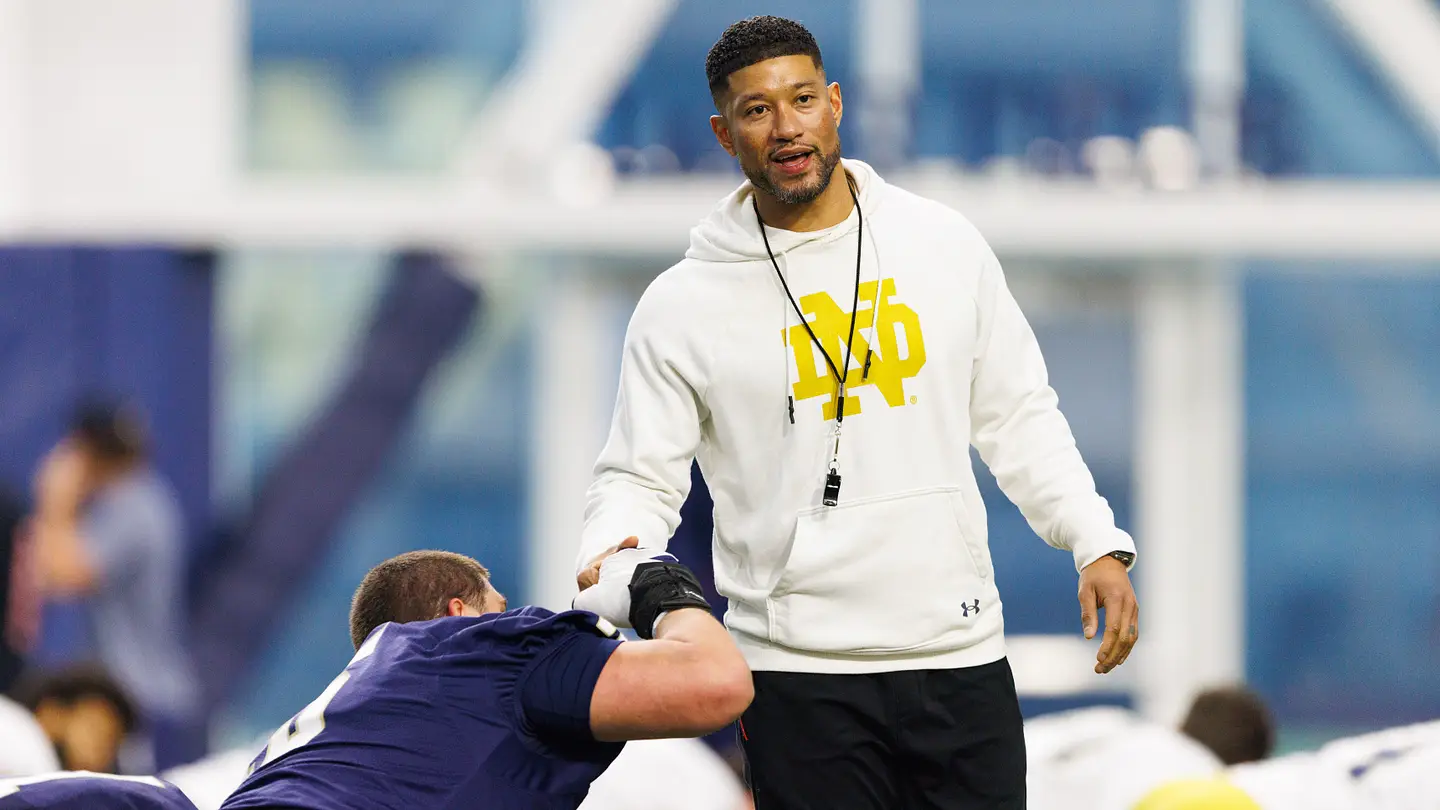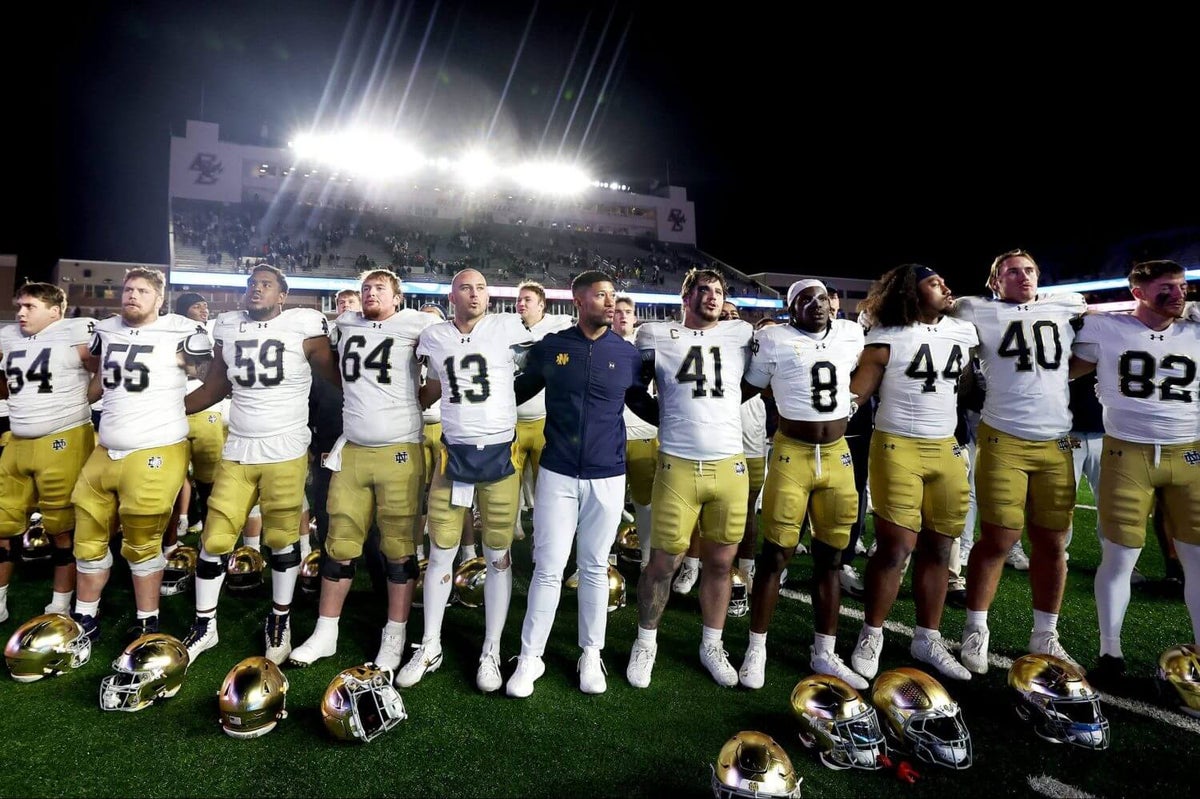
SOUTH BEND, Ind. — Last month, Clemson coach Dabo Swinney went on a mild rant, at least by his standards.While lamenting the money that’s taken over college football in the NIL era, Swinney hit the usual suspects of Alabama and Ohio State, which have won seven combined titles in the past 15 seasons.And then Swinney got to Notre Dame.“Notre Dame has their own TV station, they make their own rules,” Swinney said on Greg McElroy’s Always College Football show. “They print their own money. They got like a money machine in the backyard or something.”The idea of Notre Dame football as an apex predator in the new world of college football talent acquisition might feel odd considering priests often take a vow of poverty. But you can’t understand the roster Marcus Freeman assembled for 2026 without examining the financial investment it took to build it. Notre Dame didn’t lose a player of real consequence in the portal last cycle. It signed its highest-ranked high school recruiting class since the Lou Holtz era. And it added eight transfers, including a pair of coveted defensive tackles to go with a couple receivers from Ohio State.What if Swinney was right? Are the days of financial restraint gone from Notre Dame? The Irish had already invested heavily in their coaching staff and facilities. Offensive coordinator Mike Denbrock rates among the highest-paid assistants in the sport, as did former defensive coordinator Al Golden. The program will open a shiny new operations center, Shields Hall, before the season.But spending on players is hardest to quantify. As a private institution, Notre Dame doesn’t publicly disclose coaching contracts like public schools do. How much money is behind the Irish football roster is even more secretive. Unlike Ohio State or Texas Tech in recent years, no one at Notre Dame has gotten publicly specific on the spending devoted to football players.To better understand Notre Dame’s place in the financial arms race ahead of a season with championship dreams, The Athletic spoke to six general managers (and one agent) spread across the Power 4 and Group of 6 conferences. Some of the GMs have battled Notre Dame directly in recruiting. Others have only seen the Irish in passing during player acquisition season. And they all know the marketplace for talent, even if they can’t afford the kind Notre Dame has been adding. How does Notre Dame measure up? And if there was a money machine, where is it located on campus?“They’re a big-time spender,” said a Group of 6 general manager. “LSU, Texas Tech, Ohio State, Miami and Texas are up at the top, but Notre Dame is right there with them.”Notre Dame’s roster probably costs $40 millionEvery team gets to their number through a different combination of deals and relationships, but the total expenditure on players has become the marker of a program’s ambition for the year ahead. Revenue sharing – schools could directly distribute $20.5 million to athletes last academic year – is more a starting point than a salary cap. Of the six GMs surveyed, only one estimated the cost of Notre Dame’s roster being less than $40 million. One thought the Irish might be spending close to $48 million.“Freeman started this conversation, but I think (athletic director) Pete Bevacqua gets a ton of credit too,” said a Group of 6 GM. “Now it’s, ‘Hey, we’re Notre Dame, this is college football now. Money’s not gonna be an issue.’ Whatever was holding Notre Dame back before from winning a national championship, it’s not going to be money.”The GMs surveyed believed that when Notre Dame lost to Ohio State in the national title game two years ago, the Irish had been outspent by the Buckeyes by about a 2-to-1 ratio. The Buckeyes were on record that their roster that season cost at least $20 million, so those estimates would put the 2024 Irish closer to $10 million.Now? When asked which programs may be spending more than Notre Dame, the GMs mentioned LSU, Texas, Miami, Texas A&M and Oregon. But that’s it. Notre Dame was either just outside that top five or ahead of a couple of those schools, with LSU generally believed to be No. 1. If they’re right, Notre Dame may actually be outspending Ohio State now, wiping out an eight-figure gap in two years.“I think that has changed,” said a Power 4 GM. “I do feel like the Notre Dame program is spending at a comparable level to the biggest spenders in the game. We’re not in on a lot of same guys, not because we don’t see players the same way, it’s fishing from a different pond. If it gets down to a (recruiting target’s) top five with Notre Dame … we have not had a lot of success.”“If you really want to win a national championship today, you have to spend in the portal and spend to retain,” said an agent with multiple clients on the Notre Dame roster. “Third-party NIL, they’re willing to play the game. … They had to.”Want a five-star? That will cost at least $1 millionEvery general manager surveyed for this story agreed the compensation floor for a five-star high school prospect is above seven figures, except for non-premium positions like middle linebacker or offensive guard. And for a five-star quarterback, defensive end or offensive tackle, $1 million is probably just a starting point, with some getting closer to $2 million. Keep in mind, these are prospects yet to practice at the college level, let alone play in an actual game.Notre Dame signed three five-star prospects in the 247Sports Composite last cycle: defensive end Rodney Dunham, safety Joey O’Brien and cornerback Khary Adams. In the 2027 class, the Irish have two potential five stars committed in defensive tackle David Folorunsho and offensive tackle Olu Olubobola.“That offensive tackle, they weren’t one of his top schools until they decided they wanted him. You don’t do that unless it’s real big money,” said one Power 4 GM of Olubobola, who committed to Notre Dame over Miami, LSU and Texas A&M. “You combine that with the pitch Notre Dame has, and Freeman is an extremely good recruiter. He can connect with these guys.”Investing this much money in high school talent is a drastic change from Notre Dame’s position on NIL entering Freeman’s first season in charge. Back then, Freeman’s pitch was basically that if you come to Notre Dame and become a star, you’d get the NIL to match it. But the market has changed, with prospects now expecting up-front guarantees before seeing the field.That said, just because money is flowing to the high school level doesn’t make prospects any more likely to pan out.“I think nobody is thinking about these high school kids on massive deals, if you’re paying somebody $1.5 (million) and they’ve still got a long way to go (after his first year), do you drop him to zero? To $750K?” said a Power 4 GM. “When you set the bar so high, there’s going to be some emotion when you’re asked to take a pay cut.”How much has the market moved in two years?Notre Dame nearly tripling its NIL funding for football in two years might seem like a drastic jump. Maybe not.Compare it to the experience of a second Group of 6 general manager. Two years ago, that program lost its best player for a $100,000 offer from a Power 4 program that made last year’s College Football Playoff. This offseason, that same program lost a comparable player at the same premium position to a different team that made last year’s College Football Playoff. But this time, the payout was $1.3 million.“It’s astronomically different,” that GM said. “The money thrown around for size, the big bodies, it’s way out of whack compared to everything else. You could be an average FCS offensive lineman from Villanova and get seven figures with average tape if you’re 6-6, 310 pounds.”One GM compared the rise in salaries to the bubble that preceded the housing market crash. Another lamented the absence of efficiency in the market, where there was no point in saving money for later needs. A third figured this is just the cost of doing business and that programs need to adapt or die.Based on Notre Dame’s roster retention, high school recruiting and transfer portal acquisition (in that order), the Irish appear to be in the “adapt” camp. Notre Dame added eight players in the portal last winter, although it missed on two of its top targets: receiver Nick Marsh (Indiana) and defensive tackle Mateen Ibirogba (Texas Tech).“They don’t really have a ‘you have this much money to spend’ vibe as much as it’s ‘spend as much as you need, but be smart doing it,’” said one Power 4 GM. “With the Nick Marsh situation, they’re not gonna get outbid by a team unless they feel like it’s the right thing to do.”Being a developmental program is getting expensiveTransfer portal acquisitions take up much of each winter’s focus on college football spending. Multimillion-dollar deals for “all-in” national title contenders make for good headlines. So do volume plays, when programs add dozens of transfers in the hopes of an extreme roster makeover. But that’s not the most expensive part of roster-building. The trickier line item is amassing high school talent with little or no chance of playing next season.Several GMs called this the “acquisition fee” of being a developmental program. Notre Dame’s incoming freshman class, for example, was its highest-rated in roughly two decades. But because of the talent already retained by the staff, it has few clear opportunities to play. That means Notre Dame will have millions of NIL dollars on its bench, an enviable luxury only a few programs can afford.“You need to have enough money to do that,” said a Power 4 GM. “To get 20 kids who are top-250 players, that’s probably $10 million. If you can afford to say, ‘We’re not counting on any freshmen, what sunk cost can we afford and still go win a national title?’ That’s how the big boys have to think about it.“That is the price of acquisition for these guys. And if you don’t pay, you’re not going to get them.”This creates a delicate balance for GMs tasked with building out recruiting classes that add star power without blowing the budget. The result might be tiered recruiting classes where the overwhelming majority of the NIL funds go to the top dozen in the class while the bottom half comes relatively cheaply — MAC or Sun Belt commitments swiped in December with the potential for a big pay day later, if they’re willing to sit.Put another way, college football recruiting classes may start to resemble NBA rosters, meaning a few max contracts with a mix of veteran/rookie minimums mixed in.“Our staff talked about this last week,” said the second Group of 6 GM. “The big schools are under such pressure to sign a top recruiting class and that’s going to cost you $10-12 million. Getting five-stars across the board is not sustainable. You might get a five-star defensive lineman and another top guy, but your third and fourth guys will be less.”Doing the mathSo, if Notre Dame is really spending $40 million on its roster, how might those salaries spread across the lineup? It’s impossible to say exactly, although working backward from industry standards for player salaries, it’s not hard to get to that lucrative figure.Compare CJ Carr to some of last winter’s big quarterback transfers. When Brendan Sorsby and Darian Mensah moved, they were expected to command salaries of approximately $4 million. Drew Mestemaker transferred to Oklahoma State from North Texas on a reported $7.5 million deal over two years. Carr may have offered Notre Dame a discount to stay like Jeremiyah Love did last year after the star running back was pursued by Oregon and Texas. But it’s safe to say a quarterback with Heisman potential would be Notre Dame’s highest earner.Earlier this year, The Athletic polled front office personnel for their estimates of prices in the portal. If Notre Dame paid the high end of those figures at receiver, defensive tackle and cornerback, its five-man haul of Mylan Graham, Quincy Porter, Francis Brewu, Tionne Gray and DJ McKinney would be valued at roughly $6 million, not including returnees Keon Keeley, Jayden Sanders and Spencer Porath.That back-of-the-napkin math could put Notre Dame at $10 million simply based on its starting quarterback and transfer additions.“But Notre Dame is a more retention based program,” said a Power 4 GM. “Players that go there inherently don’t want to leave. The academics are important. So the degree matters. They’d probably be more aggressive in the portal if they didn’t recruit that well or they had more turnover.”Even assuming Notre Dame paid a lesser rate to retain players than it did to add them – Economics 101 – it’s not hard to see how this could quickly add up. Several GMs said a top-five recruiting class probably costs $10 million. Paired with the starting quarterback and transfer adds, that already puts Notre Dame halfway to that $40 million figure.As for the costs of holding together a defense that has NFL talent at all three levels: Elite defensive backs in the portal were valued at $1 million each. But Leonard Moore, All-America corner and EA video game cover athlete, is better than elite. Adon Shuler and Tae Johnson might be, too. Top defensive ends cost $1.5 million according to most GMs, and Boubacar Traore and Bryce Young are in that conversation. Linebackers were a relative value in the portal at $750,000 at the top of the market, but Notre Dame has five who could rate that highly.Apply those transfer estimates to Notre Dame’s returning defensive roster, and the total cost surpasses $30 million. That leaves the rest of the offense to total up, where the Irish have more quality players than outright stars. Still, Jordan Faison, Jaden Greathouse, Will Black and Guerby Lambert all play premium positions. The Irish are also incredibly deep, with 14 scholarship receivers and 20 offensive linemen.“This is an art, not a science. Year by year you have to feel it out,” said a Power 4 GM. “Schools like Notre Dame and Ohio State that recruit really well, there’s a sneaky high roster retention cost. You might not see a big portal splash, but they got more guys on third-year contacts.”In other words, everything comes at a cost. And it seems clear Notre Dame is willing to pay it.
Notre Dame’s $40 million question: How much does a 2026 national title contender cost?
GMs at other schools project Notre Dame to be in the mix for one of college football's top five priciest rosters. How does the math work?
2,416 words~11 min read