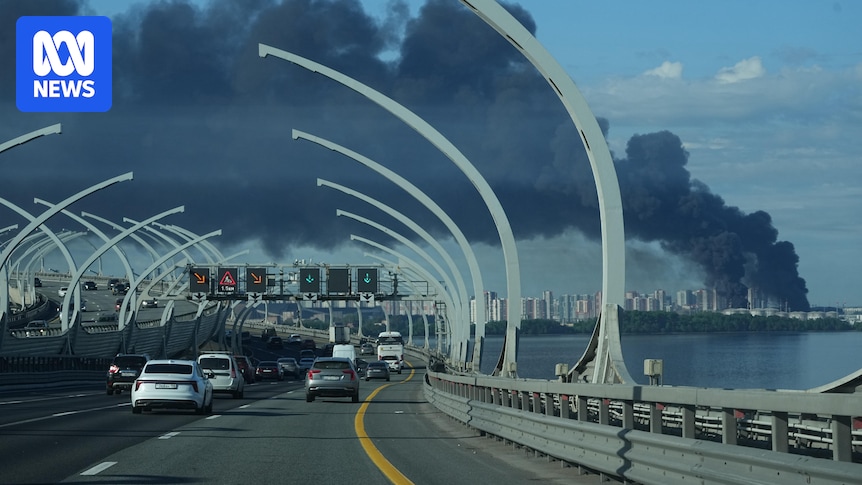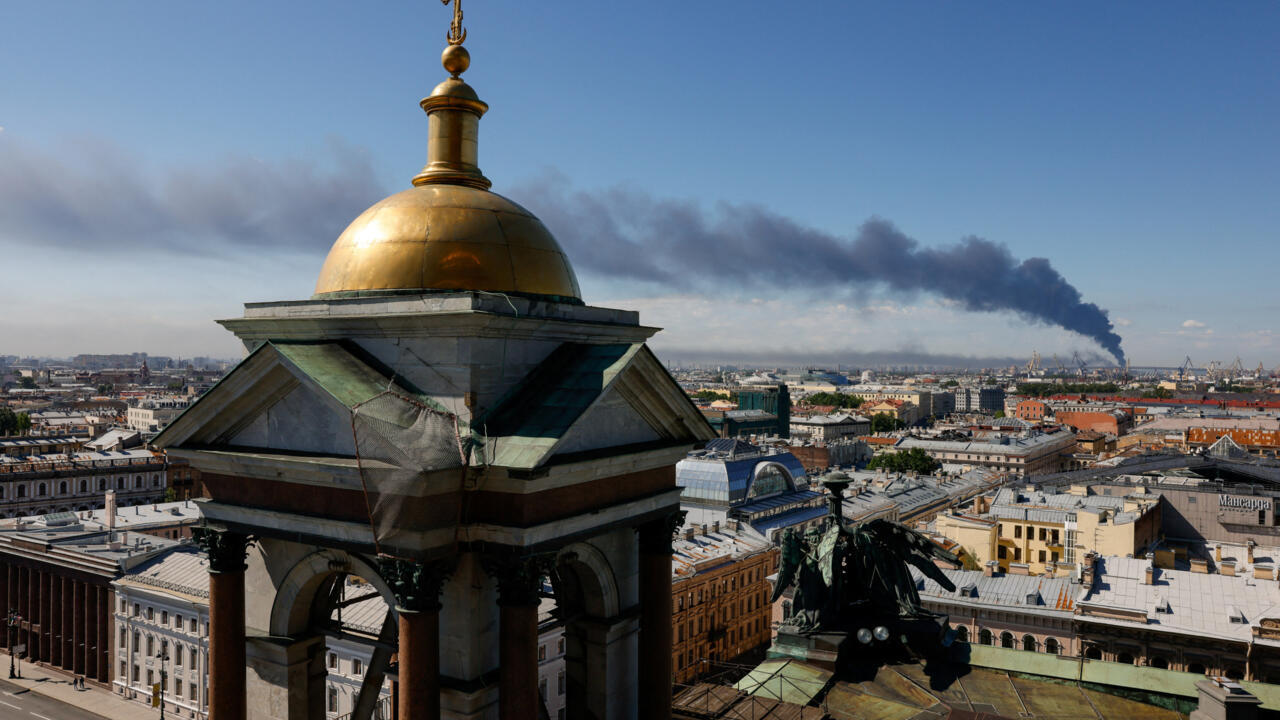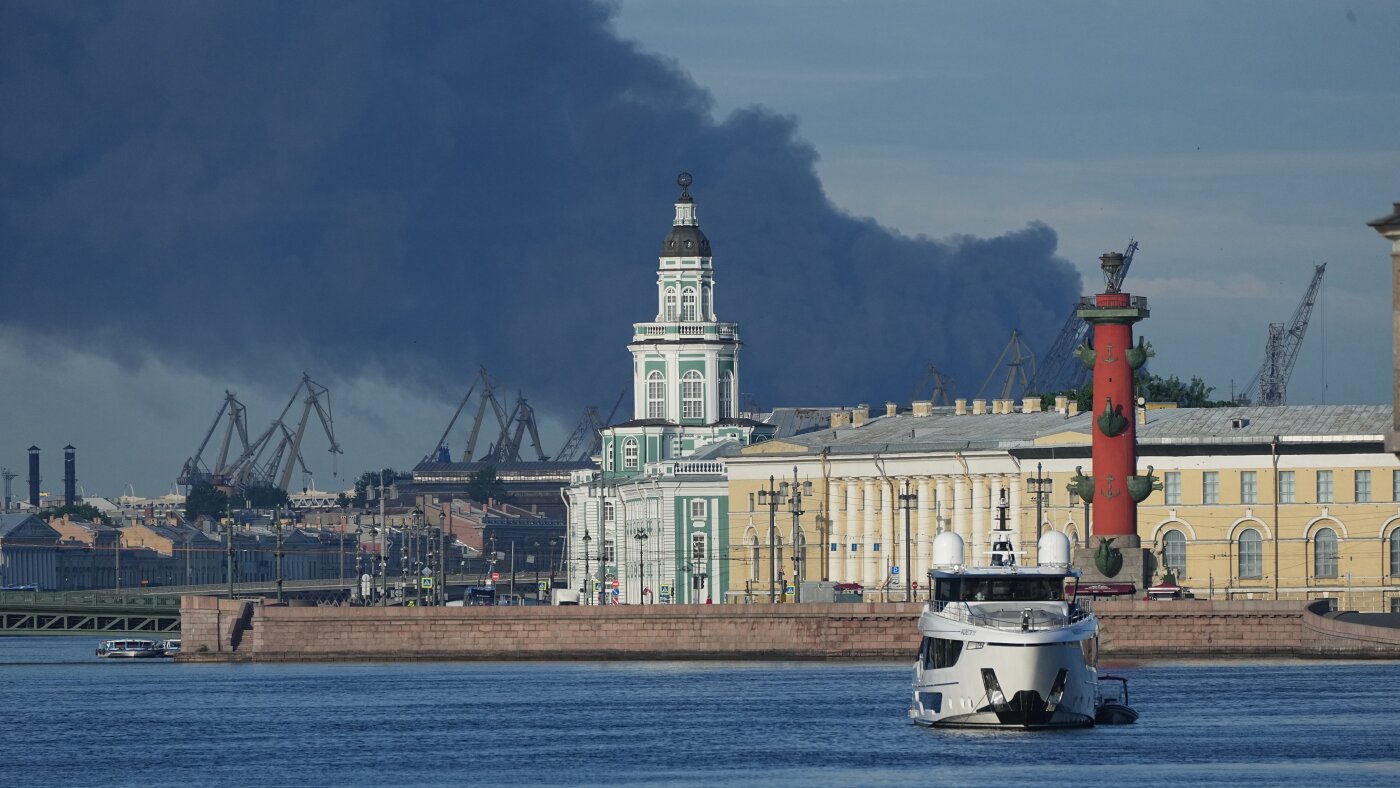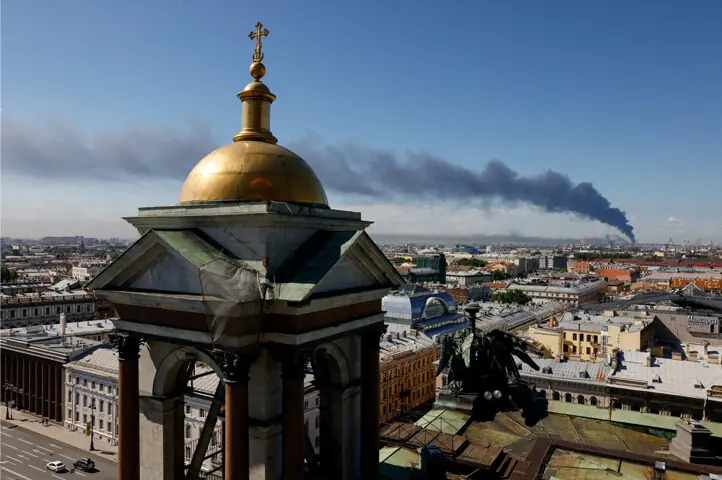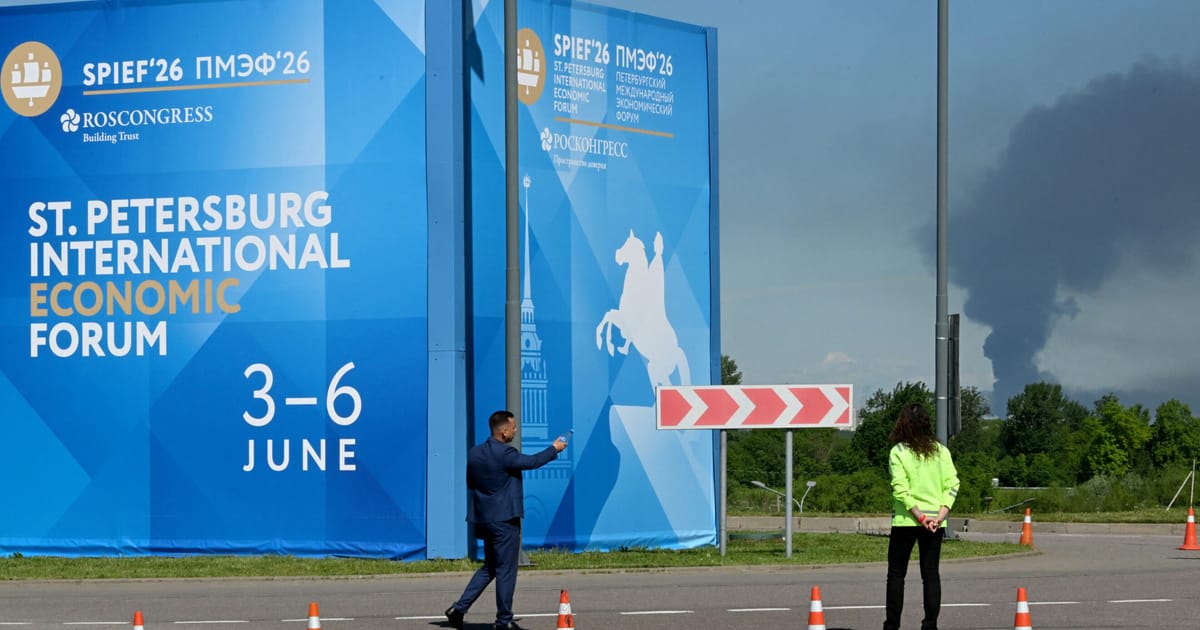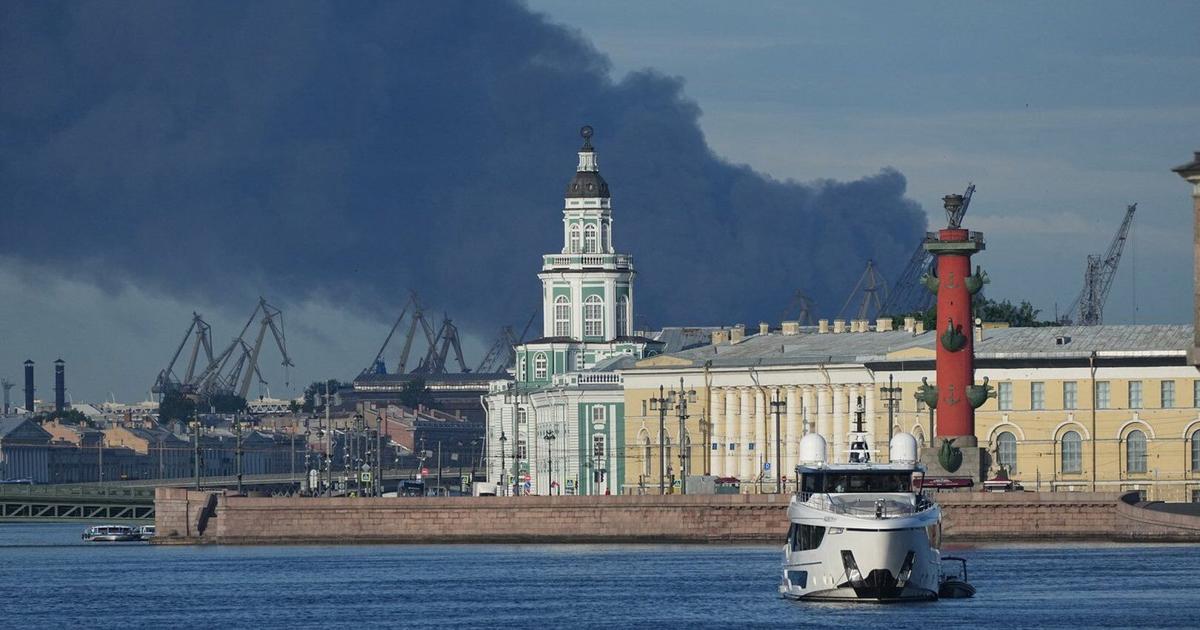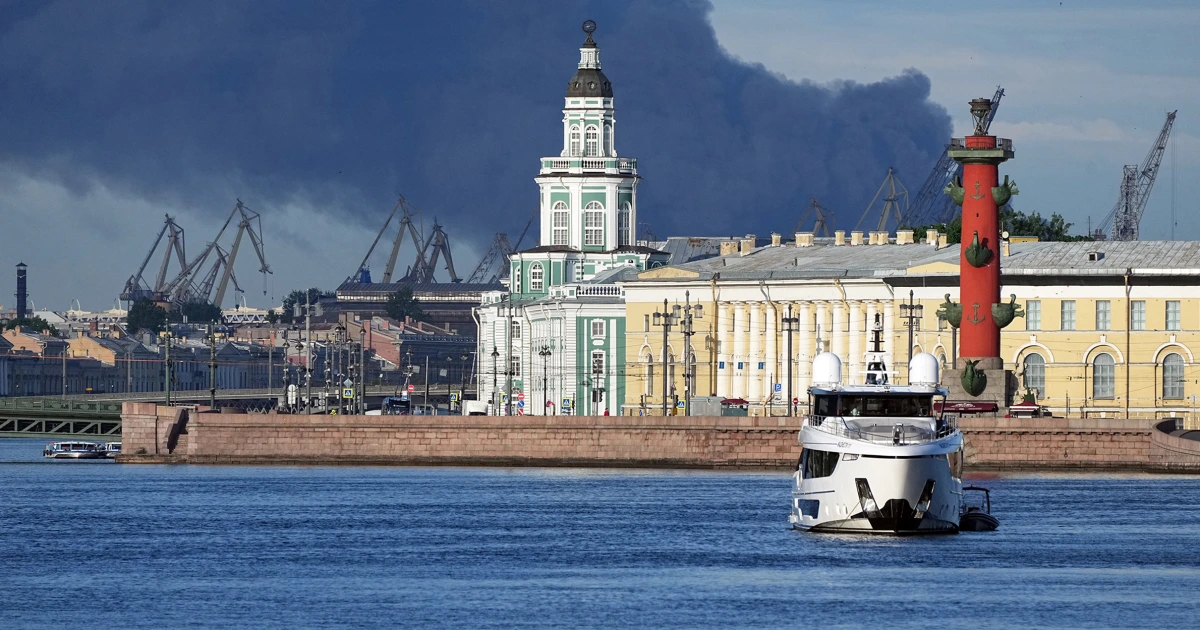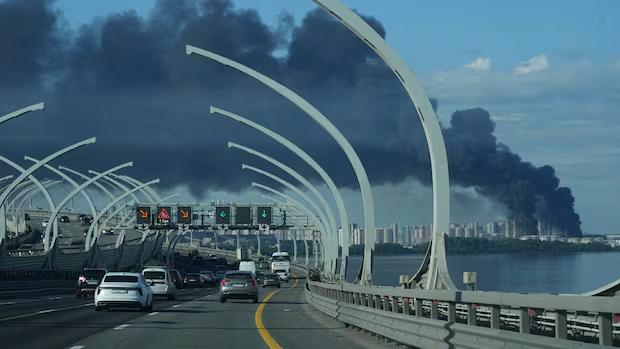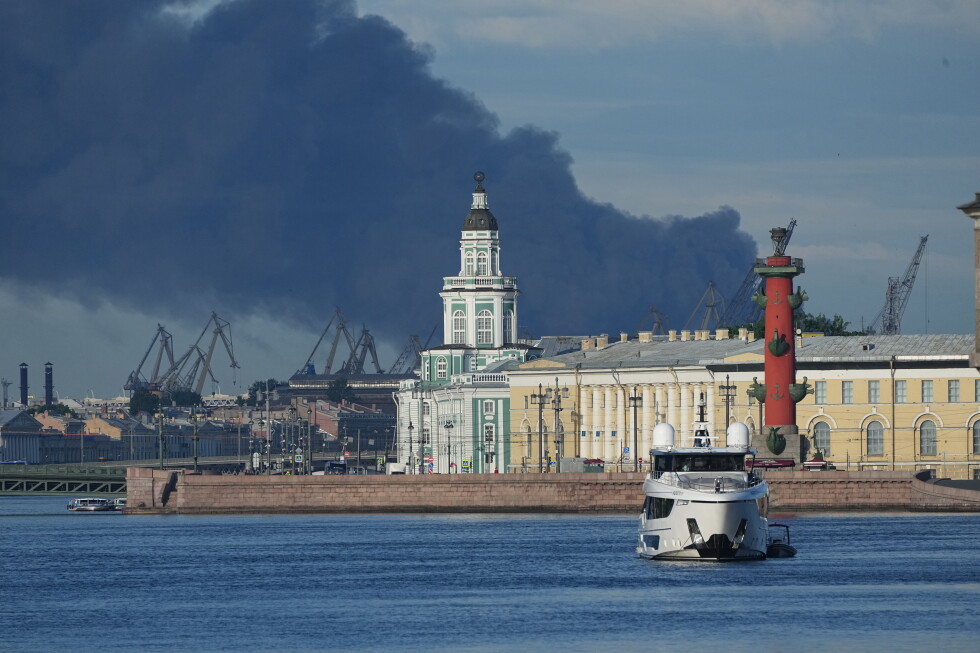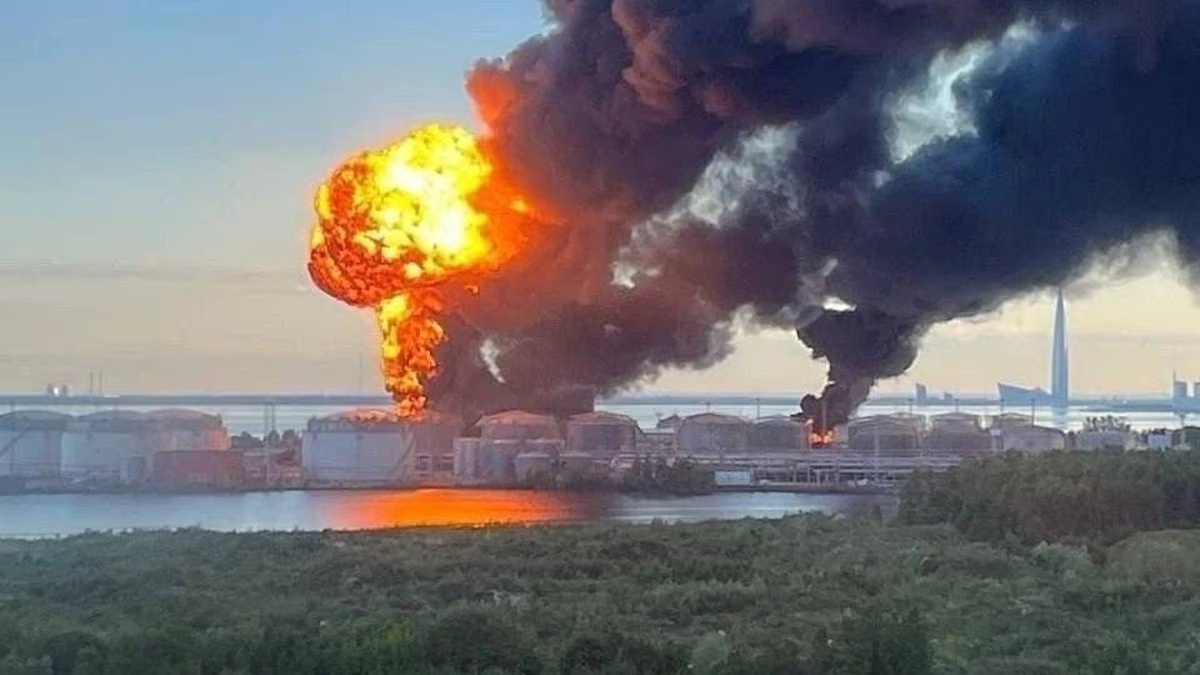
Ukraine staged a massive attack on a St Petersburg oil port today, ahead of a major economic forum hosted by Vladimir Putin in the city.The high-profile strike comes as Putin was warned his economy is on the brink due to the war, Russian citizens tried to flee Crimea and Ukraine continues to seize increasing amounts of territory on the battlefield. The oil terminal, located on the Gulf of Finland at the city's Great Port of St. Petersburg, is one of Russia's largest fuel storage and export facilities, with a throughput of 12.5 million tons per year. The attack occurred just hours before the opening of the landmark St. Petersburg International Economic Forum [SPIEF], involving high profile foreign guests from 76 countries, including the US but not most other NATO states. Known as 'Russia's Davos', the forum is Putin's main annual flagship event, showcasing investment projects, business agreements and projecting Russia's international relevance amid Western sanctions and the war in Ukraine.The massive attack made a mockery of the forum's theme: 'Pragmatic dialogue - the path to a stable future.' Russia's air defences singularly failed to protect the port, just 12 miles from the forum venue.Putin is being fed false information from the battlefield, a Washington-based think tank monitoring the war has said. Ukraine staged a massive attack on St Petersburg today ahead of a major economic forum hosted by Vladimir Putin in the city Volodymyr Zelensky brought the war to the dictator's birthplace setting ablaze a key oil port The high-profile strike comes as Putin was warned his economy is on the brink due to the war, Russian citizens tried to flee Crimea and Ukraine continues to seize increasing amounts of territory on the battlefield'ISW recently assessed that the Russian military command’s repeated exaggerations of the Russian military’s successes on the ground have likely given Putin a false perception of the battlefield situation,' the Institute for the Study of War said. It added: 'These exaggerations are likely leading Putin to believe his forces can achieve his goals in the near to medium term despite the fact that Russia’s battlefield performance has steadily declined in 2026.'There were reports that the nearby naval base of Kronstadt had also been targeted today, with up to four ships hit.The governor of St Petersburg Alexander Beglov admitted a strike on 'infrastructure facilities' at Kronstadt, principal naval base for the Russian Baltic Fleet.'Cleanup and recovery operations are currently underway. Several people have been injured,' he said.'There are no fatalities.'Russian sources accused — without offering proof — that NATO states on the Baltic had opened their airspace to Ukraine to stage today's attack.In the past states such as Estonia, Latvia, Lithuania and Finland have strongly denied doing so.'We've been bombed for over two hours with thunderous explosions,' said a woman resident living close to the terminal.Putin's governor of Leningrad region Aleksandr Drozdenko said 50 Ukrainian drones had been shot down, while failing to acknowledge the strikes on the oil port which were visible from across the city.There was a massive delay in flights at the city's Pulkovo airport, with 30 services impacted.Drones were seen flying in sight of the giant 1,516ft Lakhta Centre, the highest building in the city, before striking targets.The St Petersburg Oil Terminal is one of Russia's most important Baltic Sea fuel-export hubs, handling millions of tonnes of petroleum products each year through rail-fed storage tanks and sea-tanker berths in the city's main port.Putin is due to attend the forum on Thursday but his daughters were due to speak today — Maria Vorontsova, 41, an endocrinologist leading the dictator's drive for longevity, and Katerina Tikhonova, 39, a former rock'n'roll dancer with rising control over Russian science and technology.Controversial self-proclaimed misogynist Andrew Tate flew to Russia on Tuesday as a Putin guest at the key economic forum.Separately, Russia accused Ukraine of killing seven on an attack on a bus on the Moscow-Simferopol route in occupied Donetsk.Another 11 were wounded, said reports.A Russian weapons plant was in flames in Michurinsk, Tambov region.The Progress Plant produces high-tech aviation and missile control systems, along with equipment for gas and oil pipelines.Today's strikes followed Russia's attack a day earlier involving 656 drones and 73 missiles which killed at least 22 people and wounded 138 across Ukraine, with Dnipro suffering the highest death toll and Kyiv reporting around 90 casualties.Join the discussionWhat do you think is the biggest challenge facing Russia right now: the battlefield, the economy, or sanctions?What's your view? The strike on the oil terminal comes as Putin is suffering a fresh wave of war humiliation, amid warnings that his unaffordable conflict with Ukraine is pushing his economy to the brink of collapse Thick black noxious smoke rose over St Petersburg after repeated explosions rocked the port Russia's air defences singularly failed to protect the port, just 12 miles from the St. Petersburg International Economic Forum venueThe strike on the oil terminal comes as Putin is suffering a fresh wave of war humiliation, amid warnings that his unaffordable conflict with Ukraine is pushing his economy to the brink of collapse.Russia's Finance Ministry and its central bank has projected the government's budget deficit widening to a dangerous level if the Kremlin continues at the current rate of defence expenditure, according to Bloomberg.Authorities in Crimea are urging citizens not to panic amid ongoing petrol shortages, with pictures showing queues of cars waiting at gas stations. Russian troops have lost territory for the second straight month in a row with analysis of data from the Institute for the Study of War (ISW) showing that Ukraine retook control of more land than it lost to Putin's forces in May. Ukraine's army gained a net 282 square kilometres (109 square miles) over the month, the data showed, as Kyiv hails its improving fortunes on the sprawling battlefields across the south and east of the country.Domestically, cuts have been proposed to defence spending, with officials advising it will be difficult to fix Russia's stretched finances without finding a solution. However, disagreement among policymakers has emerged, with senior Defence Ministry figures and some Kremlin officials committed to fulfilling Putin's wartime objectives arguing that military spending should be shielded from cuts. They argue that reducing defence expenditure would inflict significant harm on the economy, given the large number of businesses that depend on military contracts.According to several people familiar with the discussions, Putin has instructed Finance Ministry officials to identify savings in other areas of the budget before considering reductions to defence spending. The sources said the scale of these concerns has not previously been disclosed publicly.And two people close to Putin's government have revealed that the Defence Ministry is demanding extra funding.Officials said defence spending may need to rise further this year to cover a budget gap that could reach three trillion rubles (£31billion).Putin has reportedly been briefed on mounting fiscal pressures since last year, meaning the current difficulties have not come as a surprise to him. They said any decision on the scale of spending reductions ultimately rests with the president, who has the final say on all major budget matters.When work began on the 2026 budget, officials were already aware that a funding shortfall of between 1.2trillion and 1.5trillion rubles could emerge during the second half of the year. Those funds were expected to be required if military spending needs increased.Sources close to the Russian government said planners had initially assumed the war in Ukraine might be drawing to a close following the meeting between Putin and US President Donald Trump in Alaska last August. Under that scenario, cutting defence expenditure later in 2026 appeared a reasonable expectation.The debate over spending priorities began before the outbreak of the US-Iran conflict and has continued since, remaining under active consideration by Putin and senior officials. The discussions reflect growing concern within the government as Russia's economy comes under increasing pressure during the fifth year of the full-scale war, forcing the Kremlin to weigh difficult financial and political choices.Those familiar with the matter said higher oil prices driven by the conflict in Iran are unlikely to provide a lasting solution.In their view, crude would need to remain above $100 a barrel for at least a year to deliver a meaningful boost to the economy. Even then, they argued, deeper structural problems affecting economic growth, inflation and the banking sector would remain unresolved.Under the Economy Ministry's three-year budget framework extending to 2028, defence spending was expected to stay largely unchanged. After rising by around 30 per cent in recent years to support a major increase in weapons production, industries dependent on state defence contracts were forecast to grow by only 4 to 5 per cent in 2026.And after cutting its growth forecast in December, Russia is swaying towards recession. Cars queue for fuel at a gas station after Russian authorities restricted fuel sales in Crimea on June 1. Ukraine has relentlessly targeted Russian oil installations in recent months People put their names on a list to join the queue for fuel at a gas station in CrimeaThe Economy Ministry expects gross domestic product to expand by 0.4 per cent this year, down from a previous estimate of 1.3 per cent.The deteriorating forecast came after Putin in April demanded answers from his officials as to why the economy was performing poorly.The admission that the economy was facing issues appeared to signal his anger that officials had not managed to avoid a slowdown. Russia's budget deficit has reached an unprecedented level despite a rise in oil revenues linked to the conflict in the Middle East. Official data shows the shortfall for the first four months of the year climbed to 5.9trillion rubles, equivalent to 2.5 per cent of GDP, around half again as large as the government's target for the entire year.The budget has recorded deficits in each of the past four years, including a 5.6trillion ruble gap in 2025. Although the current deficit remains below the 3.8 per cent of GDP recorded during the pandemic in 2020, Russia's economy is now operating under far greater pressure from sanctions, while liquid reserves in the National Wellbeing Fund have fallen by roughly 60 per cent compared with levels before the invasion of Ukraine.Officials based the current budget on relatively cautious assumptions, including a slight narrowing of the deficit and a gradual reduction in military spending. In an effort to maintain fiscal discipline and comply with the country's budget rule, the government introduced tax increases this year as part of a broader attempt to cool an economy strained by wartime spending.Expectations that a negotiated settlement to the war might ease financial pressures have failed to materialise. As a result, policymakers are now faced with the challenge of closing the budget gap, either by reducing spending or identifying additional sources of income.Government officials are also sceptical that higher oil prices will persist. At the same time, the strength of the ruble has added to fiscal difficulties by reducing the value of export earnings.Speaking last week, Finance Minister Anton Siluanov said in an interview with Kommersant that restraint was needed in public expenditure.He said: 'Reserves are not endless. Weakness in finances cannot be tolerated in the context of such large-scale transformations in the world,' adding: 'We need to improve the efficiency of budget expenditures.'It comes as Sergei Aksyonov, the Russian-installed head of the government of Crimea, said on Tuesday that people should be patient and calm amid gasoline shortages on the peninsula, which Russia annexed from Ukraine in 2014.Crimea has been suffering from fuel shortages after Ukrainian drone attacks constricted supplies from adjoining Russian-controlled territory.More than four years since the 2022 invasion of Ukraine, Russia is facing almost daily Ukrainian attacks on its oil infrastructure while Western sanctions have made crude exports more costly. Aksyonov said limits had been imposed on sales of the most commonly used gasoline, Ai-95, and that people would have to use fuel coupons for purchases.In Sevastopol, the largest city in Crimea and the traditional base of Russia's Black Sea Fleet, long queues were witnessed at filling stations.'I haven't been able to fill up for two days now,' resident Oksana Senchenko said.'Yesterday there was no gasoline, and today I'm driving around town and there's no gasoline, neither 92 nor 95,' she said.Sevastopol is working to replenish stocks to resume gasoline sales as usual from today, with sales conducted via fuel coupons yesterday, Mikhail Razvozhayev, the Russian-backed governor said.'This is a temporary measure,' he said on the Telegram messaging app. 'I want to underline: there is no need to line up early in the morning or spend the day waiting in queues.'This is a breaking news story. More to follow
Ukraine blitzes St Petersburg port ahead of 'Russia's Davos'
Volodymyr Zelensky brought the war to the dictator's birthplace setting ablaze a key oil port.
2,099 words~10 min read