This content was published on
June 3, 2026 - 07:49
4 minutes
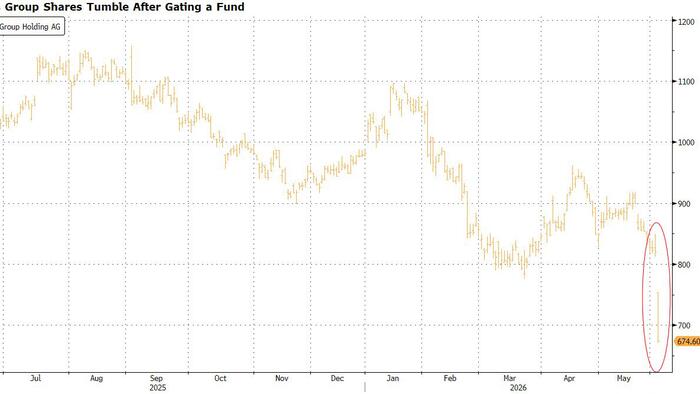
(Bloomberg) — Partners Group Holding AG is capping withdrawals at one of its evergreen private equity funds amid heightened redemption pressure, as the investor anxiety that hit private credit vehicles shows signs of spilling over to other asset classes within private markets.The Swiss firm, one of Europe’s largest listed alternative asset managers, said its $8.6 billion Global Value SICAV fund was limiting redemptions to 5% of net asset value per quarter after withdrawal requests surged to an estimated 9.8% in the second quarter, according to a letter to investors seen by Bloomberg News.There’s been a pick-up in redemption requests from private wealth clients across the firm’s evergreen portfolio, a spokesperson for Partners Group said. Such clients — who are typically far more skittish than institutional investors — make up about a fifth of assets under management across its platform and a particularly large proportion of Global Value’s investor base.The Swiss firm is one of the pioneers of evergreen funds, which operate indefinitely and typically allow investors to withdraw at least a portion of their investments quarter-by-quarter rather than locking up the capital for a set period.The redemptions are the latest challenge confronting Partners Group, which a few weeks ago denied allegations of systematic asset over-valuation made in a report by short-seller Grizzly Research.Macroeconomic shifts and geopolitical conflicts have strained private markets in the last few years, with industry-wide volatility starting in private credit vehicles spilling over into private equity, Partners Group said in the letter. “These flow dynamics have recently accelerated” and impacted the fund, it added.Private credit funds have largely been in focus in recent months, suffering large outflows amid broader worries over debt quality and also rising concerns that many are overly exposed to software companies facing the risk of being upended by artificial intelligence. With investors scrambling to yank billions of dollars from such funds, some of the biggest money managers that have capped redemptions recently include Apollo Global Management Inc., KKR & Co., BlackRock Inc. and Blue Owl Capital Inc.Partners Group “believes that redemption limitations are an indispensable feature of private markets investing to protect long-term investors in an inherently illiquid asset class,” it said in the letter. “Acting in the best interests of all investors in an evergreen fund means balancing the needs of those seeking liquidity while preserving investment capital for long-term investors who want to capitalize on market opportunities.”Credit FacilityThe gating by Partners Group comes despite the fund’s liquidity standing at around 15% of net asset value. “In addition, the fund has access to an undrawn credit facility equal to 15% of the fund’s size,” the letter said.The 19-year-old fund — which last enacted some liquidity restrictions during the pandemic — remains open to subscriptions and distributions for the full year are expected at 15%, one percentage point less than in 2025, the firm said.In April, Grizzly Research targeted Partners Group saying it was shorting the stock, citing alleged valuation inconsistencies in evergreen funds, where it estimated as much as 40% of investments may be significantly mis-marked. Grizzly said it had identified discrepancies between reported valuations and underlying performance.Partners Group, based near Zug, Switzerland, has said valuations are validated by third parties and broadly termed Grizzly’s claims as “frivolous, defamatory and highly misleading.”Shares of the asset manager, which oversees about $185 billion across private equity, credit, real estate, infrastructure and royalties, have declined about 16% this year. It has more than 30 evergreen funds across five asset classes that combined have more than $56 billion in AUM, the spokesperson said.In April, the company said it saw “positive fundraising momentum” for its private markets strategies in the first quarter, as it sought to distance itself from mounting concerns over the health of the private credit market.–With assistance from Meg Short.(Adds evergreen funds detail in fourth paragraph.)©2026 Bloomberg L.P.