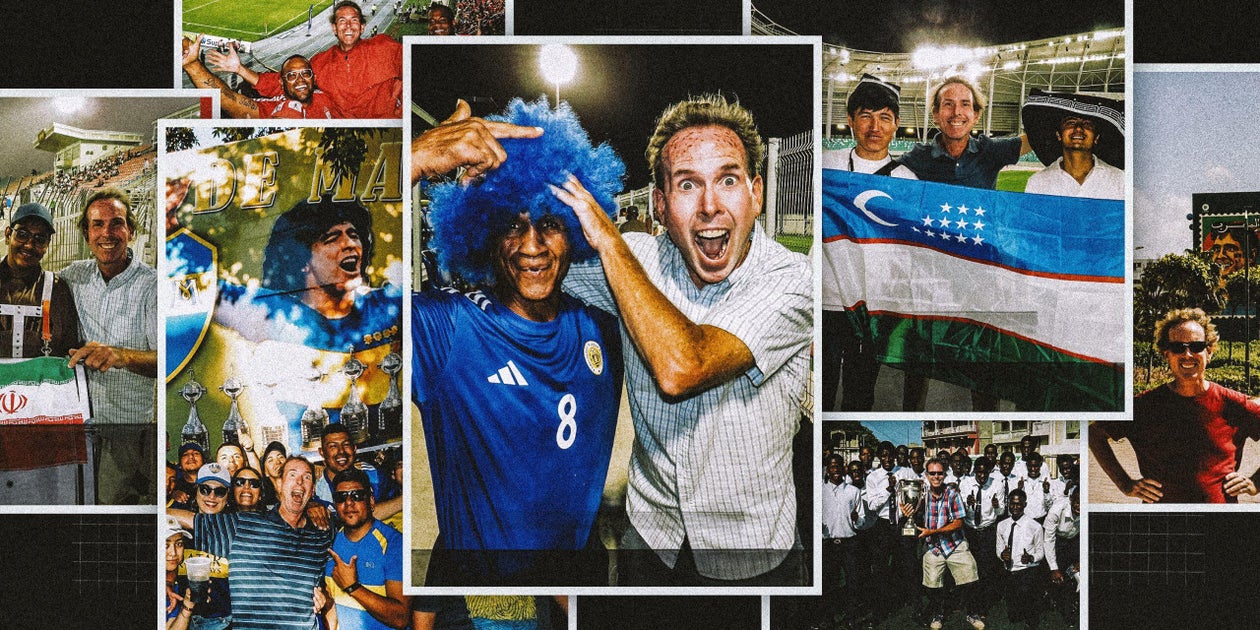
Get free access to the most comprehensive World Cup coverage in The Athletic app.In December of 2022, Joe Connor wished he was halfway around the world. Instead, he was stuck at home in San Diego watching a sport he’d never really liked.For years, Connor had traveled across the United States and the globe, to hundreds of stadiums and arenas, for hundreds of sporting events spanning all 50 U.S. states and six continents. His curiosity had driven him to baseball games everywhere from Cuba to Kenya to Korea. But the world’s game?“I wasn’t a soccer fan,” Connor admits, much less a man intent on seeing the sport in 144 different countries.So, he says, in 2022, when he planned to circumnavigate the globe, he scoped out rugby in New Zealand and hockey elsewhere. A blood clot in his leg, however, forced him to cancel the adventure. While resting at home, he clicked on his TV, sampled the 2022 World Cup, “and that,” he says, “is when the lightbulb went off in my head.”Soccer, he realized, could be a vehicle for education, his gateway to a deeper understanding of the world.And over the next three-plus years, he chased it just about everywhere.From January 2023 through April 2026, Connor says, he visited more than 200 countries or territories and saw soccer in a majority of them. He saw it at hallowed stadiums and on dirt surrounded by goats. He saw it played by superstars and schoolchildren, in spotlights or barefoot in streets, for money and for pride.He reveled in the pulsating passion of, say, the Clásico Vallecaucano in Cali, Colombia. He also sat in empty concrete bleachers far off football’s mainstream grid. He allowed the sport to lead him on an 11-part global expedition, one that touched all 48 nations who’ll participate in the 2026 World Cup. (He actually set foot in 47; war and politics prevented him from entering the 48th.)And along the way, he learned one overarching lesson about Earth’s 8 billion people, a lesson he hopes to spread to Americans living in bubbles, a lesson that contradicts all of the planet’s conflicts and hate.“We’re all human,” Connor says.That was his takeaway from the “dream world tour” that began as a South American pilgrimage and became something more.“When you get to know people at a personal level, we’re all the same,” Connor says. “And there’s no better place to do that than a sporting event.”‘Football … it was everywhere’By now, Connor knows, you probably have some questions, such as: Why? And how?His story dates back to a childhood in Connecticut blessed with sports and local adventures. He played ice hockey through high school. Like many 20th-century American kids, he also grew obsessed with baseball. In his mid-20s, soon after losing an entry-level job, he planned his first road trip — to 15 Major League Baseball parks in 21 days. He’d call his dad from landline phones with updates on his whereabouts and excitement.Then, the following year, his dad died at age 57. “His death was a turning point for me,” Connor says. Life, he suddenly thought, is short, precious, finite. And he decided: “I’m not gonna wait on retirement to do things.” He got to his 30th MLB park by the end of the year. Then he looked further afield.His work as a freelance sportswriter soon took him abroad for baseball. He also began expanding his U.S. repertoire and branding himself “Mr. Sports Travel.” Over the past three decades, he says, he has been to every NFL, NBA, MLB and NHL stadium, plus every Division I college venue for those same four sports. He continued writing but also worked as a career coach and invested in real estate. That, he says, has allowed him to self-fund his voyages.Soccer, for decades, had hardly been on his radar. When he briefly played it growing up, “it was brutal,” Connor says. “I hated it.” But something about the 2022 World Cup — the drama, the fervor, the nationalism — opened his eyes to what he’d been missing. He “became hooked.”So off he went to Brazil in January 2023, first to São Paulo, then to Rio de Janeiro. He stood with Vasco de Gama supporters, chanting “dá-lhe Vasco olê olê,” and when their team scored, beer flew. Fathers lifted daughters into the air. The shirtless man next to him, like tens of thousands throughout São Januário stadium, unleashed a guttural roar.Next, Connor went to Boca Juniors and River Plate in Argentina. He stood in an upper corner of La Bombonera, as the sun set over Buenos Aires, and heard unceasing noise unlike any other he’d sampled. In Uruguay, he stood with hinchas and drummers; they erupted when Defensor Sporting equalized in the ninth minute of stoppage time against Peñarol. In Paraguay, he saw Olimpia and Cerro Porteño, but even at a teen futsal match in Asunción, he found songs, drums and intensity.Eventually, after a week in Antarctica, he saw flares and flying pyrotechnics in Chile; he saw blue and white smoke, plus fireworks and pandemonium, at Alianza Lima in Peru. In Bolivia, he saw The Strongest upset River Plate in a Copa Libertadores opener; he also saw kids playing 5-v-5 on a concrete court with fading lines, graffiti-lined walls and net-less goals.
His soccer voyage reached all 48 World Cup countries. He has one message for the world
Joe Connor's remarkable "dream world tour" took him on a soccer odyssey that reached the entirety of the 2026 World Cup field
TL;DRAI
Joe Connor ha visitato 47 dei 48 paesi della Coppa del Mondo 2026 (2023-2026), usando il calcio per connettere culture e persone. Lo sport emerge come linguaggio universale che supera conflitti e differenze, rivelando l'umanità condivisa oltre barriere culturali.
2,560 words~12 min read