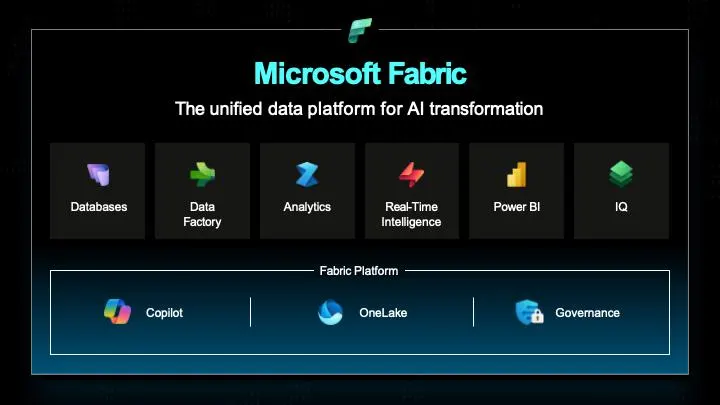
GPU-accelerated Fabric Data Warehouse is Microsoft's latest step toward building the infrastructure needed for AI, real-time data and event-driven enterprise operations.MicrosoftMicrosoft used Build 2026 to introduce its GPU-accelerated Fabric Data Warehouse, the first fully managed data warehouse to offer GPU acceleration. The performance improvements are meaningful, but the more interesting story is what they reveal about where enterprise technology is heading.AI investment is no longer the question. The challenge is whether the underlying data, operational systems, governance models and technology foundation are ready to support AI at scale. Addressing that complexity is emerging as a key theme at Microsoft Build 2026.The next phase of AI will depend less on models and more on data readiness, governance, interoperability and operational execution. Built on NVIDIA accelerated computing and entering early access preview soon, Fabric Data Warehouse reflects a broader shift in how vendors are positioning data platforms. Microsoft is now positioning the data warehouse as an execution layer for applications, AI agents and data-driven workflows.KramerERP offers paid services to technology companies, similar to those provided by other tech-industry research and analyst firms. These services include research, analysis, advising, consulting, benchmarking, acquisition matchmaking, video and speaking sponsorships. KramerERP, an ERP and data industry expert, has collaborated with or is currently working with the companies listed in this article.Architecture Is Moving Past CPU-OnlyDeployment is designed to be simple. Teams enables this capability in workspace settings with one click, applying to all SQL Analytics Endpoints and Data Warehouses in that workspace without requiring query rewrites. Eligible queries are automatically routed to GPU execution when users hit run, and ineligible queries seamlessly fall back to the CPU engine while preserving correctness. That fallback design makes GPU acceleration additive rather than a major platform migration, which matters for organizations that have spent years stabilizing their data environments.MORE FOR YOUMicrosoft's TPC-H 300GB testing suggests GPU-accelerated Fabric Data Warehouse maintained stronger relative performance as concurrency increased, reflecting a broader architectural approach designed for AI, analytics and increasingly distributed operational workloads.MicrosoftMicrosoft backed the announcement with customer evidence and TPC-H 300GB benchmark results. In internal testing conducted in May 2026, GPU-accelerated Fabric Data Warehouse delivered up to 3x faster performance at single concurrency, 6x at 16-user concurrency and 7x at 64-user concurrency against three comparable cloud data warehouse providers. The progression matters because most data warehouses slow down as concurrency rises. An early access customer in healthcare reported up to 5x faster query speeds in production. A professional services customer reported 3.4x faster execution at single concurrency for complex workloads and greater consistency under shared platform load. A manufacturing customer reported improvements in analytics-heavy reporting workloads. “Microsoft has spent decades advancing analytics performance through core engine innovation and hardware acceleration; a philosophy rooted in SQL Server. GPU-accelerated Fabric Data Warehouse is the next step: same queries, same scale, but answers fast enough to keep up with how people think,” said Bogdan Crivat, corporate vice president for Azure Data Analytics at Microsoft. Additional details are available in a recent Fabric Blog.The performance gains are significant but the more interesting story is the design behind them. Microsoft said the underlying architecture is based on research described in CoddSpeed: Hardware Accelerated Query Processing in Microsoft Fabric, which received the ACM SIGMOD 2026 Industry Track Best Paper Award. The architecture is built around hardware abstraction layers designed to operate across GPUs, FPGAs, custom ASICs and multiple interconnect technologies, reflecting a shift toward infrastructure built for increasingly distributed workloads.Why Architecture MattersFor years, enterprise software was built around CPU-based transactional systems designed for predictable workloads and human users. AI changes that model. Agentic systems generate significantly more requests, require faster access to operational data and place greater demands on concurrency across the enterprise.That is why the underlying design matters more than the benchmark numbers. The challenge is no longer a faster query. It is supporting thousands of simultaneous interactions across applications, analytics platforms, workflows and AI agents.As organizations move toward agentic AI, the workload shifts from human-driven transactions to machine-driven activity. Data platforms, ERP systems and operational applications will need to support much higher levels of concurrency without creating bottlenecks.Speed Changes BehaviorWhen access to data becomes faster and more responsive, people naturally ask more questions, explore more scenarios and make decisions more quickly. The same dynamic applies to AI agents. Faster data access allows agents to interact with operational systems more frequently, evaluate more conditions and take action closer to real time.As Crivat noted, the real change is not the speed itself but what people and systems do with it. The value is enabling people and AI agents to move from insight to action with less friction. The next generation of enterprise systems will be defined less by reporting performance and more by how effectively they support autonomous workflows, AI-driven decision making and increasingly event-driven business operations.The Shift From Platforms To EcosystemsOne aspect that deserves more attention is efficiency. Microsoft said the platform can use older-generation GPUs already deployed in its data centers while maintaining much of the performance benefit. If those results hold true, it means the conversation moves from just about speed to economic considerations as well. Infrastructure decisions are increasingly being evaluated based on cost, efficiency, utilization and long-term return on investment. Those discussions resonate with CFOs just as much as CIOs.Microsoft is competing with AWS, Google Cloud, Oracle, Snowflake and Databricks for platform relevance. Every vendor wants to be the layer where data, AI, applications and business processes come together. The benchmark results are impressive, but enterprise customers will ultimately judge these platforms by how well they support AI, analytics and operational workloads at production scale. Interoperability, ecosystem strength and operational simplicity may matter even more over the next several years.One area where Microsoft appears positioned is interoperability. Fabric, OneLake and Azure AI are designed to work across platforms, support open formats such as Delta and Iceberg and connect to data that exists beyond Microsoft's own ecosystem. That is important because very few organizations operate in a single-vendor environment. Most enterprise architectures already span multiple cloud providers, ERP platforms, data platforms and business applications.The conversation is shifting away from selecting a single platform and toward building ecosystems where data, applications and AI agents can operate together. As AI adoption accelerates, the vendors that simplify interoperability and reduce architectural complexity will likely have an advantage over those focused primarily on locking customers into a single stack.AI Readiness Is Becoming The Real ConstraintERP is where these infrastructure investments start to deliver value. For years, ERP systems served primarily as systems of record. Today they are evolving into systems of action powered by APIs, real-time data, event-driven architectures and AI-enabled workflows. As organizations move toward agentic AI, operational systems will generate and consume far more transactions, events and decisions than traditional human-driven environments ever required.That shift places new demands on infrastructure. AI agents do not wait for overnight batch jobs. They require continuous access to operational data, real-time context and the ability to execute decisions across finance, supply chain, procurement, manufacturing and customer operations. Query performance, concurrency and low-latency analytics become operational requirements rather than reporting requirements.At the same time, faster infrastructure does not solve foundational data problems. Most organizations do not struggle to access data. They struggle to maintain consistency, governance, ownership and business context as data moves across applications and platforms. AI does not solve data quality problems. It amplifies them. A faster query engine running against fragmented or poorly governed data simply produces bad outcomes more efficiently.This is where the market reality becomes clear. The ERP, data, cloud and infrastructure vendors are moving quickly. In many cases, customer modernization efforts are not keeping pace with the technology being delivered. The challenge is rarely technology. It is the process change, data cleanup, governance, organizational alignment and execution required to take advantage of it. AI readiness is becoming a catalyst for modernization, as organizations that fail to address these fundamentals will struggle to scale AI initiatives beyond isolated pilots.What Microsoft Still Needs To Prove At Production ScaleThe next phase of AI will not be determined by who has the strongest models or the best chatbot demos. It will be determined by which vendors can operationalize trusted data, scalable infrastructure, interoperability and AI-ready ecosystems across complex operational environments. Microsoft is positioning Fabric, Azure Data and its broader ecosystem as a key part of that future. GPU-accelerated Fabric Data Warehouse offers an early indication of where Microsoft’s data platform strategy is heading.Microsoft is building for a future where AI, analytics and operational systems interact across complex environments. The technology appears promising but broader customer validation is still needed. Organizations will want to see more production deployments, workload diversity and clearer operational outcomes before drawing conclusions. The next question is how quickly customers can turn these capabilities into measurable business value.
Microsoft Build 2026 Reveals the Future of AI, Data and ERP
Microsoft Build 2026 demonstrates how data, AI, and ERP are converging as enterprises build the infrastructure and operational foundations for autonomous operations.
1,463 words~7 min read