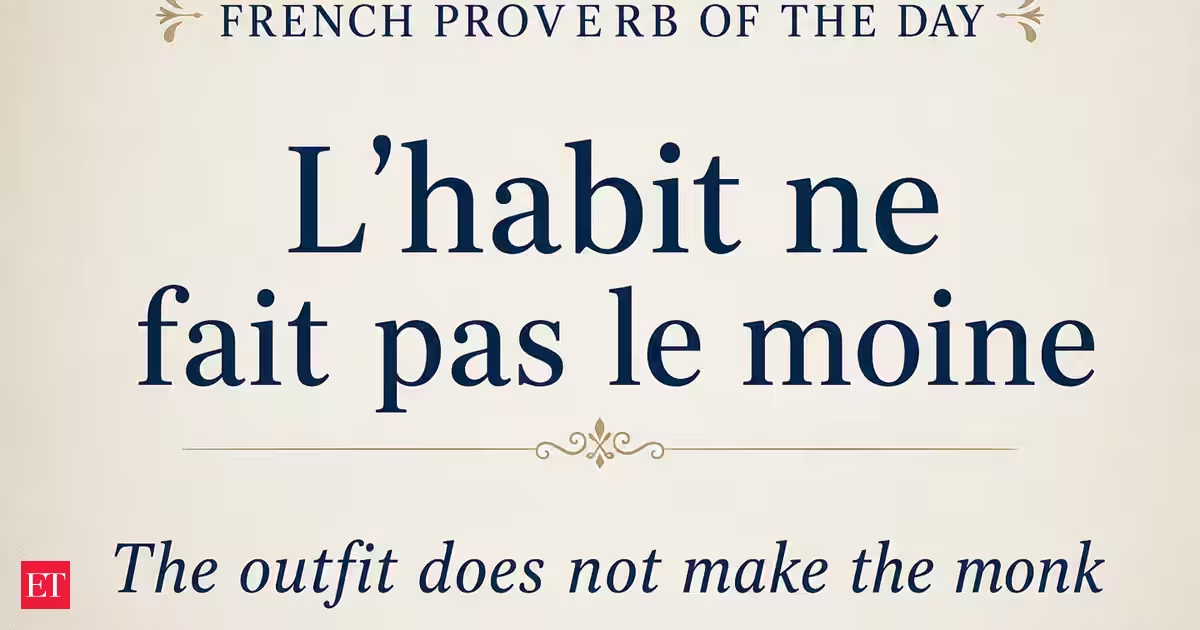
French Proverb of the Day highlights a traditional saying that reflects patterns of human judgment, social perception, and the way cultural values influence ideas of trust and character in everyday life. The proverb “Never trust a woman who mentions her virtue” offers insight into how older societies often viewed self-expression and morality, suggesting that true character is understood more through behavior than through spoken claims. It reflects historical assumptions about reputation, credibility, and the importance placed on outward modesty and silent virtue.Many people turn to such proverbs to better understand human behavior in simple, relatable terms. These sayings are often rooted in cultural observation and lived experience, passed down through generations. Over time, they have become part of daily reflection, reminding us that trust, identity, and perception are shaped not only by what people say about themselves, but also by how their actions are interpreted within a given social and cultural context.French Proverb of the Day — Why trust is earned and not given “Never trust a woman who mentions her virtue”French Proverb of the Day highlights a traditional saying that reflects ideas about human judgment, trust, and how perception of character is shaped in everyday social life.The first part of the proverb suggests that openly declaring one’s own virtue can influence how others perceive credibility and sincerity. It challenges the assumption that self-description alone is enough to establish trust, instead shifting attention toward how character is demonstrated through actions over time.The second part emphasizes how trust and moral judgment are shaped by perception, interpretation, and social experience. It suggests that people often evaluate others not just by what they claim about themselves, but by how consistent their behavior appears in real situations. In this sense, trust is influenced as much by observation as by speech.Together, the proverb teaches that character and credibility are not purely defined by self-expression. People form judgments based on both what is said and what is consistently shown through behavior, experience, and context. What appears as moral certainty is often a combination of self-presentation and external interpretation.Why you don’t judge a book by its cover“Don’t judge a book by its cover” is a saying that reminds us not to form opinions based only on appearance. It highlights the idea that outward looks can be misleading and do not always reflect a person’s true character, abilities, or intentions. People often make quick judgments based on first impressions, clothing, status, or behavior, but these surface-level factors rarely tell the full story. The proverb encourages patience, understanding, and deeper observation before drawing conclusions about others. It teaches that true value is often hidden beneath the surface and can only be understood through time, experience, and interaction. In life, many important qualities such as kindness, intelligence, and integrity are not immediately visible, making it important to look beyond appearances to discover what truly matters.Life lessons from the proverbThe proverb carries practical lessons about trust, judgment, and how individuals interpret character in everyday social interactions.1. Actions shape credibility How much trust a person earns often depends more on consistent behavior than on what they say about themselves.2. Self-promotion is not proof of character It is easy to assume that speaking about one’s own virtues establishes trust, but true credibility is built through demonstrated actions over time.3. Observation matters more than claims People tend to judge others not only by their words, but by how their behavior aligns with those words in real situations.4. Trust develops through consistency When actions remain steady across different circumstances, trust becomes stronger and more natural.5. Perception is shaped by experience How we evaluate others is influenced by past interactions, social context, and the ability to interpret behavior beyond surface-level statements.Why this proverb is still relevant todayIn modern life, the proverb “Never trust a woman who mentions her virtue” extends beyond its historical and gender-specific wording and can be understood in the broader context of trust, self-presentation, and credibility. It applies to social media culture, personal branding, workplace reputation, and everyday communication, where people often shape how they are perceived through what they say about themselves as much as through what they do.The proverb encourages critical awareness and emotional intelligence. It reminds us that trust is not built through declarations alone, but through consistent behavior over time. In many cases, how someone presents their character publicly may not fully reflect how they act in real situations, making observation and experience important in forming judgment. Ultimately, it teaches a simple but broader truth: credibility is shaped more by actions than by self-description, and real trust develops through consistency, not claims.English equivalent and related expressionsOther English expressions that reflect similar thinking include:“Let your actions do the talking.” “Character is what you do, not what you say.” “Words are easy, deeds are hard.” “Proof is in the behavior.” Each of these highlights the idea that trust and character are revealed through behavior over time, rather than through what people say about themselves.
French Proverb of the Day: “Never trust a woman who… — Life lessons on perception, trust, social judgment, character and why actions speak louder than words
French Proverb of the Day highlights the meaning of “Never trust a woman who mentions her virtue.” The saying reflects traditional attitudes toward morality, reputation, and social perception, where virtue was often judged through silence, appearance, and behavior rather than open self-expression. It suggests the idea that people who frequently speak about their own moral goodness may be perceived as less authentic, and that true character is believed to be revealed through actions rather than words.
823 words~4 min read