Using threat modelling to make system dependability observable, testable, and actionable
Executive summary
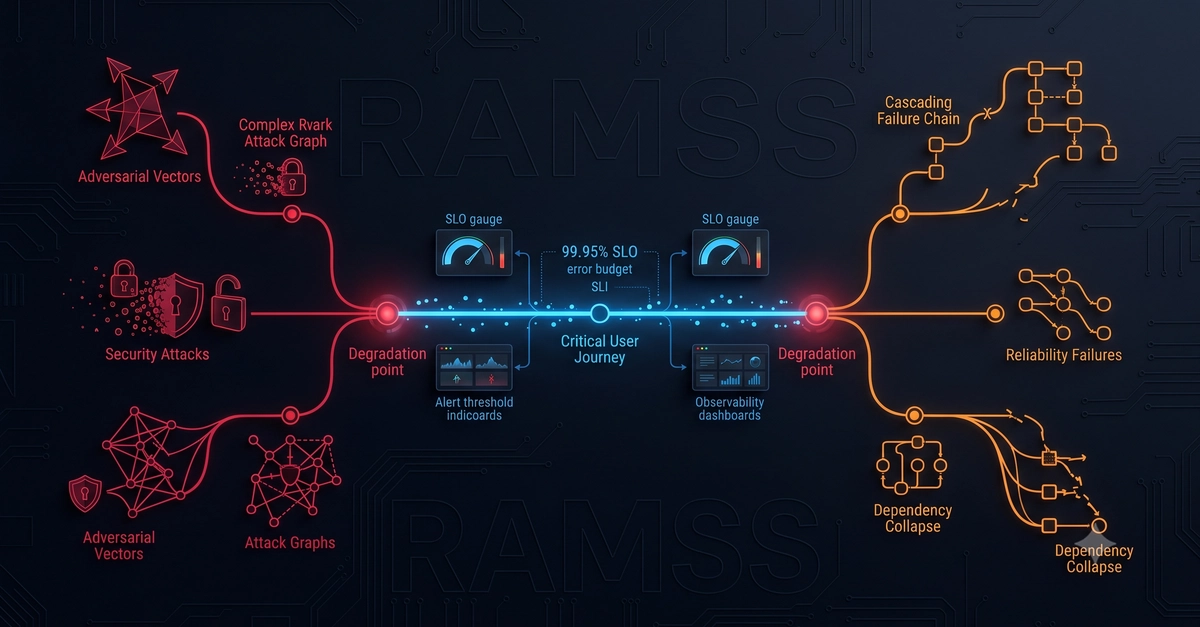
Security and Reliability address system degradation. Security addresses degradation from intentional actions, such as denial-of-service attacks, while reliability addresses degradation from failure, load, dependency behaviour, operational change, or complexity. The underlying engineering question is the same: which critical system property can degrade, how would users experience that degradation, how would we detect it, and what controls would prevent, contain, or recover from it?
This document proposes a practical way to bridge the two disciplines: anchor analysis on Critical User Journeys, express expected behaviour through SLOs and SLIs, use RAMSS to ensure coverage across dependability dimensions, and adapt PASTA-style threat modelling to reliability scenarios. The goal is not to merge Security and Reliability into one generic practice. The goal is to reuse the strongest habits of each discipline: security's adversarial modelling and reliability's production-oriented measurement, validation, and recovery loops.
The most useful outcome is a shared model of degradation scenarios. A degradation scenario links a critical user journey to a concrete reliability or security threat, the system weakness that makes it possible, the signal that would detect it, the objective it would violate, and the mitigation or experiment that would validate the control. This makes risk easier to discuss with engineering teams because it connects abstract concerns to user impact, SLO burn, business loss, and testable remediation.