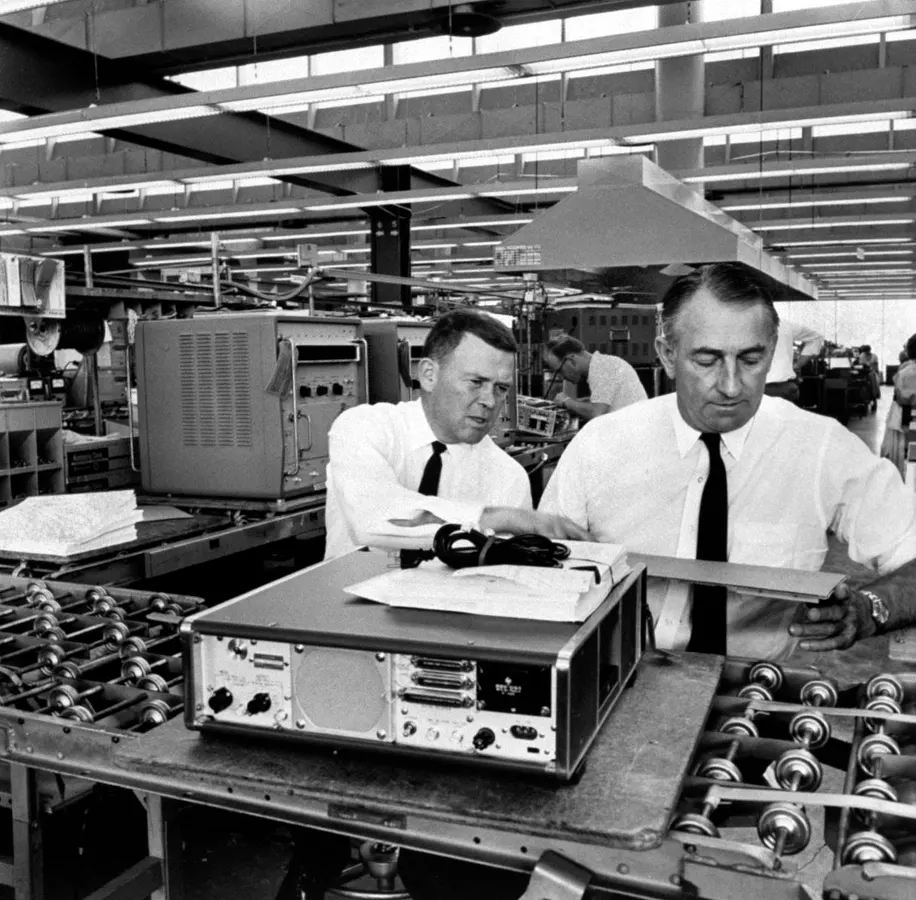
Hewlett Packard founders William Hewlett (L) & David Packard (R) w. transistorized electronic counters in factory. (Photo by Jon Brenneis/Getty Images)Getty ImagesDell and HPE just posted their strongest AI server quarters yet, sending both stocks soaring — but the surge in demand is colliding with rising component costs and thin server margins. The key question now is whether AI-driven revenue growth can outpace the mounting pressure on profitability. That tension helps explain why the market reacted so sharply: Dell Technologies jumped 32% on May 29 — its best single trading day ever — after reporting fiscal first-quarter 2027 results, while Hewlett Packard Enterprise rose about 30% after hours on June 2 following its biggest earnings beat since 2018.For two companies I long dismissed as low-growth box shippers, I was surprised by the magnitude of the upside move.This raises many questions — the most important of which for investors is this: Does the quality of the growth justify these moves? My answer in a nutshell is: partly yes. That’s because Dell beat expectations and raised guidance on the strength of 757% demand growth for its AI-enhanced servers, while HPE enjoyed a 40% rise in revenue helped by networking — boosted by its acquisition of Juniper Networks — and AI products.However, both companies suffer from low margins — made worse by higher chip costs and tariffs — and HPE’s networking growth falls from 150% to 7% after stripping out the effect of Juniper.MORE FOR YOUWhat HPE And Dell Reported And Why Their Stocks JumpedBoth companies reported strong growth because they are tapping into the rise in AI capital spending. Yet the shares also move on the basis of momentum and short sellers buying stock to cover their money-losing bets.Dell stock jumped 32% because the company beat expectations and raised guidance. Specifically, Dell’s revenue grew 88% to $43.8 billion — $8.4 billion more than expected — and adjusted earnings per share of $4.86 were $1.92 above consensus.That growth came primarily from the 181% pop in the company’s Infrastructure Solutions Group — most notably due to a 757% increase to $16.1 billion in the company’s AI-optimized server revenue.Dell’s prospects look bright as its backlog soared to a record. The company booked $24.4 billion in new AI orders during the quarter and ended with a record $51.3 billion backlog. Demand "continues to exceed supply with memory as the primary constraint," Dell Chief Operating Officer Jeff Clarke said, according to Blocks & Files. Dell — about which I wrote skeptically in July 2018 — has proven me wrong. When the company went public that month, Dell touted digital transformation as a growth driver, but until 2025, the stock did not move much.Then the boom in hyperscaler spending on AI infrastructure changed the market’s perception of the company from a cyclical PC maker to an AI-infrastructure platform — sending the stock up 331% in the last year.HPE similarly beat expectations and raised guidance — though not as much as Dell — sending its stock up 145% so far in 2026.HPE revenue grew 40% due to growth in the company’s networking and AI businesses. The quarter features the biggest earnings beat since 2018 — adjusted EPS of 79 cents was 26 cents above estimates. The surge in networking and servers stemmed from HPE’s acquisition of Juniper Networks as companies upgrade their networks for AI — resulting in $1.8 billion in AI system orders and a record backlog. The Tailwinds And Headwinds Facing Dell And HPEBoth companies have strong tailwinds. Dell raised its full-year AI server revenue target 20% to $60 billion. Supply scarcity makes orders visible and enables Dell to raise prices. HPE’s networking business is more profitable than its servers — hence the Juniper acquisition lifted networking to 30% of revenue and half of operating profit, noted Tikr.Yet rising prices for components — such as memory chips — squeeze margins. This is particularly problematic for the thinly profitable server industry. For HPE, another headwind looms: the Juniper acquisition boosted networking revenue 150%. Without that, the unit’s organic growth is a mere 7%, noted Techi. Unless HPE can sustain its 20% networking operating margin, investors could lose confidence in the stock.Does The Bull Case Prevail Over The Bear Case?While the AI capital expenditure tailwind is real, both companies now risk being at best fairly valued due to the rapid run-up in their stock prices. If demand exceeds supply, investors may worry whether Dell can raise its prices for AI servers to make up for the higher costs it incurs due to a memory shortage.Meanwhile, HPE traded above several analyst targets before the company announced earnings. This means the increase in the stock may have been due more to AI optimism than fundamentals analysts have modeled. Simply put, Dell looks priced for perfection, and HPE has traded above most analyst targets on largely inorganic growth.However, if both companies continue to beat and raise, their stock prices could keep going up.
AI Spending Surge Fuels Dell And HPE But Profitability Lags
AI server demand lifts Dell and HPE to record quarters, but rising component costs and thin margins raise questions about how long their beat‑and‑raise streaks can last.
821 words~4 min read