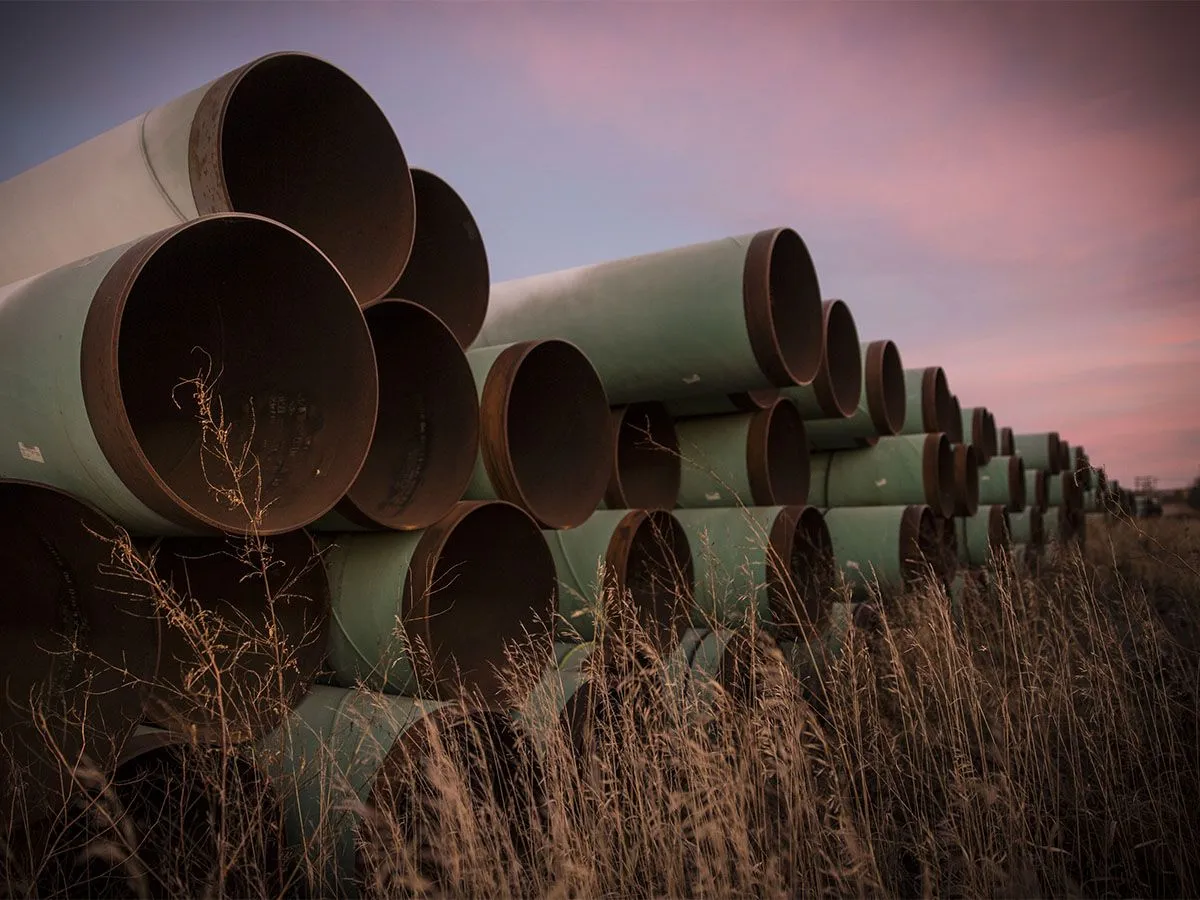
Skip to Content News Archives Economy Energy Oil & Gas Renewables Electric Vehicles Mining Commodities Agriculture Real Estate Mortgages Mortgage Rates Finance Banking Insurance Fintech Cryptocurrency Work Wealth Smart Money Wealth Management Investor Personal Finance Family Finance Retirement Taxes High Net Worth FP Comment Executive Women Puzzmo Newsletters Financial Times Business Essentials More Innovation Information Technology FP500 Podcasts Small Business Lives Told Tails Told Shopping Financial Post Store Obituaries Place a Notice Advertising Advertising With Us Advertising Solutions Postmedia Ad Manager Sponsorship Requests Classifieds Place a Classifieds ad Working Profile Settings My Subscriptions Saved Articles My Offers Newsletters Customer Service FAQ News Economy Energy Mining Real Estate Finance Work Wealth Investor FP Comment Executive Women Puzzmo Newsletters Financial Times Business Essentials HomeEnergyCanadian pipeline industry seen on 'edge of something really big' as more projects advanceChris Varcoe: Oilpatch gaining confidence to up production with string of new pipeline expansions and projects progressingLast updated 23 minutes ago You can save this article by registering for free here. Or sign-in if you have an account.Miles of unused pipe, prepared for the proposed Keystone XL pipeline, sit in a lot on Oct. 14, 2014 outside Gascoyne, North Dakota. Andrew Burton/Getty ImagesThe timing may be tight, but it appears the Canadian oilpatch will be able to keep adding production without exhausting all available pipeline space in the coming months.Subscribe now to read the latest news in your city and across Canada.Exclusive articles from Barbara Shecter, Joe O'Connor, Gabriel Friedman, and others.Daily content from Financial Times, the world's leading global business publication.Unlimited online access to read articles from Financial Post, National Post and 15 news sites across Canada with one account.National Post ePaper, an electronic replica of the print edition to view on any device, share and comment on.Daily puzzles, including the New York Times Crossword.Subscribe now to read the latest news in your city and across Canada.Exclusive articles from Barbara Shecter, Joe O'Connor, Gabriel Friedman and others.Daily content from Financial Times, the world's leading global business publication.Unlimited online access to read articles from Financial Post, National Post and 15 news sites across Canada with one account.National Post ePaper, an electronic replica of the print edition to view on any device, share and comment on.Daily puzzles, including the New York Times Crossword.Create an account or sign in to continue with your reading experience.Access articles from across Canada with one account.Share your thoughts and join the conversation in the comments.Enjoy additional articles per month.Get email updates from your favourite authors.Create an account or sign in to continue with your reading experience.Access articles from across Canada with one accountShare your thoughts and join the conversation in the commentsEnjoy additional articles per monthGet email updates from your favourite authorsSign In or Create an AccountorWith a string of new pipeline expansions and projects progressing, it’s providing industry leaders and analysts confidence in the ability to add more egress, as was done in the early 2000s.It’s also a far different outlook for the sector than in the past decade, which saw several large projects derailed or stuck in regulatory and legal limbo.Get the latest headlines, breaking news and columns.By signing up you consent to receive the above newsletter from Postmedia Network Inc.A welcome email is on its way. If you don't see it, please check your junk folder.The next issue of Top Stories will soon be in your inbox.We encountered an issue signing you up. Please try again“It feels like kind of . . . back to the mid 2000s to say 2010-ish. It’s like that period again where we’re kind of on the edge of something really big,” Trans Mountain Corp. CEO Mark Maki said in an interview.“There’s a number of things that have to come together. Now, you go back six years . . . there were barely any chess pieces on the board or puzzle pieces,” added Bevin Wirzba, CEO of South Bow Corp. “Now, there’s a lot of pieces on the board, but they’re not all connected yet.”The comments, made last week at the Energy Roundtable event, capture the progress being made on the pipeline front as Canadian oil output continues to climb.On Friday, South Bow announced that its open season — a process to determine long-term shipper interest in the company’s proposed Prairie Connector project, which would move more barrels from Western Canada into the U.S. — was successful.The Calgary-based company expects to make a final investment decision on the proposed development by the middle of next year.Prairie Connector would use 150 kilometres of pipe already in the ground in Canada that was initially intended for the Keystone XL project, and add new pipeline to move more oil south, where the system would link up to a new U.S. project proposed by Bridger Pipeline. South Bow CEO Bevin Wirzba was photographed in the company’s downtown offices on Tuesday, June 4, 2024. Gavin Young/PostmediaAt the same time, Calgary-based Enbridge is looking to optimize its massive Mainline oil system by up to 400,000 barrels per day in two phases — adding 150,000 bpd by the end of 2027, and a second phase by the end of 2028.Trans Mountain Corp., which is owned by the federal government, is considering ways to increase its capacity by about 300,000 barrels per day (bpd) within the next three years.Trans Mountain would begin by adding drag-reducing agents that would allow up to 90,000 more bpd of oil to flow through its line — it can currently transport 890,000 bpd from the Edmonton area to Burnaby, B.C. — by the first quarter of next year.A second project would see new pump stations added to the system, pushing total capacity to almost 1.2 million bpd by the end of 2028.In the longer term, the Alberta government is also proposing a greenfield pipeline to the Pacific Coast — operating no later than 2034 — although a route and project proponent have not been announced.The Trans Mountain system, which can access markets in Asia, is expected to be “close to full” this month for the first time since a $34-billion expansion project was completed and began operating in 2024, Maki noted.A final investment decision (FID) on its new optimization initiative could be made later this year.“We are pre-ordering stuff. We see the economics. We see the shipper demand,” Maki said. “It’s a highly, highly likely project.” Trans Mountain Corporation CEO Mark Maki was photographed in the company’s Calgary offices on Thursday, Jan. 16, 2025. Gavin Young/PostmediaConsultancy S&P Global Energy has forecast that Canadian oil production is expected to increase by about 500,000 bpd above last year’s levels, exceeding 5.8 million bpd, by 2030.In a recent report, S&P Global estimates that effective pipeline export capacity averaged 4.9 million bpd last year, while surplus capacity averaged just over 300,000 bpd for the year.“By as early as the winter of 2026–27, supply could more materially overtake export pipeline capacity if existing pipeline systems are not expanded,” it noted.However, under its base case scenario, the extra capacity of pipeline projects already announced would accommodate Western Canada’s export volumes.“Putting aside some tight periods through the winter months, the system does look like it should balance,” Kevin Birn, Canadian oil markets chief analyst with S&P Global Energy, said Monday.“We are moving back into a period where we need those expansions to come online . . . If these things come in as advertised, the system should be able to clear and we should avoid those (wider oil price) differentials. But timing is everything when it comes to pipelines.”Analyst Nate Heywood of ATB Cormark Capital Markets noted higher commodity prices, due the conflict in the Middle East, are incentivizing increased oil output in Western Canada. If production exceeds pipeline capacity, it could lead to more oil moving by rail and a wider differential affecting Canadian crude prices.“With pipeline projects typically taking years to get into service, we are lucky right now we have these optimization projects that are very short cycle in nature,” he said. “And if the timing doesn’t line up for a couple of months, it is very temporary in nature.”Heywood estimates the spare capacity of oil pipelines out of Western Canada is currently between 100,000 and 150,000 bpd.Maki said he sees a “stair-step” of new transportation capacity coming online that should match up with higher production.“Coming into this year, I was worried,” he said.“But I think there’s enough (new capacity) that will be delivered in ‘27, we should be OK.”Chris Varcoe is a Calgary Herald columnist. Join the Conversation This website uses cookies to personalize your content (including ads), and allows us to analyze our traffic. Read more about cookies here. By continuing to use our site, you agree to our Terms of Use and Privacy Policy.
Canadian pipeline industry seen on 'edge of something really big' as more projects advance
It appears the Canadian oilpatch will be able to keep adding production and avoid running out of pipeline room in the coming months.
TL;DRAI
South Bow, Trans Mountain, and Enbridge are advancing pipeline projects adding 700,000+ barrels/day by 2028, reversing a decade-long stall. The concurrent projects signal reduced permitting risk and investor confidence, affecting supply chain resilience and operational costs for North American enterprises.
1,446 words~7 min read