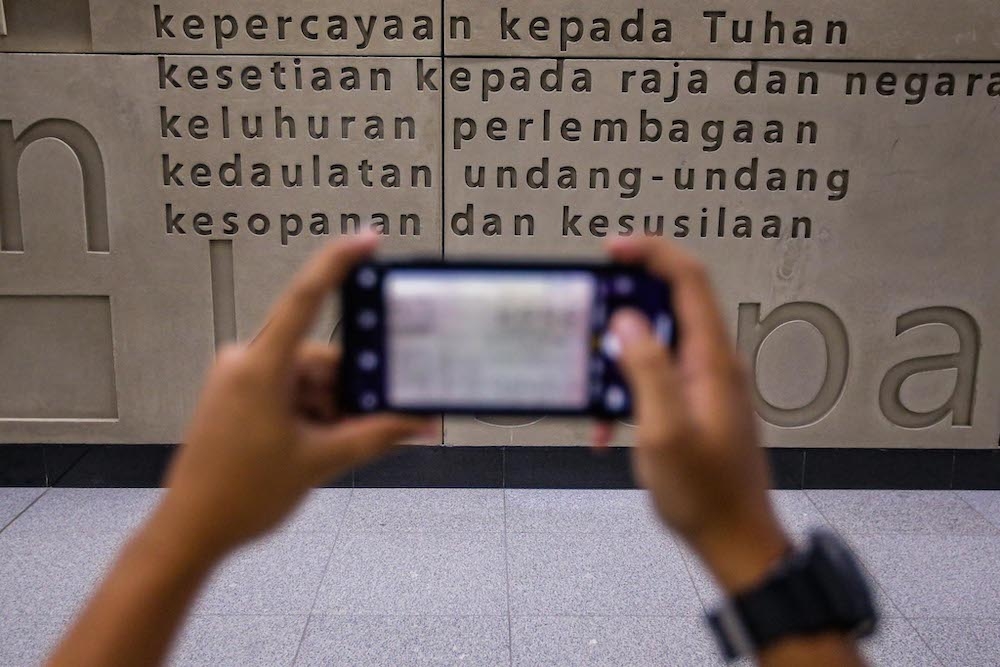
(New users only) It's tax relief season! Get up to RM300 when you save with Versa! Plus, enjoy an additional FREE RM10 when you sign up using code VERSAMM10 with a min. cash-in of RM100 today. T&Cs apply. Tuesday, 02 Jun 2026 4:13 PM MYT JUNE 2 — Our own great constitutionalist, Prof Dr Shad Saleem Faruqi explains the Rukun Negara in the following paragraphs.The Rukun Negara are five stirring objectives of our nation: unity; a democratic way of life; a just society where the prosperity of the country can be enjoyed together in a fair and equitable manner; a liberal approach towards our rich and varied cultural traditions; and a progressive society that will make use of science and modern technology.Supporting the objectives are five transcendental ideals: belief in God; loyalty to king and country; supremacy of the Constitution; rule of law; and courtesy and morality.Launched by the then Yang di–Pertuan Agong on Aug 31, 1970, and like the Pancasila of Indonesia, the Rukun Negara was meant to be the sail and anchor of our nation and its guiding philosophy.Unfortunately, it could not be presented to Parliament because the Emergency Proclamation of May 15, 1969, had sent Parliament into dissolution. Regrettably also, the Rukun Negara has not become the guiding light it was meant to be. The Rukun Negara was meant to be the sail and anchor of our nation and its guiding philosophy. — Picture by Hari Anggara Lip service is paid to the Rukun Negara in all schools. It is honoured but hardly observed and emulated.The above explains why it remains one of his two fervent hopes that the Rukun Negara could be incorporated into our Federal Constitution as a stirring Preamble to our supreme law.If you wonder why, Prof Faruqi explains in the following paragraphs.The Rukun Negara distills the essence of our Constitution. Its principle of “Supremacy of the Constitution” replicates Articles 4(1) and 162(6) of the Constitution. “Belief in God” is honoured in Articles 3 and 11. “Loyalty to King and country” is required by innumerable provisions, including Articles 32-38.“Rule of law” is implied in provisions for judicial review of governmental action in Articles 4, 121 and 128. “Democratic way of life” is promoted by innumerable provisions conferring personal liberties in Articles 5 to 13 and providing for elected and representative assemblies at both federal and state levels in Articles 44-49, 71-72, and 113-119.“Rich and varied cultural traditions” are protected by provisions for freedom of religion in Article 11 and freedom of speech, assembly and association in Article 10. The right to use vernacular and native languages is protected by Article 152. Malay and native customs are safeguarded even in times of emergency under Article 150(6A).“Morality” is safeguarded by empowering Parliament in Articles 10 and 11 to enact laws to safeguard morality.The special rights of Sabah and Sarawak in our federal set-up are entrenched in about 30 Articles of the Constitution.I particularly like it when Prof Faruqi describes the Rukun Negara as “distilling” the essence of the Federal Constitution.So, if one is a citizen of the country by reason of Part III of the Federal Constitution (Articles 14-22) – mind you, there can’t be any other reason – but rejects the Rukun Negara, then His Majesty Sultan Ibrahim, King of Malaysia, is right.He or she is not worthy of being regarded as a Malaysian citizen.* This is the personal opinion of the writer or publication and does not necessarily represent the views of Malay Mail.
When one is not worthy of being regarded as a Malaysian citizen — Hafiz Hassan
JUNE 2 — Our own great constitutionalist, Prof Dr Shad Saleem Faruqi explains the Rukun Negara in the following paragraphs.The Rukun Negara are five stirring objectives of our...
580 words~3 min read