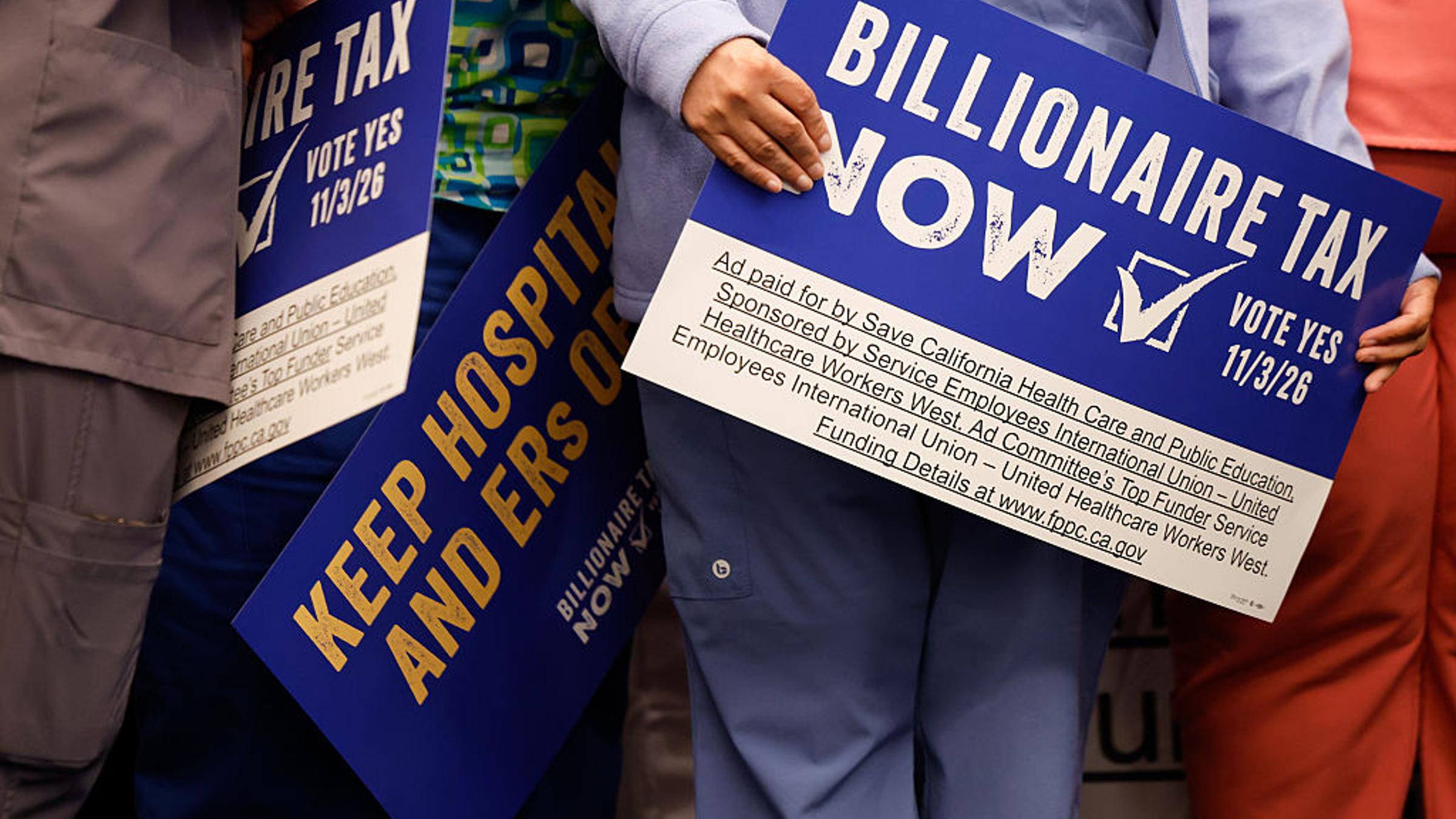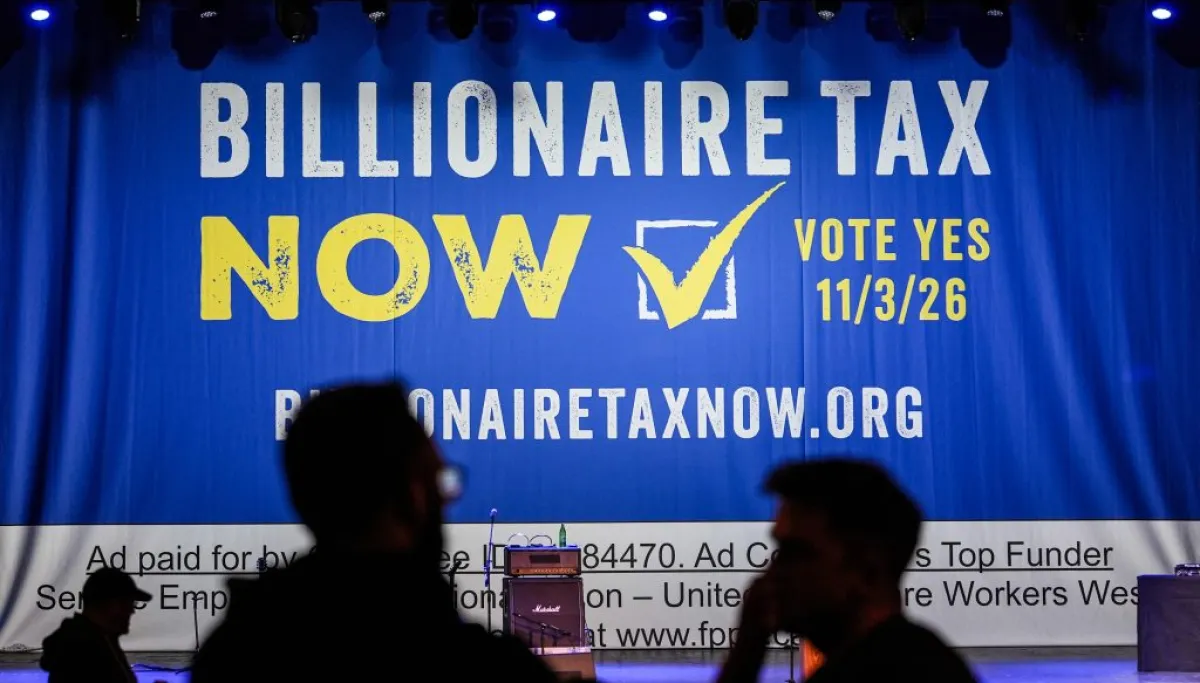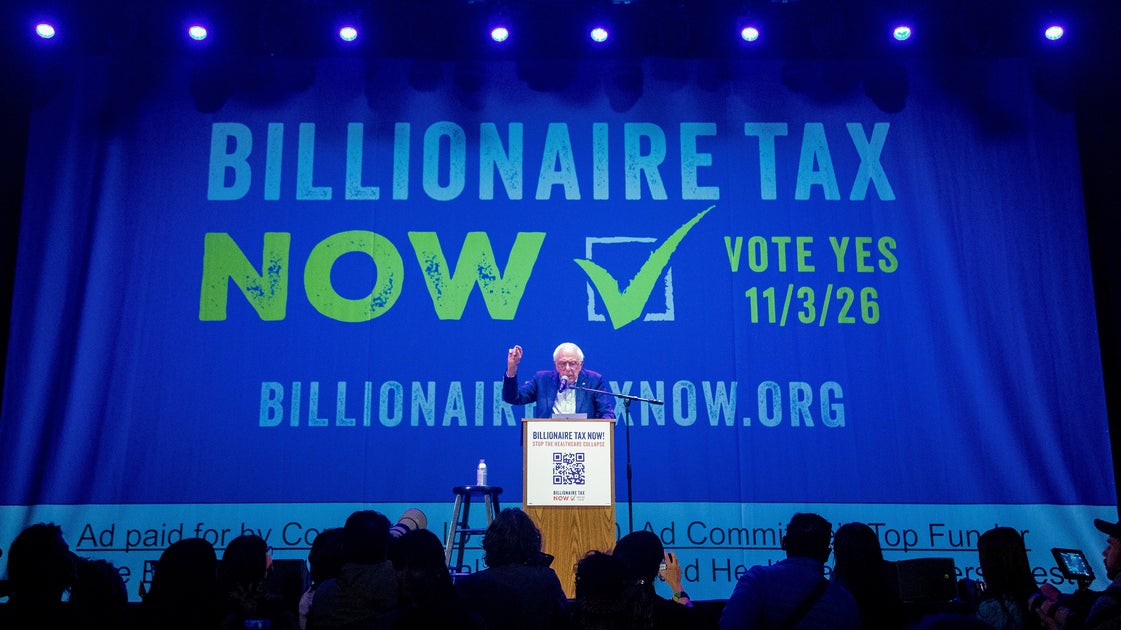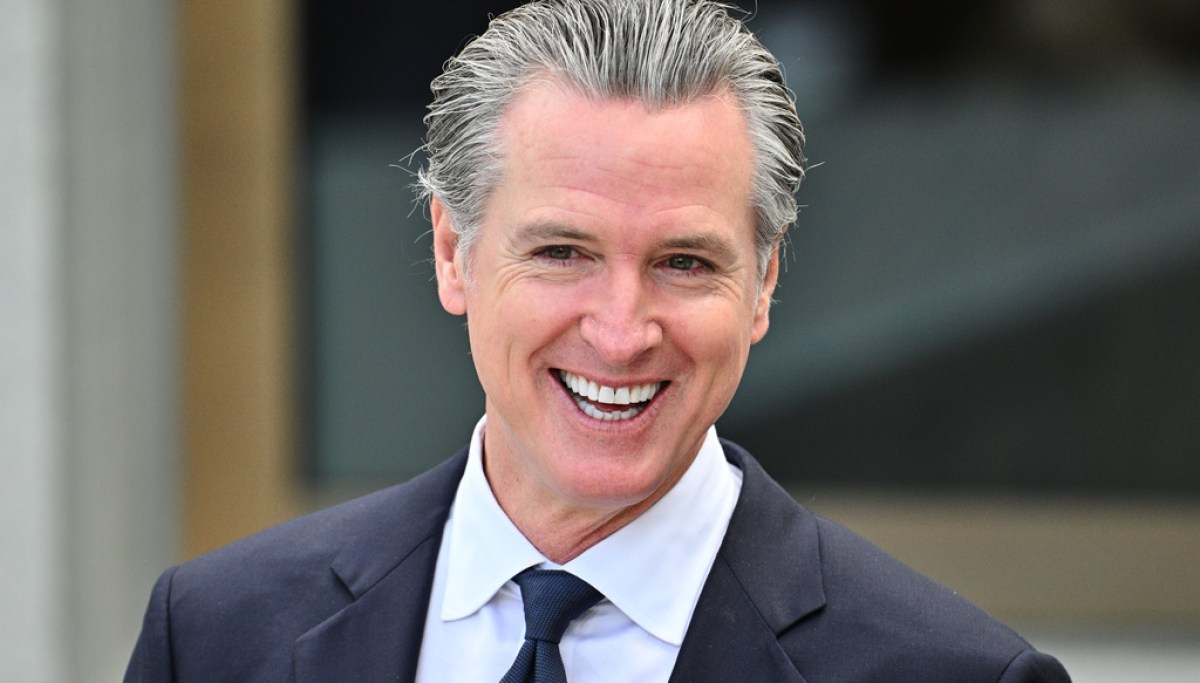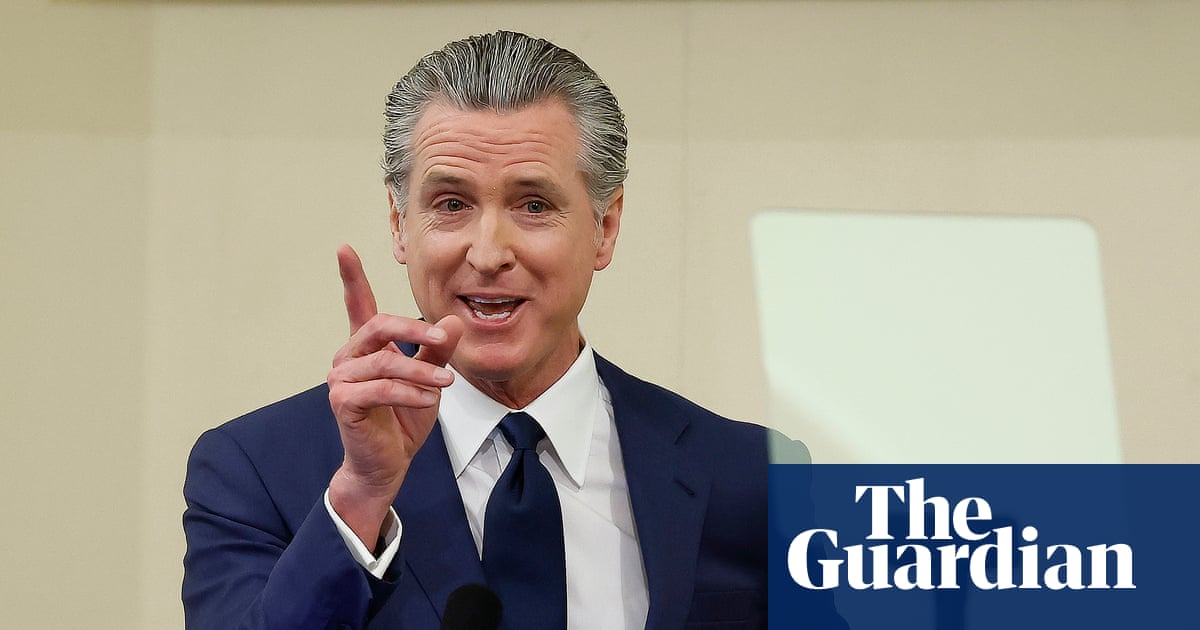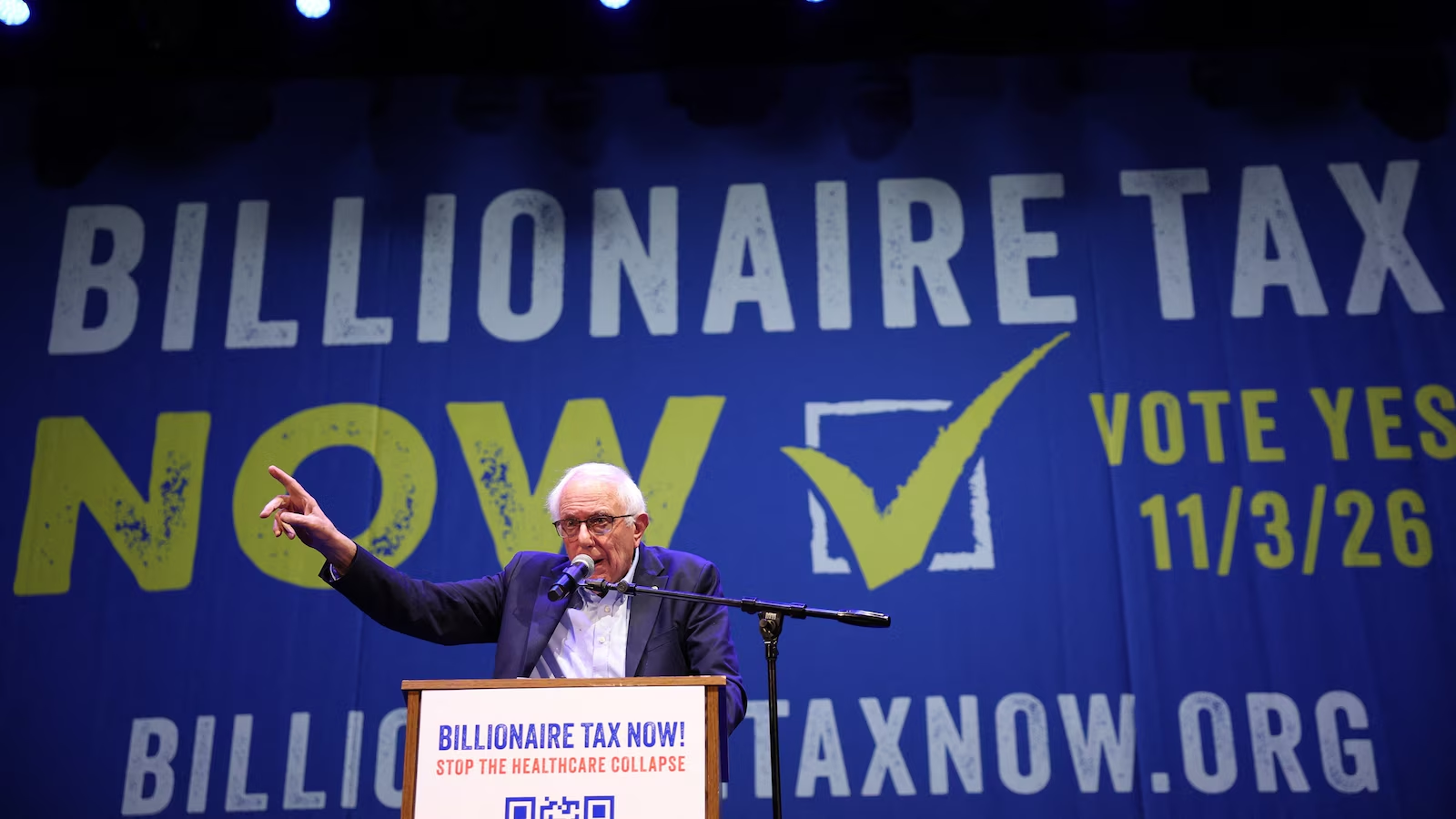
California is considering a one-time 5% tax on the wealth of billionaires. SEIU-UHW, a healthcare workers union, recently submitted the signatures required to put the tax to a vote as a ballot measure in November. California Gov. Gavin Newsom opposes the tax. In a May 5 debate, all the candidates running for California governor but one, Tom Steyer, voiced opposition. Steyer later told Wired that the tax “doesn’t go far enough,” though he also emphasized that he wants California to be “where the companies that are changing the world are begun and grow and stay.” Brian Brokaw, a longtime Newsom adviser who leads Stop the Squeeze, a group opposing the tax, told ABC News that the measure could financially devastate the state. Sen. Bernie Sanders, I-Vt., speaks during the campaign kickoff for the California Billionaire Tax Act at The Wiltern in Los Angeles on February 18, 2026.Patrick T. Fallon/AFP via Getty Images“We're not just talking about individual billionaires. You're talking about an entire economy that is the backbone of California's economic engine,” he said.The tax was introduced in response to steep cuts to California’s healthcare funding that resulted from the passage of the President Donald Trump's “Big Beautiful Bill.” According to SEIU-UHW, the tax would generate around $100 billion over five years, funneling 90% of those revenues toward the healthcare sector.Suzanne Jimenez, chief of staff at SEIU-UHW and one of the architects of the measure, warned of a “complete collapse” of the healthcare system in California if funding shortfalls go unaddressed. SEIU-UHW, along with its associated political groups, has contributed more than $31 million to a proxy called Save California Healthcare and Public Education Committee to support the initiative. The most well-resourced organization opposing the measure is Building a Better California, which supports committees promoting two competing ballot initiatives that purport to improve government transparency and to protect retirement savings from taxes, respectively. If either of those ballot initiatives receives more votes than the billionaire tax measure, the group will negate it. Building a Better California has raised more $118 million from 10 donors. More than half of that money comes from Google co-founder Sergey Brin.The campaigns for both competing ballot measures have received around $48 million and $49 million, respectively, in contributions since February, almost all from Building a Better California. Although the group’s opposition to the billionaire tax is widely reported, representatives from Building a Better California and the campaigns it supports do not comment on the measure directly. “We are solely focused on passing our measure,” a spokesperson for the group promoting the retirement savings initiative told ABC News. Popular ReadsShana Kushner Gadarian, a professor at Syracuse University who studies political psychology, thinks the alternative ballot measures may have been crafted to oppose the tax without appearing to support billionaires over healthcare workers. “My guess would be that the strategy is to just avoid the whole question of the billionaire tax … to be for something rather than against something,” Gadarian told ABC News. Candidates Katie Porter, Chad Bianco, Antonio Villaraigosa, Xavier Becerra, Matt Mahan, Steve Hilton and Tom Steyer interact at the end of a debate in the race for governor of California, hosted by the San Francisco Examiner and CBS, in San Francisco on May 14, 2026.Carlos Barria/ReutersAbout 250 billionaires would be taxed under the measure. An analysis from the state’s nonpartisan Legislative Analyst’s Office says it is hard to predict how much revenue the tax would yield.“It is likely that some billionaires decide to leave California,” the report says. “The reduction in state revenues from these kinds of responses could be hundreds of millions of dollars or more per year.”Scholars are divided as to what the impact of the tax will actually look like, however. A report from the University of Missouri School of Law suggests that threats by billionaires to relocate may be strategic posturing.Jimenez agrees.“I think it's kind of the same scare tactic we see time and time again around any kind of campaign that is about investing in public services,” she said. An analysis from the California Budget and Policy Center estimates that the state could lose as much as $30 billion in Medicaid funding annually as a result of the H.R. 1 cuts. The analysis also suggests that as many as 3.4 million people could lose coverage. Whether the one-time California tax succeeds or fails could impact debates in Washington on whether taxes on billionaire wealth could be viable at the federal level. California’s Rep. Ro Khanna has teamed up with Vermont Sen. Bernie Sanders to introduce legislation that would establish an annual 5% percent wealth tax on billionaires nationwide. “Even if you don't win this time, now people are at least talking about the possibility of a billionaire tax,” Gadarian said. “That seems pretty strategic to me.”
Proposed 'billionaire tax' in California spurs controversy and heavy spending
Factions for and against California's so-called "billionaire's tax" have expended tens of millions weighing in on the measure likely to land on the November ballot.
TL;DRAI
California Nov ballot measure proposes 5% wealth tax on billionaires, projected to raise ~$100B in five years for healthcare. Success would set precedent for federal wealth taxation and potentially reshape venture capital and startup ecosystem dynamics.
798 words~4 min read