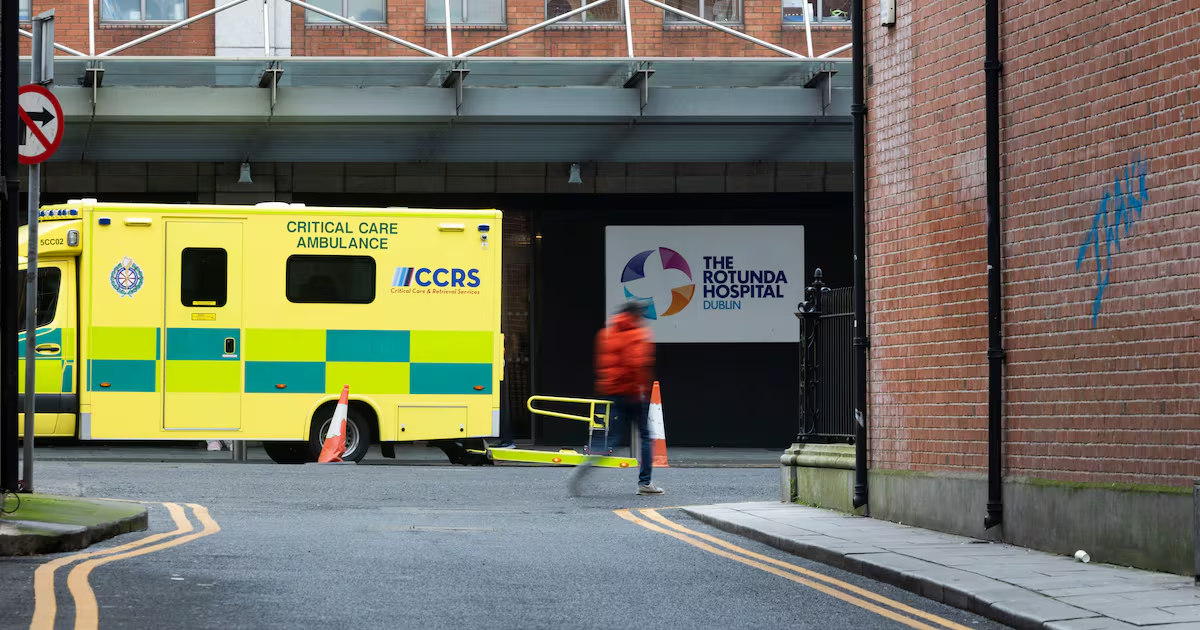
“We hold these truths to be self-evident, that all men are created equal ...” Though we would now correct the sexist language of the American Declaration of Independence of 1776, the idea that we are all born equal is supposed to be foundational to our republic. Except, of course, in Dublin’s (and the world’s) oldest maternity hospital, whose master is making a last stand for the right to be born superior.I should declare an interest: when it comes to the Rotunda Hospital in Dublin I am profoundly biased. Both of my sons were born there within the public health system. It was, at the time, bordering on decrepit and the facilities were primitive. But the staff and the ethic of care were wonderful. Private maternity care was available and I suppose, at a stretch, we could just about have afforded it. But we trusted the Rotunda. We did not believe we would be treated worse in any way if we did not pony up for a consultant’s fee.I must therefore also declare my shame at the extraordinary defiance of public policy, and of the basic ethic of equal birth, by the hospital’s master Prof Sean Daly at a hearing of the Oireachtas health committee last week. Daly told the committee’s impressive chairman Pádraig Rice that he and the hospital’s board are deliberately permitting consultants who signed contracts committing them to public-only work to use the hospital for private work. He acknowledged this quite blithely and without apology.Let this sink in: a hospital that gets €100 million a year in State funding is sticking two fingers up to the State’s Sláintecare policy, a centrepiece of which is the removal of private practice from public health facilities. And it is consciously facilitating consultants who are paid about €250,000 a year by the State – on the explicit proviso that they do only public work in public hospitals – to do private work in a public hospital.The background to all of this is that stand-alone private maternity care in Ireland is not financially viable. Up to 2014, there was a fully private maternity hospital in Dublin, Mount Carmel. When the Celtic Tiger died, it ended up in the State’s bad bank, Nama. Nama tried to sell it and dozens of investment companies thought about buying it. But they all realised they couldn’t make it profitable for one overwhelming reason: the birth rate was declining inexorably. The number of people with €10,000 to stump up for the posh push was shrinking. It proved there is only one way for private birth services to make a profit: if they piggyback on public hospitals and their facilities. Consultants can make a decent extra wedge if they are already being paid (and insured) by the State and if their private work is passively subsidised by the taxpayer. It’s nice work if you can get it, but you can only get it in a public facility.The problem for those who want to hold on to this nice little earner is the public-only consultant contract. Consultants who switched from the old contract to the public-only one in 2023 were given until the start of this year to stop treating any private patients in public hospitals. No more piggybacks. Obstetricians can no longer use a public hospital like the Rotunda as a base camp from which to offer lucrative trips to the summit of natal superiority.Unless, that is, they have the brazenness to just carry on doing it. Which, it turns out, they do. The Rotunda’s website, in its offer to private maternity customers, actually boasts about its exploitation of the hospital’s public resources: “As a patient of The Rotunda Private, you have the best of both worlds. The personal attention and care from one of our consultants, along with the state-of-the-art facilities of The Rotunda Hospital ... A further benefit is that the consultant will have access to all of the hospital facilities and any additional services necessary to deal with all aspects of pregnancy care no matter how complicated or acute the situation may be.”In making it clear last week that this use of all of the public resources of the hospital for private profit is the hill he and his colleagues will die on, Daly suggested they are serving an ethical purpose: “It is primarily about safety for women and women’s choice.” The real “choice” here is that offered by the hospital: “Fees range from €3,200 to €4,500 for your chosen consultant.” No mention of that, of course. But it’s the “safety” stuff that is truly outrageous.In 2022, when the masters of the maternity hospitals started to make this argument, Chris Fitzpatrick, former master of the Coombe, pointed out that what they were really implying was that care for pregnant women with complex medical needs “can only be provided if women continue to pay up to €5,000 to see the obstetrician of their choice”. What makes this especially egregious is that the women who are most likely to need complex care in pregnancy are those who can least afford to pay top-up fees. Does Daly understand the implications of suggesting that “safety” for women is dependent on their ability to pay? I can’t believe that either he or the vast majority of doctors and midwives at the Rotunda would stand over such a claim.Rice, at the Oireachtas committee, asked the obvious question: “What’s going to happen in relation to this?” Mellany McLoone, the HSE’s manager for the area that includes the Rotunda replied: “It’s an ongoing discussion between ourselves and the Rotunda.”The right of a small group to continue to enjoy “the best of both worlds”, using public facilities for commercial ends while making a mockery of the State’s health policy, is a matter for delicate discussion. We must not upset those who hold these truths to be self-evident: that some must always be born more equal than others.
Fintan O'Toole: Rotunda’s defiance of public policy shows us how some are born more equal
Let this sink in: a hospital that gets €100m a year in State funding is sticking two fingers up to the State’s Sláintecare policy
TL;DRAI
Rotunda Hospital Dublin, State-funded €100M/year, permits consultants on public-only contracts to conduct paid private maternity services within public facilities, breaching Sláintecare policy. When institutions allow dual-revenue streams despite policy bans, public subsidy leaks to private profit and governance erodes—a risk pattern wherever public funding meets enforcement gaps.
982 words~4 min read