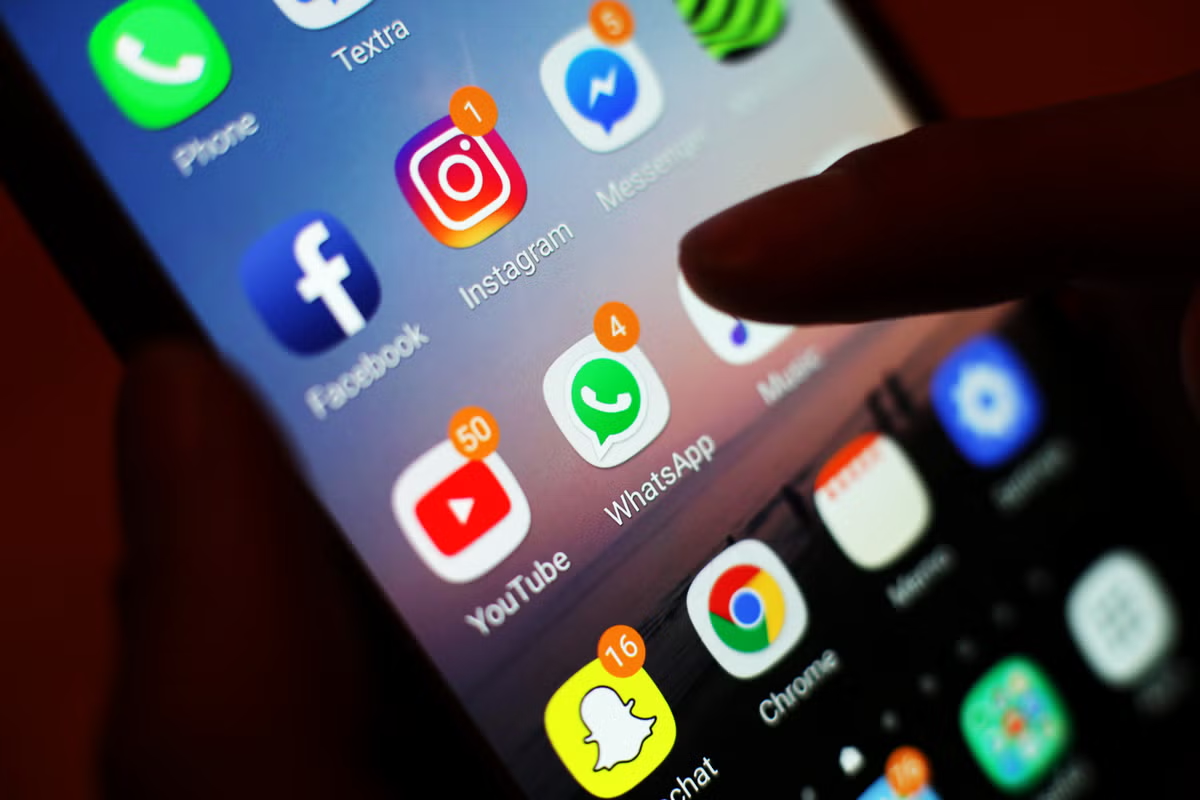
Sir, – There are reports that the UK is set to announce a crackdown on social media for children within weeks, with age limits and changes to allegedly addictive design features in place by the end of the year. Meanwhile, Ireland continues to prevaricate. The Government’s Online Health Taskforce in its report published in December 2025 advocated for a harm-reduction approach that combines digital literacy, “safety by design” standards for tech platforms, and proportionate regulatory safeguards under the Digital Services Act.Notably, the taskforce prioritised fixing the underlying products, shifting the focus from blanket bans on teenagers to eliminating harmful features like infinite scrolling and algorithm-driven content. The taskforce highlighted the use of a blanket ban as a “blunt instrument” that will not meaningfully resolve the issue. However, this is not the view of the vice-president of the Irish Medical Organisation, Prof Matthew Sadlier, who suggested in February that a ban on social media was “imperative” to protect children from harmful online content. Several countries in Europe have announced or are in the process of introducing a social media minimum age ban. These include Spain (age 16) France, Norway and Greece (age 15), Austria (age 14), Portugal and Germany (age 13). Is there a case for the introduction of both a minimum age ban and better standards? This would result in an age limit ban on social media aligned with a robust set of standards that social media apps must meet. – Yours, etc,DR CATHERINE CONLON,Ballintemple, Cork.AI and the PopeSir, – The recent warnings from Pope Leo XIV regarding artificial intelligence deserves serious attention, not least because the effects are already visible in everyday life.Much of the debate around AI focuses on future threats such as automation or surveillance. Yet a quieter cultural shift is already taking place, as increasing numbers of people, particularly younger adults, are turning to AI systems for emotional support, relationship advice and guidance on personal problems.At first glance this may appear harmless or even helpful. However, over time, dependence can subtly replace judgment. Advice once sought from friends, family, teachers or community is increasingly being outsourced to systems which simulate understanding but possess neither wisdom nor human experience.The danger is not that machines suddenly become conscious, but that human beings begin assigning them an authority they do not deserve. AI is fast, responsive and non-judgmental. For isolated or vulnerable individuals, that can become deeply persuasive.Historically, institutions such as the Catholic Church attempted to provide moral frameworks during periods of social upheaval. Whether religious or not, there is value in raising questions about where unchecked technological dependence may lead.Efficiency and convenience are not the same as meaning, wisdom or human connection. If society is not careful, we may gradually trade authentic relationships for artificial assurance – and only realise the cost once those habits are firmly embedded. – Yours, etc,WILSON BURGESS,Derry.One-off housing not helpfulSir, – The Government has announced that in an effort to encourage Irish citizens living abroad to return, and to help with the housing crisis in general, restrictions on one-off houses are to be significantly reduced. For many reasons this will be seen to be a very poor decision and one which will have very little impact on the housing crisis, but which will damage our already stressed rural environment.For the past few years, up to 5,000 one-off houses have been built annually, each of them having a negative impact on the beauty of our landscape. This number could easily be doubled in years to come. And as has been reported recently, a very large percentage of them have problems with their septic tanks, many of them leeching human effluent into our rivers and streams. In addition, we are now going to miss our carbon reduction targets by a significant margin, and each of these houses will encourage more car ownership and extra kilometres driven, mostly in diesel and petrol cars. Another obvious outcome will be the further hollowing out of our towns and villages, resulting in empty premises and the blight of urban dereliction.None of these all-too-predictable outcomes will benefit the country, and the only winners will be the TDs who will approve this measure in pursuit of votes, and getting re-elected is ultimately what matters most to them. – Yours, etc,TREVOR TROY,Baile Átha Buí,Co na Mí.Eliminating smoking Sir, – I agree with Dr Paul Kavanagh’s letter of May 29th where he says that Ireland must act now to eliminate the tobacco industry’s power to addict and harm the next generation and that we need to build a tobacco- free future, but it is not going to be easy.Society needs to acknowledge the enormity of the task and the forces arranged against it, namely big tobacco and its paid actors who wish to perpetuate a world addicted to nicotine. Take the case of New Zealand where the world-first generational smoking ban was thwarted and repealed in February 2024, when the newly elected centre-right coalition led by prime minister Christopher Luxon scrapped the impending legislation. Opposition politicians claimed that the decision was influenced by lobbying from big tobacco.I must admit total defeat in my own attempts to get success in this area. In 2016 I submitted a petition “Creating a tobacco-free generation” to the Oireachtas Joint Committee on Petitions. It was broadly similar to the original New Zealand measures which were subsequently scrapped. The reply from the committee declining my proposal informed me that the Department of Health had an action plan for a Tobacco Free Ireland. Unfortunately, the plan’s target to reduce smoking to less than 5 per cent by 2025 failed miserably.Thankfully, all news on the tobacco front is not bad. The Maldives has become the first country in the world to introduce a generational smoking ban, coming into effect on November 1st, 2025. It is illegal there for anyone to sell tobacco to those born after January 1st, 2007. It might take years or so for the full positive health effects to become known, but it is more likely to succeed than anything tried to date, including raising the smoking age to 21 years as is intended here in Ireland.With the UK leading the way in this part of the world, it seems only logical for our Government to show some backbone on this issue and row in with our neighbours who are trying to save lives and not be beholden to big tobacco, whose only goal seems to be to profit to the tune of trillions of dollars per year by the sale of their highly addictive product, nicotine, which kills more than half of those who smoke. – Yours, etc,BOBBY CARTY,Templeogue,Dublin 6W.Dunsink and views of WalesSir, – Your article on the recent viral Wicklow “hills” video and the visibility of Ireland from Wales in hot weather highlights a phenomenon that has fascinated observers for centuries (“How a viral Wicklow ‘hills’ video shows why Ireland is visible from Wales in hot weather,” May 28th). In fact, Henry Ussher, the first director of Dunsink Observatory, recorded seeing the distant Welsh mountains from Dunsink in west Dublin in the first paper of the Transactions of the Royal Irish Academy in 1787.Ussher wrote that “In particular states of the atmosphere, and more especially on the approach of severe weather, the Welsh mountains are distinctly visible, particularly that ridge of hills which runs SW to point Braich-y-pwll, and bounds Caernarvon bay”. Dunsink Observatory still offers beautiful views for astronomers and the public across Dublin towards the Wicklow Mountains and, on rare clear days, across the Irish Sea to Wales. The recent inclusion of Dunsink Observatory on Ireland’s Unesco World Heritage Tentative List is an important step towards preserving not only this historic observatory, but also its relationship with the surrounding landscape, views and dark skies that have inspired generations of observers for more than two centuries. – Yours, etc,PROF PETER T GALLAGHER, Head of Astronomy & Astrophysics,Director of Dunsink Observatory,Dublin 15.UN report and IsraelSir, – In its latest report on sexual violence in wars, the UN has documented “patterns of sexual violence” inflicted by Israeli state forces during 2025 on detained and imprisoned Palestinians (“Israel included in UN report on sexual violence in wars,” May 29th). Of course, these are not new claims. On May 11th, for example, the New York Times published a detailed and hard-hitting article by its journalist Nicholas Kristof – a two-time Pulitzer prize winner – in which he reported on the widespread sexual abuse, including rape, of Palestinians by Israeli prison guards, soldiers and settlers. His article was pointedly titled “The Silence That Meets the Rape of Palestinians”.What was the official Israeli response to this? Kristof’s rigorous article was immediately denounced as “Hamas propaganda” by the Israeli ministry of foreign affairs and a libel action was threatened against the New York Times.Now that the UN has documented clear patterns of sexual abuse, how has Israel reacted? It has said it is breaking off all contact with UN secretary general António Guterres. It is worth noting that some participants on the recent Gaza flotillas also claimed that they were subjected to sexual abuse while in Israeli custody. In fact, France has now launched an investigation into the treatment of its citizens.Will the “international community”, including the EU, actually do something about this? Or will it look the other way? – Yours, etc,FINTAN LANE,Lucan,Co Dublin.Sir, – What will it take before Israel is treated like any other state accused of committing atrocities?When does their “Get Out Of Jail Free” card expire?Tens of thousands of children in Gaza are dead or wounded. Families are living in ruins without food, water, hospitals or safety. Most of Gaza’s infrastructure has been destroyed, huge areas are under Israeli military control, and the killing has spread beyond Gaza into Lebanon, where children are dying there too. If any other country did this, there would be outrage, sanctions and isolation. Why is this different?Human rights and international law either apply to everyone or they mean nothing. Palestinian lives should not count for less. People will remember who spoke out, and who chose to look away. – Yours, etc,CHARLES McLAUGHLIN,Stoneybatter,Dublin 7.Israel v Ireland matchSir, – May one ask the Taoiseach and his Government if they think that Cork City or Shamrock Rovers would have been facilitated in fulfilling a fixture against a Black and Tans selection lest their failure to do so might have repercussions from a governing body with no moral conscience whatsoever?Sometimes, taking the correct stance has inconvenient consequences. Might our Government please stand up for what is right, what is moral and what is just? Stop the games against Israel and take the consequences. – Yours, etc,BILLY HANNIGAN,Limekiln,Dublin 12.Leinster rugby and competitionSir, – For years, Irish rugby supporters have been assured that concentrating almost all of the resources and attention in Leinster is not favouritism but merely the inevitable consequence of excellence. The fact that this excellence has repeatedly stopped one step short of a fifth star appears to have finally resulted in the dangerously radical idea that Irish rugby might benefit from stronger Munster, Ulster and Connacht sides.Your rugby correspondents appear to have collectively realised that simply assembling as much talent as possible in one location does not guarantee delivery of the required outcome and that sport is slightly more complicated than accounting and resource allocation.For quite some time, Paris Saint-Germain FC pursued European success by accumulating extraordinary financial resources and some of the world’s most celebrated players. The desired outcome remained frustratingly out of reach. Their eventual breakthrough came when the emphasis shifted from assembling the biggest collection of stars to building the strongest collective unit. And with that focus they have already won it twice in successive seasons.Perhaps the lesson is that great teams are not built by concentrating every advantage in one place, but by fostering genuine competition throughout a system. – Yours, etc,DIARMUID O’CINNEIDE,Garryowen,Limerick.Sir, – There has been a lot of soul searching after Leinster’s latest final defeat, blaming the players and coach. But the fault clearly lies with the IRFU for not investing enough money in Leinster.Surely they can see that Tadhg Beirne and Jack Crowley are just wasting away in Munster and it’s obvious that you cannot win the Champions Cup without three-four internationals for each position? Similarly with Matt Hansen and Bundee Aki in Connacht, get them to Dublin. But the most glaring omission is their failure to sign Antoine Dupont or Maxime Lucu as back-up to Gibson Park, this is just asking for failure. Win or lose, up the Blues. – Yours, etc,JIMMY COUGHLAN,Cork.Remembering Tomi ReichentalSir, – As a young man I had regular contact with Tomi Reichental in a mutual business environment. He was such a pleasant gentleman to deal with, but at that time I had no notion of his background. Years later, and long after he had embarked upon his campaign of Holocaust awareness, I asked him if he would accede to an interview with my daughter who was doing a school project on the Holocaust. Not only did he agree, he invited us to his home and gave my daughter hours of his precious time answering all her questions with a kindness and candidness that took both my and my daughter’s breath away. After the “formalities” of our interview, he and his partner invited us to join them for tea and cakes in their kitchen. There we continued to chat about anything and everything. It was like a small family gathering. Both myself and my now grown-up daughter retain to this day a sense of privilege for the kindness, openness and hospitality we received that day. And the messages we took away with us will last for ever. Thank you Tomi. May you rest in everlasting peace. – Yours, etc,HUGH McDONNELL,Glasnevin,Dublin 9.
Letters to the Editor, June 2nd: On social media and age limits, AI and the pope and Leinster rugby
Several countries in Europe have announced or are in the process of introducing a social media minimum age ban
2,290 words~10 min read