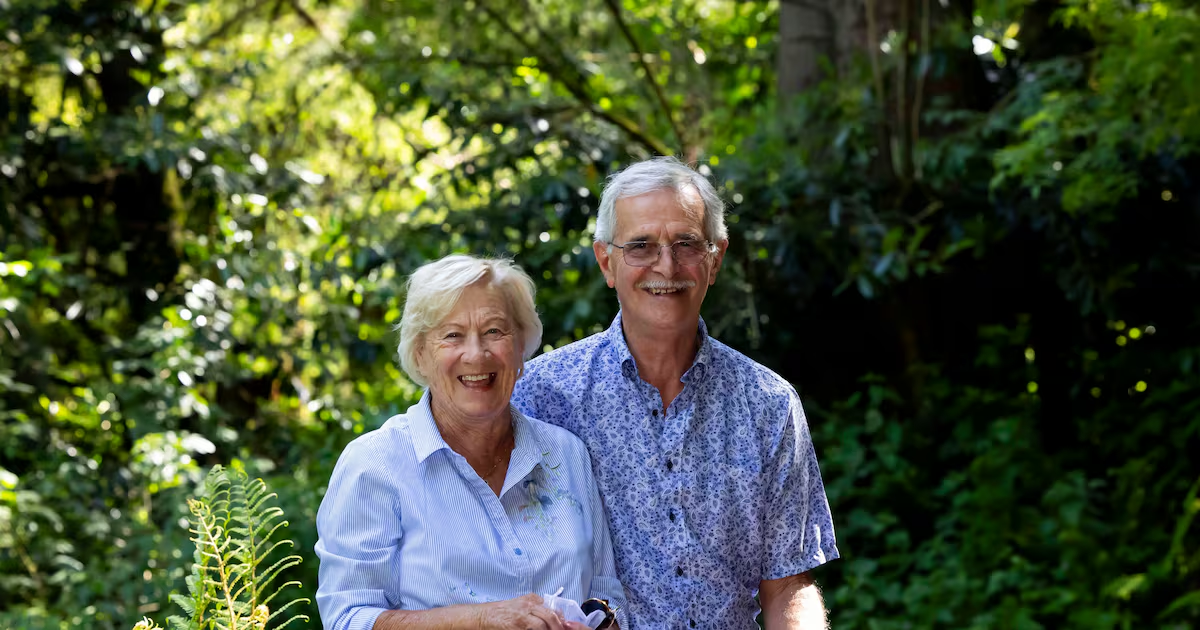
Retirees Brian and Rina Beechey, who fell in love as teenagers almost 60 years ago, are a poster couple for healthy and happy ageing.On a beautiful sunny morning at their home, within an estate of former holiday houses outside Gorey, Co Wexford, they acknowledge they are “very blessed” in where they live. It’s a world apart from the inner-city orphanage in Dublin where Rina spent her childhood, after the death of her mother when she was two, and from Brian’s native Coventry in the UK.Here a beach is just across the road, where they go to walk every morning with their two cute rescue dogs, or in nearby woods. “These dogs are our lifesavers,” says Rina (79), pointing to the diminutive Tuppence, who has nestled in between us on the sofa, and the larger, older Tilly, lying on the floor across the room. “They walk us,” says Brian (77).The couple also have bikes and love to cycle – locally when summer hordes are not thronging the narrow roads; otherwise, the Waterford Greenway is a favoured destination. They even took their bikes to Spain earlier this year. Sometimes, they play tennis on the court beside their house, a legacy of the estate having been built for holiday-makers.Neither of them rushed into retirement. Brian had his own joinery business into his late 60s before helping Rina more with the health store, Mrs Bee’s Healthy Options, that she ran for nearly 20 years in Gorey before selling it on when she was 72.“I loved it, I really didn’t want to give it up,” she says.“But there comes a time in life where you have to say, if we don’t give it up, we’ll drop on the job,” Brian points out. They have been retired seven years now and appear to be thriving.They get great peace of mind from a free, extensive check-up that their GP calls them for every year, under a HSE chronic disease prevention (CDP) programme that started in 2022. Aimed at identifying and monitoring people at high risk of cardiovascular disease or diabetes, the review includes blood and urine tests, blood pressure checks, weighing and waist circumference measuring. Along with a chat about lifestyle, the information feeds into the devising of a personalised care plan designed to keep them well.You have this lovely sense of knowing you have another year to go gallivanting— Rina Beechey“It’s like an NCT for human beings,” says Brian of their annual reviews at The Palms Surgery in Gorey, which involves consultations with a GP and practice nurse over two visits. When all the test results are available, they are called back to go through them, with comparisons available from previous years. “It is a great relief,” the couple say, to know that “everything is functioning the way it should” and that if there was anything suspect, it would be worked on straight away.“You have this lovely sense of knowing you have another year to go gallivanting,” adds Rina, who attributes her youthful enthusiasm for life now partly to the fact that “I had no youth”.[ GPs who take part in chronic disease management programme will not be surprised by latest findingsOpens in new window ]With her widower father unable to look after his three young daughters, she and a sister were put in the North William Street orphanage, while the other sister went to an aunt. This was followed by a “horrible” time in a boarding school in Mountmellick, Co Laois.But life changed for the better at age 17, after she went to a catering job in Coventry, where she met Brian. She returned to Ireland in her mid-30s, with her husband and their three children, one of whom, Annalene, went on to become a West End star.The Beecheys are among more than 300,000 people now enrolled in the prevention scheme, which is one of three strands provided by GPs as part of the CDP programme. A newly published first report on the first two years of the prevention element, analysing the data of more than 155,000 patients, shows the benefits. “Quite a lot of them had shown great improvements in their clinical picture,” Dr Orlaith O’Reilly, clinical lead for the CDM programme, tells The Irish Times.Rina Beechey: 'We’ve had a great life. We do everything together.' Photo: Mary Browne “For instance, 41 per cent of them who originally had [elevated] blood pressure now didn’t have it, so it was controlled.”High blood pressure is a major risk factor for cardiovascular disease, stroke dementia and chronic kidney disease.[ How Irish healthcare compares with other countries: you might be surprisedOpens in new window ]“There was another 16 per cent, who originally had high cholesterol, that’s why they were there, and that was now controlled within target. And a further 11 per cent who had poor physical activity profile now had adequate physical activity profile. It was working basically. So that’s very good to see,” says O’Reilly.The 20 per cent of people who were diagnosed with pre-diabetes through the programme was higher than she expected. In addition, two per cent, or about 3,000 people, were picked up as already having diabetes. She stresses the importance of patients being sent an appointment by their GP for this programme, as what they are being tested for are silent indicators of potential dangers ahead.“When people aren’t consciously aware that there’s something wrong, they tend not to look after it.”For instance, high cholesterol and high blood sugars are silent diseases – until the heart attack hits. The whole point of this prevention programme is to catch and treat these silent conditions early, so they don’t go on to cause trouble.Rina and Brian Beechey with their dogs Tilly and Tuppence in Courtown woods, Co Wexford. Photo: Mary Browne The proactive approach is a big change from the traditional, reactive system of healthcare waiting for something to happen, says Dr Joe Gallagher of The Palms Surgery, who, like at least 97 per cent of his GP colleagues nationally, is running the programme. He sees the motivational effect of not only calling patients in for appointments but also in encouraging them to set goals ahead of their next review in a year’s time. Anybody diagnosed as having developed one of the chronic diseases covered by the management programme is transferred to the treatment strand and will get twice-yearly reviews. Research from The Irish Longitudinal Study on Ageing (Tilda) published earlier this year highlighted huge gaps in the diagnosis and management of high blood pressure. It found 62 per cent of adults aged 50-plus with high blood pressure were not appropriately managed, either because they were undiagnosed and not treated, or treated but not controlled. The prevalence of hypertension had increased from 63 per cent to 71 per cent over 12 years, while only 56 per cent of the people affected were aware they had the condition.Eligibility for the prevention programme when it started in early 2022 was 65 and over. Extra funding the following year enabled inclusion of those over 45 years with high blood pressure. It was further extended in 2024 to patients over 18 diagnosed with hypertension and to women with a pregnancy complicated by gestational diabetes or pre-eclampsia.However, the entire CDM programme, that started with the treatment scheme in 2020, only covers public patients, ie those with a medical card, or with a GP visit card, to which everybody over 70 is entitled (although all patients with the pregnancy complications are included). Both O’Reilly and Gallagher believe the results so far make a compelling case for extending the programme to private patients as well.The impact of the programme upends the presumption that in our two-tier healthcare system, private patients always fare better than public patients. A review, entitled Chronic Disease Management in Irish General Practice (2019 vs 2024): A retrospective audit of public and private patient records, by Dr Mike O’Callaghan of the Irish College of GPs, concludes that these structured reviews improve care quality, while private patients remain under-monitored.“The public cohort had smaller increases in ED use, fewer inpatient stays, and reductions in unscheduled GP and out-of-hours visits, suggesting structured CDM may reduce reliance on urgent or reactive care,” he writes, adding that inequities between public and private patients “are likely to widen unless structured supports are extended across both cohorts”.[ Accepting uncertainty is a key component in living with chronic illnessOpens in new window ]The over-65 population of Ireland is expected to be one million by 2057, according to projections by the Central Statistics Office. Clearly it is in the whole of society’s interest that this segment of the population remain as well as possible for as long as possible. Unless we focus on prevention strategies, “we just won’t be able to cope with what’s coming”, says Gallagher. The CDM programme “is getting not only the healthcare community but people themselves into that mindset”.A recent study from the UK’s Oxford Longevity Project asserted that at least 80 per cent of responsibility for ill health in old age lies in how we choose to live our lives. This claim, as the Guardian reported, was challenged by others, who argued it neglected wider arguments about how much control people really have over individual choices when it comes to issues such as poverty, pollution and access to healthcare.“You can characterise being overweight as within your control but it is certainly not helped by the environment we live in,” agrees O’Reilly. But the CDM prevention strategy supports people in recognising and addressing modifiable risk factors for cardiovascular disease and diabetes. “We have a flagship programme here and we could really do more with it,” she says. Her vision is that whenever GPs around the country identify patients with high risk factors, they could be enrolled, regardless of their private/public health status.With prevention being the central component of an EU-wide Safe Hearts Plan launched last December, O’Reilly adds, “I would love to see Ireland take cardiovascular prevention on as one of the EU presidency themes.” The CDM programme has already won a United Nations award and, as Gallagher remarks: “It’s not very often Irish healthcare wins awards but they see this as being very proactive and structured.”When the Beecheys go back to the GP for their annual review this July, no doubt there will be talk of Rina’s 80th birthday celebrations planned for Spain next March. Earlier this year, the couple took their car and bikes on the Rosslare-Bilbao ferry, along with Tilly and Tuppence, to spend six weeks south of Alicante. Now they, their adult children and four grandchildren, have decided it is the place to be when the ebullient Rina embarks on her ninth decade.“We’ve had a great life. We do everything together,” she says of the man she married 57 years ago. They enjoy reading, music; she bakes and cooks, while he dabbles in home-made wine.As for her advice for a happy older age, “all I can say is we get up in the morning and just live for today”.
‘It’s like an NCT for human beings’: Annual health check gives peace of mind
Private patients missing out on benefits of public healthcare prevention programme
TL;DRAI
Ireland's preventive screening program (300K+ patients) detected 41% controlled hypertension, 16% controlled cholesterol, and 20% pre-diabetic cases through annual monitoring. Early detection of silent health risks outperforms reactive approaches—a principle directly applicable to infrastructure resilience and operational performance management.
1,828 words~8 min read