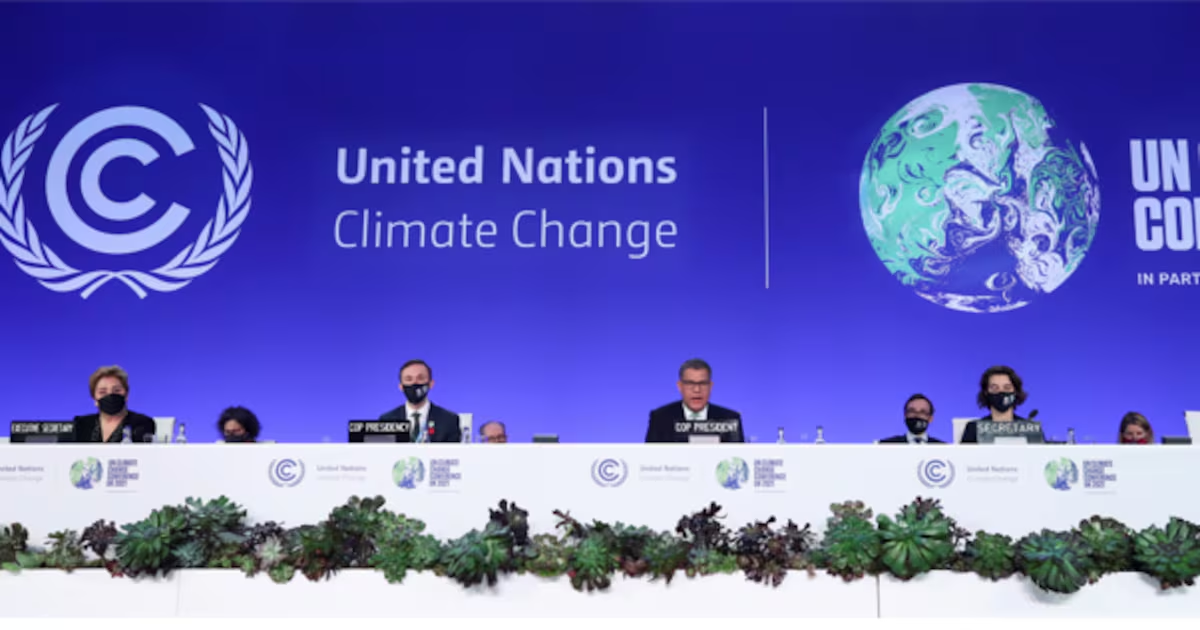
Dateline: December 6 2035 Henri, walking down Paris’s Champs-Elysees, noticed a quieter ambience than usual, a stark contrast to the once-vibrant Parisian streets. Yet another “To Let” sign hanging in a neighbourhood bistro window. This observation reflects a broader trend across Europe, where economies are grappling with an impending economic collapse. Countries such as France, Greece and Germany are facing recessions, increasing debt and widespread unemployment. A factor in this downturn is the EU’s heavy investment in climate change policies which, while morally commendable, have not mitigated climate impacts, leading to economic difficulties for member states. The EU’s approach to climate economics initially seemed rational, with early, science-backed policies like targeted carbon reductions proving cost-effective and helping to control severe temperature increases. However, the shift towards net-zero emissions and the commitment of a staggering €400-trillion since the Paris Accord 20 years ago didn’t align with pragmatic economic considerations.Studies reveal that the actual costs of these climate policies were often more than double the theoretical expenses, yielding less than 17 euro cents of economic benefit for every euro spent. The media’s portrayal of these policies mainly highlighted their benefits, creating a skewed public perception and downplaying the substantial economic costs. This led to outsized investments in areas with questionable climate impact. Audacious plans such as carbon capture, electric vehicle subsidies and advanced agritech proved grossly inefficient and ineffective. Critics have pointed out that the true costs of these climate controls over the past decade have made the negative economic fallout from Brexit look like a drop in a rapidly rising ocean. Witnessing the EU’s new “climate crisis”, the global community is rapidly switching to investing in innovative new green technologies, rather than purely curtailing carbon. The EU’s attempt to outspend rather than out-innovate in clean energy has proven unsuccessful. The question now is whether EU member states can rescue their economies and still survive to fight climate change in the future. For Henri and the planet’s sake, we hope they can! /First published in Mindbullets December 7 2023. Ready, Set, STOP! EU announces travel ban to save the climate Dateline: October 12 2035 The northern hemisphere’s record-breaking heatwaves continue to claim casualties. Many of the Pacific and Indian Ocean island states have started to call in the pledges from surrounding nations and are relocating their citizens to drier and cooler lands. Sub-Saharan Africa is battling relentless waves of drought and floods while trying to feed its ever-growing population. In Europe, climate refugees from North Africa and Asia are pouring in, sparking violent social unrest and widespread mass protests. The stage is set for drama during next week’s Council of Europe ministers meeting, scheduled to start with a social dinner hosted by the French president. One of the more controversial items on the agenda that is threatening to rip the EU apart is the “travel ban for the climate” proposal, mooted by hardliners within the EU parliament as the only way to reach the +1.5ºC climate goal. Climate scientists and the Global South (who are bearing the brunt of climate change) are supporting the proposal, while top tourism destinations are firmly against it. The concept is simple but incendiary: ban all leisure travel for the next 15 years; only allow essential work travel; move all goods traffic to trains and electric vehicle trucks, and ban all cruise ships from entering European territorial waters unless they are sail-and-solar hybrids. That it will give the Earth a chance to recover and get back into balance, all agree, but the societal cost for the developed world will be ginormous, as the economic activity pushed away will probably never return. With government overreach and the implementation of arbitrary rules and Covid-19 lockdowns still fresh in memory, EU citizens are already rebelling. They question who should approve travel requests and on what basis, and point to darker times in European history when people’s movements were controlled by the state. On the positive side are the results from France’s ban on short-haul flights that have reduced pollution and revitalised the rail travel industry, though airlines and aircraft companies’ fortunes have plunged. The media are anticipating an explosive session and we can expect to see a flurry of compromises and trade-offs coming out of the meeting. But if you’re planning the holiday of a lifetime this festive season, get ready to stop! / First published in Mindbullets October 12 2023. Despite appearances to the contrary, Futureworld cannot and does not predict the future. The Mindbullets scenarios are fictitious and designed purely to explore possible futures, and challenge and stimulate strategic thinking.
NEWS FROM THE FUTURE: Climate costs sink EU economy
Europe’s big bet on cutting carbon backfires
762 words~3 min read