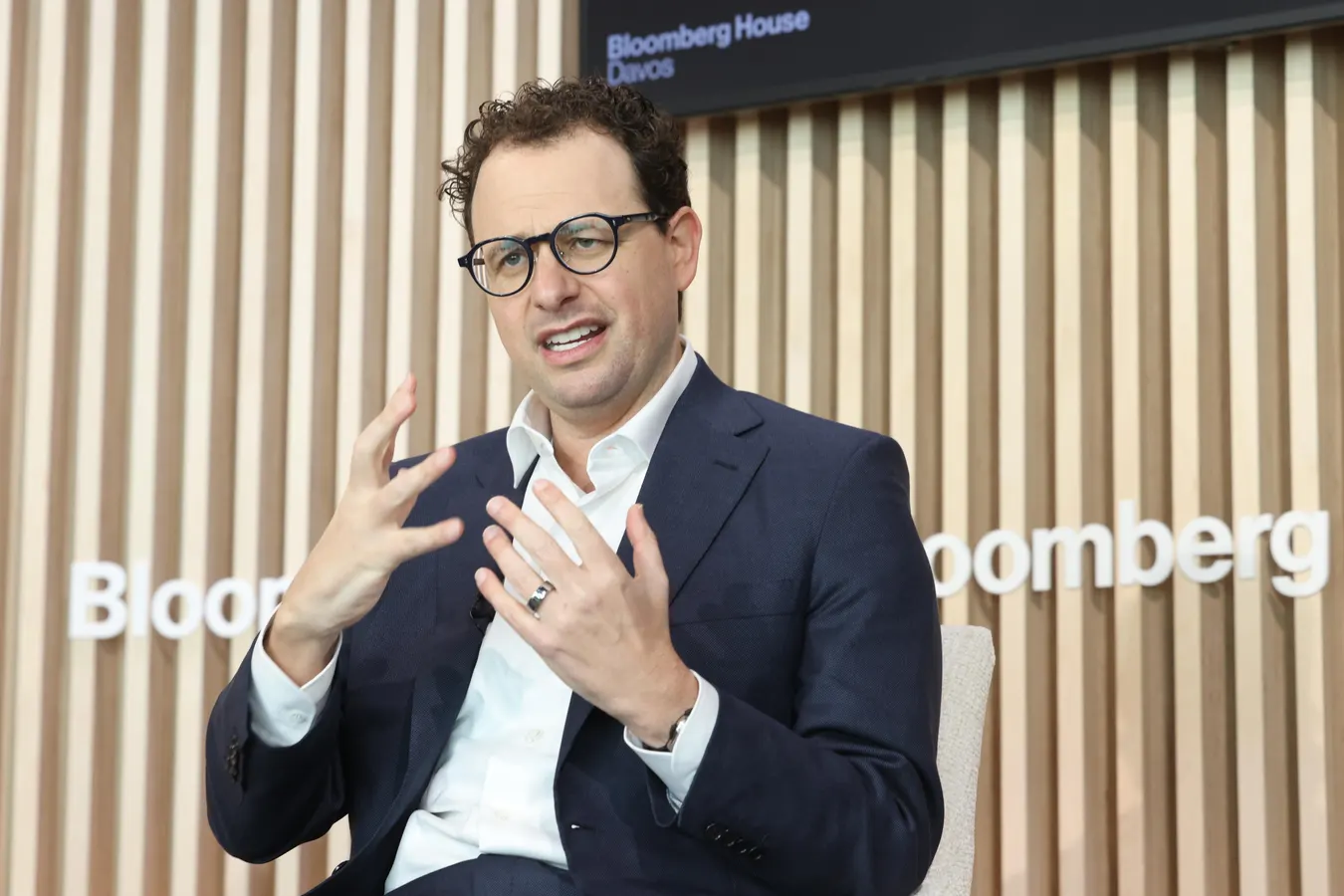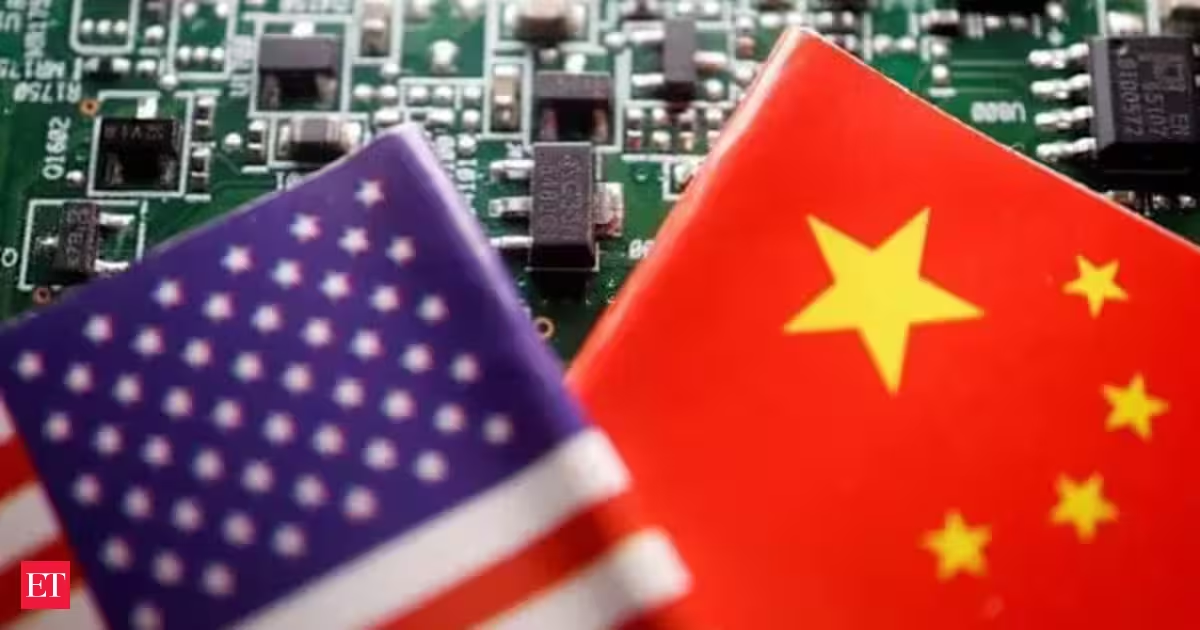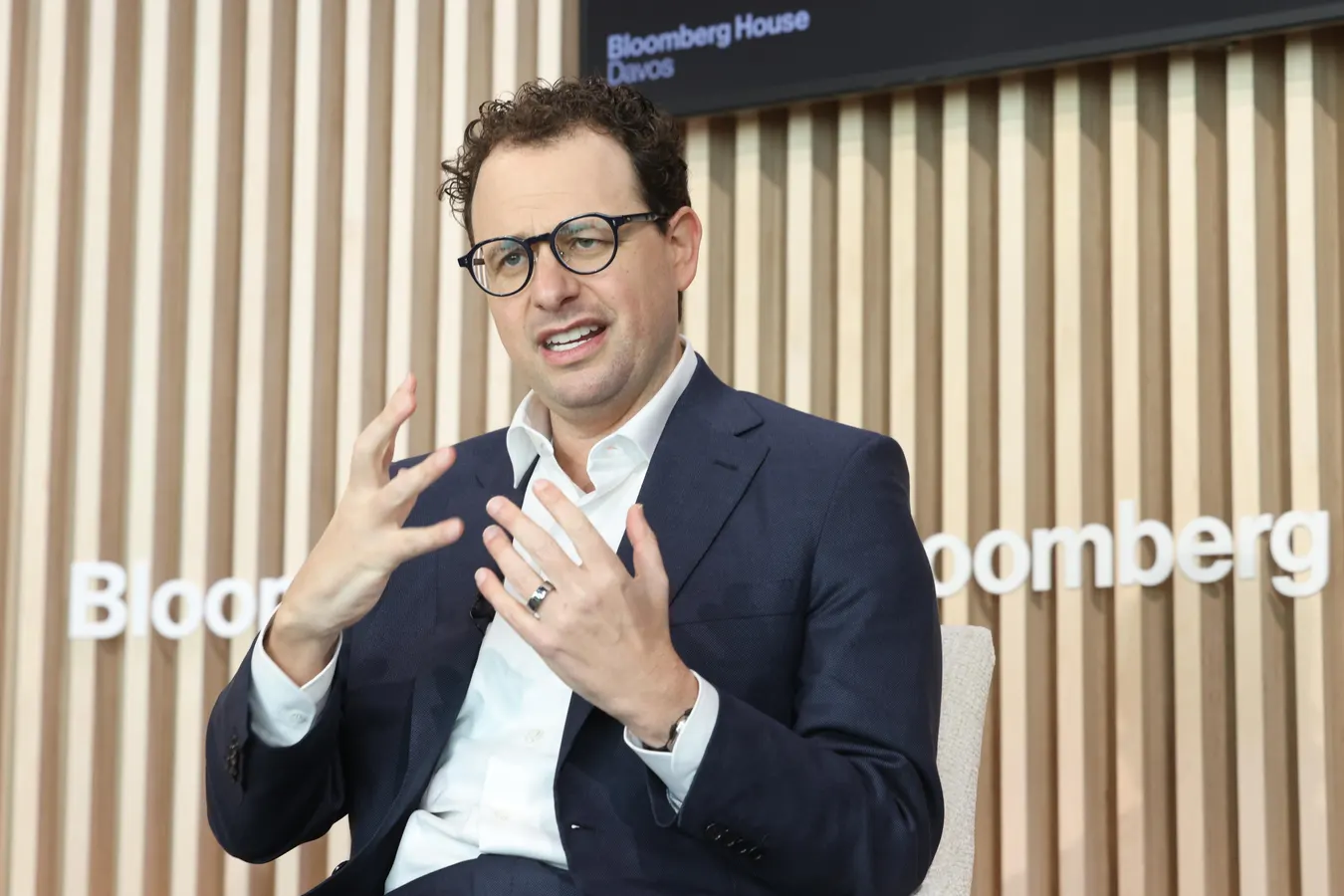
Dario Amodei, co-founder and CEO of Anthropic, which confidentially filed initial paperwork with the Securities and Exchange Commission, taking a step toward a potential initial public offering.© 2026 Bloomberg Finance LPTwo of the most influential CEOs in American technology are now publicly clashing over the single most important industrial policy question of the decade: whether restricting advanced chips to China protects America’s AI lead or accelerates Beijing’s rise. Their fight is no longer a theoretical debate. It is shaping how Washington, Wall Street and the global tech industry think about who controls the next era of compute.There is an old joke in the audit profession that the only thing more dangerous than an argument between two CEOs is an argument between two CEOs who are also business partners. We are watching that joke play out in real time.In January, at Davos, Anthropic’s CEO Dario Amodei told Bloomberg that selling Nvidia’s H200 chips to China was “a bit like selling nuclear weapons to North Korea.” Nvidia and Anthropic had announced a $10 billion partnership just two months prior. By mid-May, Jensen Huang fired back, publicly calling the analogy "stupid" and "madness." Two of the most consequential business leaders of our generation are now publicly using the words "crazy" and "stupid" about each other’s positions on the most important industrial policy question of the decade. So who has the better case?Amodei’s Case: Lock In The Lead While The Window Is OpenOn May 14, Anthropic published a policy paper titled "2028: Two scenarios for global AI leadership." It is the most comprehensive statement Amodei has published of what he hopes Washington will do to lock in America's lead at the AI frontier.MORE FOR YOUAs Anthropic views it, the most important input for frontier AI is compute. American and allied companies — Nvidia, AMD, TSMC, ASML and Samsung — have built a commanding lead in advanced chips. U.S. export controls, sustained across three administrations, have kept that lead intact.It’s indisputable that some Chinese labs have world-class software talent. DeepSeek and Qwen are genuinely impressive remain constrained by access to the highest-end chips. Anthropic’s paper argues that if the U.S. closes the smuggling loopholes that allow restricted chips to reach Chinese labs through third countries, and tightens semiconductor manufacturing equipment controls, American AI companies could lock in a "12-24 month lead" in frontier AI capabilities by 2028.Amodei’s broader framing, repeated in venue after venue, is what he calls "a country of geniuses in a data center." Imagine, he says, 100 million minds smarter than any Nobel laureate, organized inside a single national infrastructure. The question of which nation builds that infrastructure first, he argues, may shape the global order for decades.Anthropic also clearly benefits commercially from a world in which Chinese open-weight models like DeepSeek and Qwen remain compute-starved. Chinese models are dramatically cheaper to run on a per-token basis and can operate in a "forked" environment where a user can take a copy of the codebase and develop it independently from that point forward. Forking means that all the safety firewalls can be stripped out and proprietary information does not flow back to the models' inventors.Anthropic has built its enterprise franchise, running at a reported $44 billion annual revenue run rate , partly on the premise that its closed-weight, U.S.-trained models are the safer choice for regulated industries. Those financial incentives don’t necessarily make Amodei’s arguments wrong. They mean readers should view them the way they might consider a Boeing executive's views on aircraft tariffs.Huang’s Case: The Compute Is Already ThereHuang has made the opposite argument with growing intensity for more than a year.At Computex Taipei in May 2025, he called export controls "a failure" that "gave Chinese companies the spirit, the energy, and the government support to accelerate their development." At the FT Future of AI Summit in November, he told reporters that "China is going to win the AI race" — a statement Nvidia softened hours later via an official corporate post clarifying that China was merely "nanoseconds behind."Nvidia, for all its success, clearly feels pain from China export restrictions. In April, Huang told the Special Competitive Studies Project that Nvidia’s market share in China had fallen from "90-some odd percent" to zero. China contributed roughly 20% of Nvidia’s revenue at peak. Huang argues that the export-control regime did not stop China from building AI capacity. It simply transferred that chip revenue to Huawei, Cambricon and other domestic Chinese chipmakers, who now have a guaranteed home market they would not otherwise have enjoyed.On the Dwarkesh podcast, Huang even claimed that Mythos, Anthropic’s cyber-offensive model whose capabilities it considered too dangerous to release publicly before U.S. government and financial infrastructure hardened, did not require sophisticated GPUs to develop. Mythos, he said, "was trained on fairly mundane capacity, and a fairly mundane amount of it. The amount of capacity and the type of compute it was trained on is abundantly available in China." He asserted that China already has the chips required to train a frontier model and the gap between what Nvidia sells and what China can produce domestically is shrinking.Dwarkesh pressed the obvious contradiction. If Chinese chips already match Nvidia’s, what is Nvidia really being denied? And if Nvidia chips are materially better, does selling them to China accelerate exactly the capability gain Huang says is happening anyway? Huang’s answer did not entirely satisfy, and the contradiction is the soft spot in his case.Huang also has skin in the game. Nvidia wrote down billions of dollars in inventory tied to canceled China sales. Huawei projects $12 billion in AI chip revenue in 2026, a 60% jump, in a market Nvidia used to own outright. Huang was a prominent member of the U.S. CEO delegation in Beijing this month, and he publicly hopes for an H200 sales relaxation. Again, it doesn't make him wrong, but he is far from disinterested.The Other CEOs In The RoomIt is tempting to frame this as a binary argument between Amodei and Huang, but two other influential American AI CEOs disagree with both in revealing ways.Sam Altman of OpenAI has staked out a distinctly different position, less focused on restriction than on acceleration. Testifying before the Senate Commerce Committee in May 2025, he argued that the United States should “export our values” through AI rather than cede the global market to Chinese alternatives. “I think the U.S. winning the AI race is very important,” he told senators. “I think it matters a lot.” On compute controls, Altman has been notably agnostic, suggesting the smarter play is to make American AI so capable and so trusted that allied nations choose it on the merits rather than through restrictions that may simply accelerate domestic alternatives. Elon Musk has gone furthest of all. On Peter Diamandis's Moonshots podcast in January, he predicted that "based on current trends, China will far exceed the rest of the world in AI compute," because Chinese electricity output will reach roughly three times America's by year-end. "China will figure out the chips," he said.As Musk sees it, the entire chip debate is a sideshow. The binding constraint on AI is power generation, and on that variable, China is simply leapfrogging the United States. As I noted last summer, Musk has made this point for years: "China power generation looks like a rocket going to orbit and U.S. power generation is flat."Coming from the man building the largest single AI cluster on earth at X.ai’s Colossus complex in Memphis, that suggests U.S. policymakers may want to make the power supply the top priority in the AI race. The question is whether anything America does on chips matters relative to the massive buildout of China's power grid.What The Chinese Side Actually Looks LikeDeepSeek, Qwen, Kimi and a handful of other Chinese frontier labs have produced AI models that, on many published benchmarks, compete with American models at a fraction of the training cost. Chinese researchers have made genuine contributions to model architecture, distillation techniques and reinforcement learning. When I wrote about DeepSeek last summer, I came away genuinely impressed by the technical sophistication of what Chinese teams were producing.Huawei’s recent Ascend generation of chips does not equal Nvidia’s Blackwell, but it is closer than most American observers realize, and the gap has narrowed over the past 18 months.China’s policy response to U.S. export controls has been exactly what one would expect from a country that has executed five-year industrial plans for seven decades. Beijing has poured capital into domestic chip champions, accelerated wafer fab construction and turned what was originally a vulnerability into a strategic priority.Whether that response would have happened anyway is the central empirical question. Hard to know without rerunning history. What we can say with confidence is that the Chinese chip industry today is materially more capable than it was when the export-control regime began in 2022.If Huawei delivers in 2026 and 2027 anything close to what Huang predicts — chips that close 80% to 90% of the gap with Nvidia’s leading edge, manufactured at scale on Chinese soil — then Huang’s case will look prescient, and the export-control regime will look like an expensive way to subsidize Huawei’s customer base. If the Ascend program stalls in yield, in advanced packaging or in software ecosystem maturity, Amodei’s case looks stronger.And if Musk is right that the ultimate AI constraint is electrons, and not chips or algorithms, and if Chinese power generation continues to expand at three to four times the American rate, then the compute-availability question could become irrelevant. No matter what Washington does on chips, American grid investment, permitting reform and nuclear restart timelines may end up mattering more to this contest than any single Commerce Department rule.In the meantime, the chatbots themselves may be more honest than their CEOs. When I asked DeepSeek last summer whether China could catch up, it offered the answer both Amodei and Huang still avoid: "If China solves its chip problem, their scale and state power could tip the scales. But if the U.S. keeps attracting geniuses and stays ahead in AGI? Game over."Game over, but not necessarily in the way the chatbot implied. The more likely outcome is messier, more human and arguably more interesting. Two technologically sophisticated civilizations, each with genuine strengths, racing to solve the same hard problems in parallel. That race has produced some of the most consequential scientific progress of our lifetimes, and there is no particular reason it has to stop. The CEOs are arguing about the rules. The rest of us will get to use whatever they build.
How The US-China Chip Standoff Will Shape The AI Race
America’s AI leaders clash over whether chip export controls secure a U.S. edge or speed China’s rise, shaping the future of compute, power and global tech policy.
TL;DRAI
Anthropic CEO Amodei and Nvidia CEO Huang clash: export controls preserve US 12-24 month AI lead by 2028 or shift production to China. The dispute shapes Washington's compute policy and AI dominance, impacting every tech executive's infrastructure budget strategy.
1,757 words~8 min read