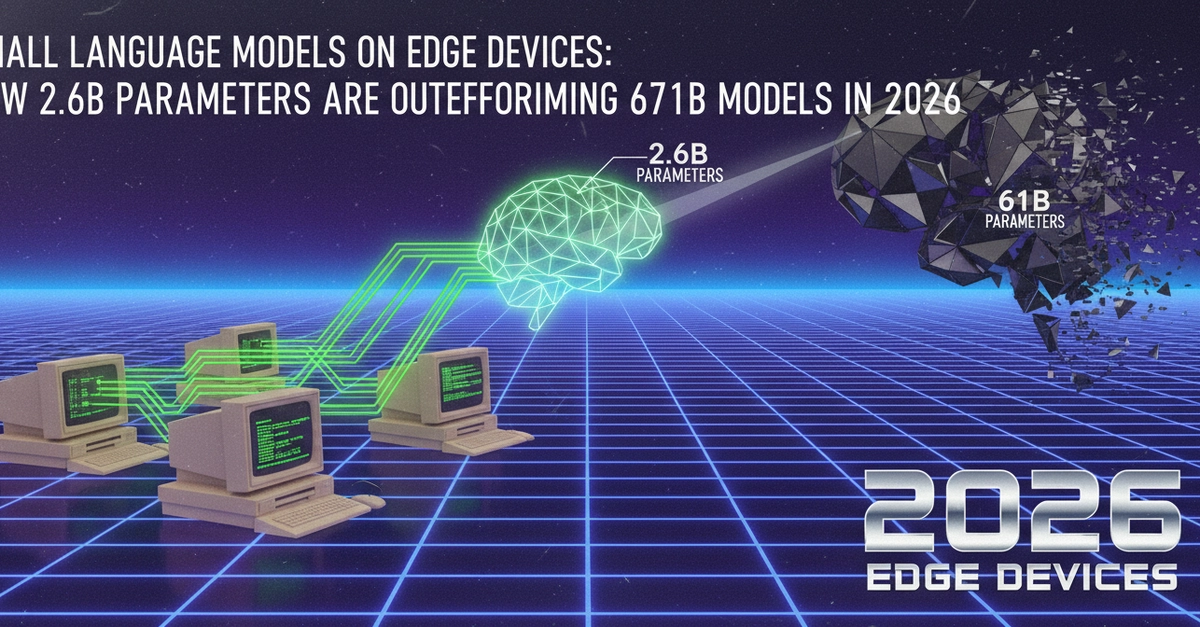
In 2026, a 2.6-billion-parameter model just beat a 671-billion-parameter system on domain-specific reasoning benchmarks — and the implications for enterprise AI are staggering.
The Number That Stopped the AI Industry in Its Tracks
Here is the claim that went viral across Reddit's r/LocalLLaMA and r/AISEOInsider in early 2026: a carefully fine-tuned small language model (SLM) with roughly 2.6 billion effective parameters outperformed DeepSeek-R1's full 671B-parameter Mixture-of-Experts architecture on targeted enterprise reasoning tasks. The post accumulated thousands of upvotes, sparked heated debates, and forced a reconsideration of the prevailing assumption that bigger models always win.
This was not a fluke or a cherry-picked result. It was the culmination of a multi-year trend that has been quietly reshaping the AI landscape. Microsoft's Phi-4-Reasoning, a 14B-parameter model, has demonstrated the ability to outperform models fifty times its size on Olympiad-grade mathematics. Google's Gemma 4 E4B, with just 4.5 billion effective parameters, achieves a 69.4% score on MMLU-Pro — a benchmark where models ten times larger struggled just two years ago. Alibaba's Qwen3-4B rivals the performance of Qwen2.5-72B, a model eighteen times its size.