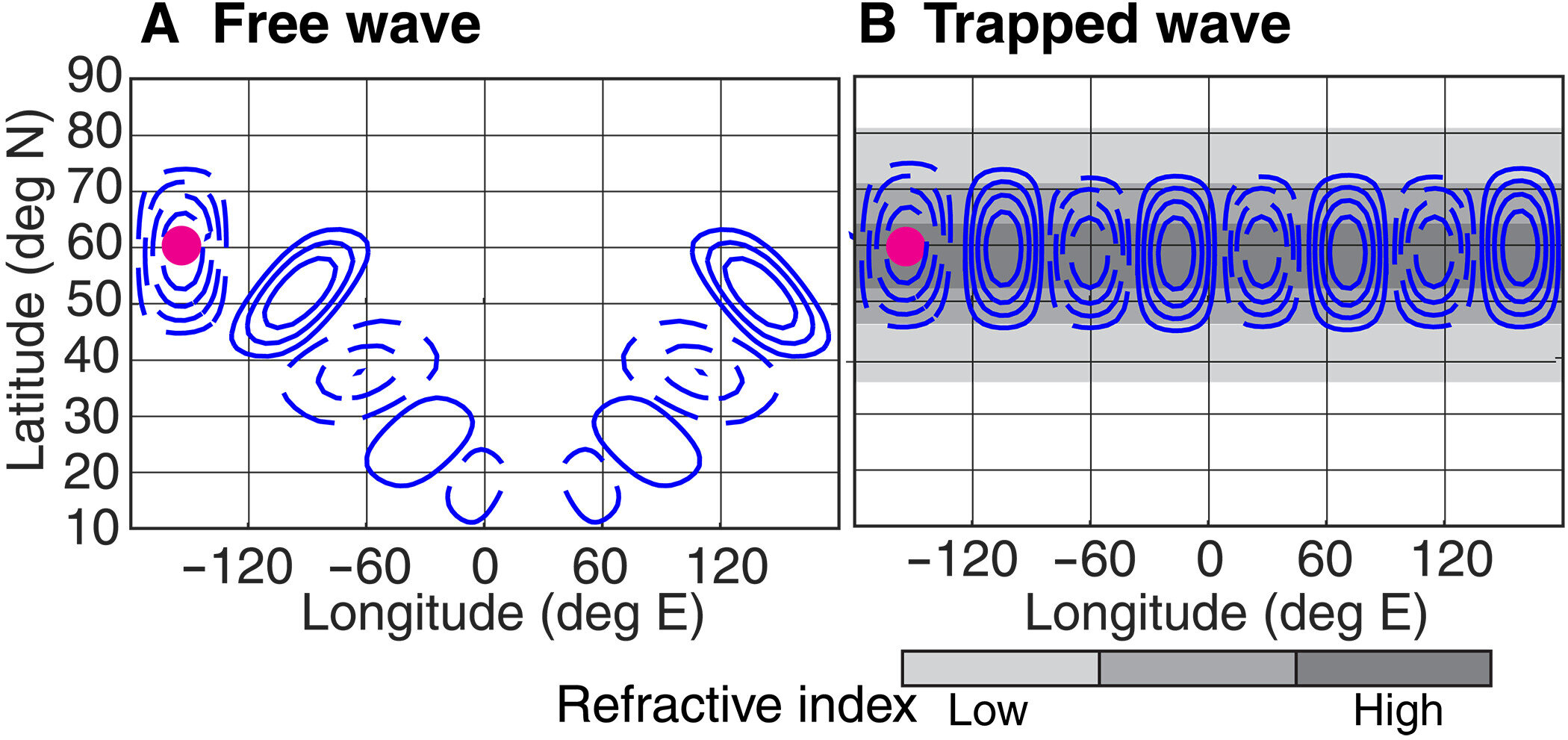
Free and trapped quasistationary Rossby waves. Credit: Science Advances (2026). DOI: 10.1126/sciadv.adp3054
Across much of the northern hemisphere, extreme weather events like heat waves and heavy precipitation have increased in frequency and severity over the last several decades. A new study from the Harvard John A. Paulson School of Engineering and Applied Sciences (SEAS) shows that one proposed partial explanation, so-called "quasiresonant amplification of quasistationary Rossby waves," may not be capable of explaining any of this increase in severe weather events.
New study questions leading theory
The study, published in Science Advances and co-authored by Assistant Professor of Environmental Science and Engineering Marianna Linz and research associate Todd Mooring, calls for greater caution in how certain types of atmospheric dynamics are interpreted.
Rossby waves are large-scale wiggles in the jet stream—the fast-flowing air in the upper atmosphere that acts as a boundary between cold polar air and warm tropical air. If a Rossby wave stalls in the right place, it can contribute to an extreme weather event, like a heat wave. The Harvard team set out to test a specific theory of how these large, stationary waves arise.