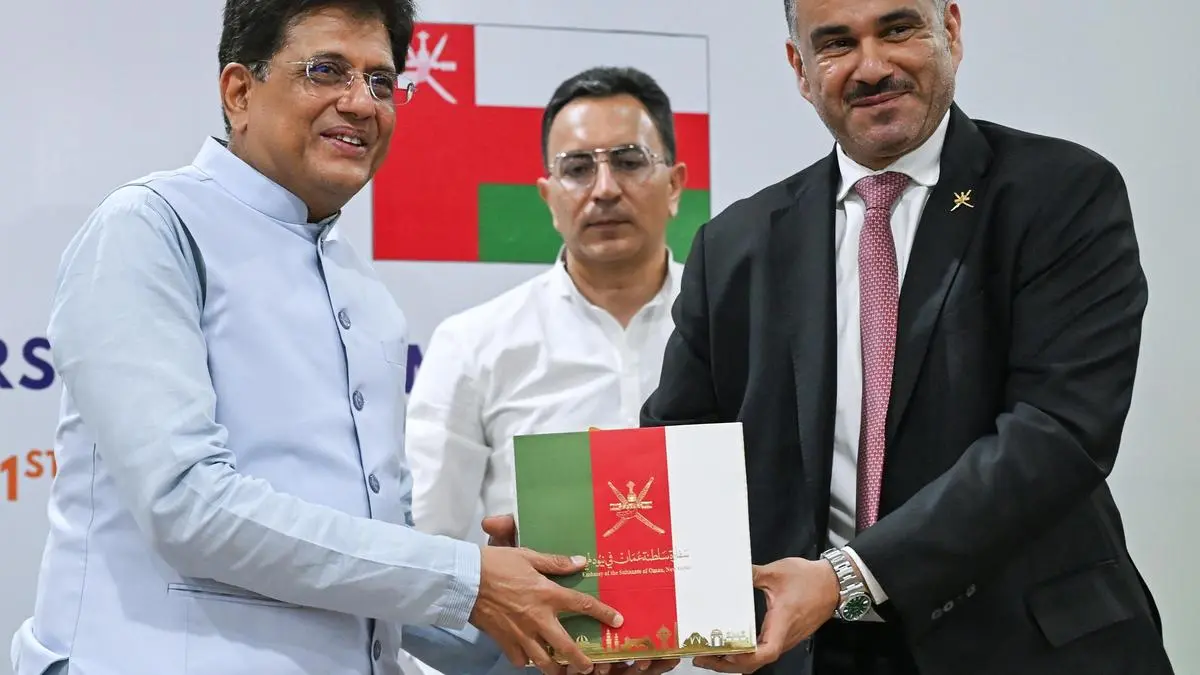
Union Commerce and Industry Minister Piyush Goyal and the ambassador of Oman to India Issa Saleh Abdullah Alshibani during the India-Oman Comprehensive Economic Partnership Agreement, in New Delhi on Monday
| Photo Credit:
The India-Oman comprehensive economic partnership agreement (CEPA) came into force on Monday providing duty-free access to 98 per cent of Indian tariff lines, covering about 99 per cent of the country’s exports including textiles, gems & jewellery, engineering goods, agriculture and marine products and pharmaceuticals.Oman gained from tariff elimination or reduction on 78 per cent of its tariff lines and is set to benefit in sectors such as energy, fertilisers, and industrial raw materials. Indian consumers are also set to get cheaper Omani dates as imports of the fruit will enjoy quota-based duty concessions under the agreement.“With 99.38 per cent of India’s exports receiving duty-free access, the agreement unlocks new opportunities for our exporters and professionals to gain opportunities. Oman is our trusted partner, a bridge for our people and a gateway to the Gulf and East Africa,” Commerce and Industry Minister Piyush Goyal said on Monday .High ExemptionIndian exports to Oman totaled about $4 billion in fiscal 2026, led by refined petroleum products such as petrol ($781 million) and naphtha ($746 million), followed by calcined alumina ($277 million), iron and steel products ($230 million), machinery ($178 million), and rice ($167 million), per a report by research body GTRI. “Although more than 80 per cent of Indian exports already entered Oman at relatively low average tariffs of around 5 per cent, duties on certain products reached as high as 100 per cent. Their elimination is expected to improve the competitiveness of Indian goods in the Omani market, though export growth will inevitably be constrained by the country’s relatively small population and market size,” the GTRI report noted.Beneficiary SectorsBilateral trade between India and Oman reached $11.18 billion in FY26, up from $ 10.61 billion the previous fiscal.The agreement is expected to significantly boost MSMEs, manufacturing and employment by enhancing competitiveness in labour-intensive sectors such as gems and jewellery, textiles, leather, footwear, marine products, engineering goods, processed foods and pharmaceuticals, the Minister said. Many of these labour-intensive goods were earlier facing 5 per cent duty in Oman.Oman’s strategic logistics hubs at Sohar, Duqm and Salalah provide Indian exporters enhanced access to wider GCC and East African markets.Published on June 1, 2026