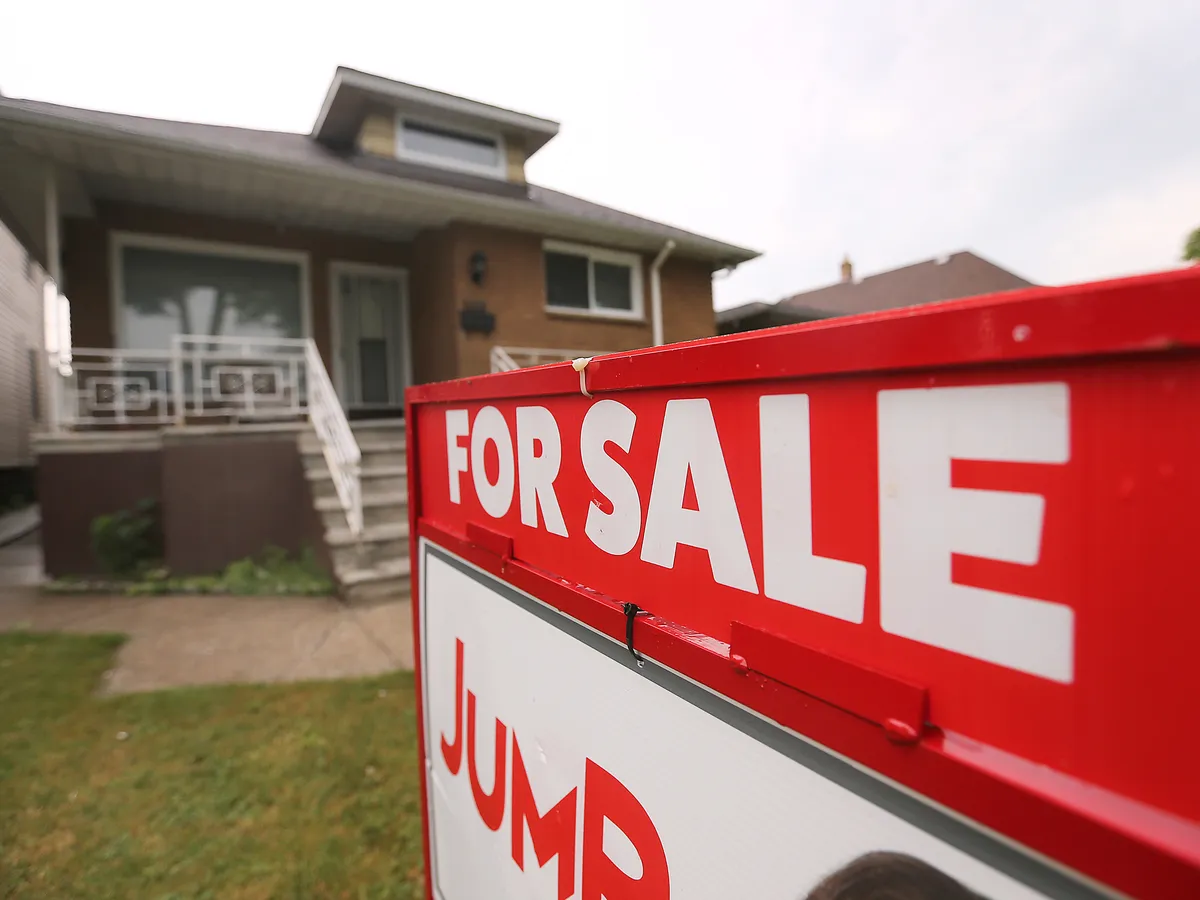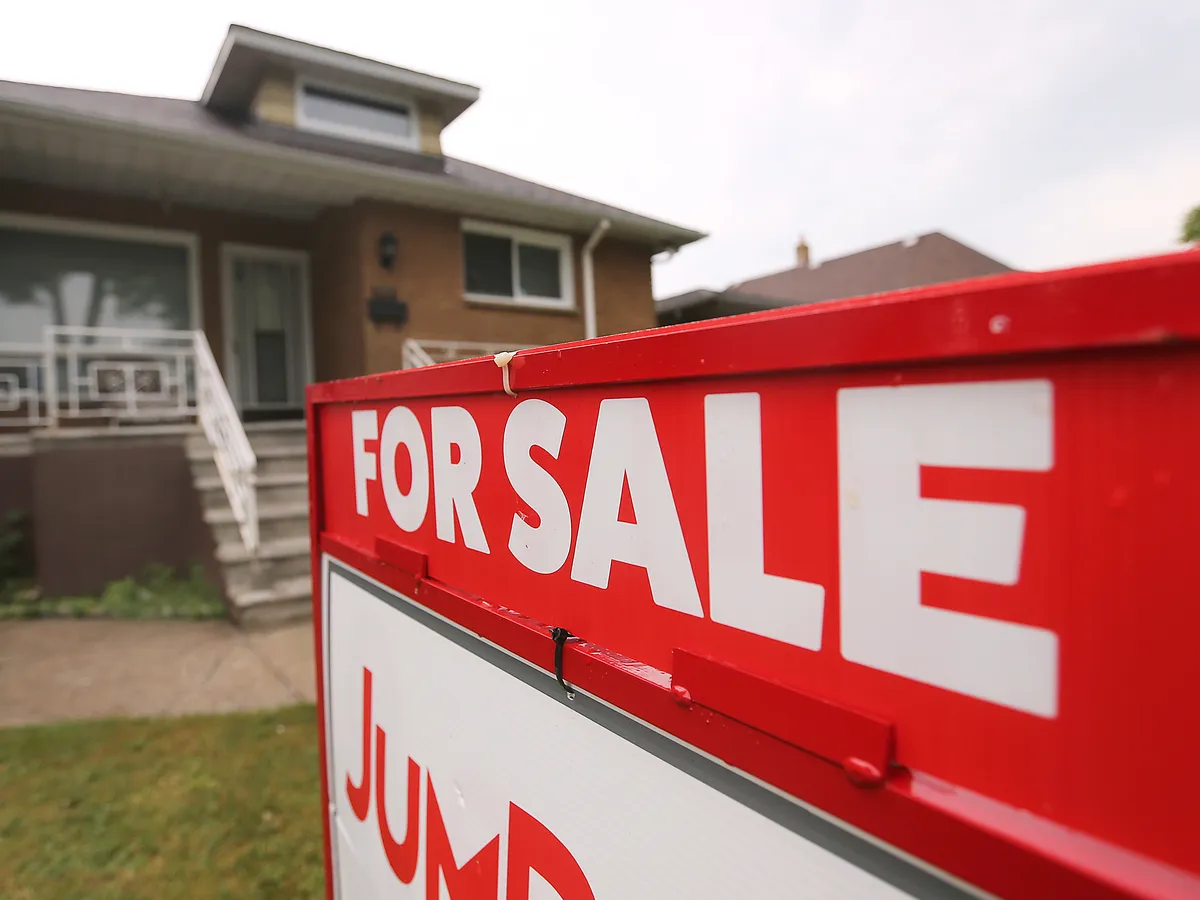
Skip to Content News Archives Economy Energy Oil & Gas Renewables Electric Vehicles Mining Commodities Agriculture Real Estate Mortgages Mortgage Rates Finance Banking Insurance Fintech Cryptocurrency Work Wealth Smart Money Wealth Management Investor Personal Finance Family Finance Retirement Taxes High Net Worth FP Comment Executive Women Puzzmo Newsletters Financial Times Business Essentials More Innovation Information Technology FP500 Podcasts Small Business Lives Told Tails Told Shopping Financial Post Store Obituaries Place a Notice Advertising Advertising With Us Advertising Solutions Postmedia Ad Manager Sponsorship Requests Classifieds Place a Classifieds ad Working Profile Settings My Subscriptions Saved Articles My Offers Newsletters Customer Service FAQ News Economy Energy Mining Real Estate Finance Work Wealth Investor FP Comment Executive Women Puzzmo Newsletters Financial Times Business Essentials HomeReal EstateA 20% housing drop still leaves Canadians locked outAbout 55% of Canadians want home prices to fall furtherAuthor of the article:Last updated 1 hour ago You can save this article by registering for free here. Or sign-in if you have an account.A for sale sign is shown on a house on Howard Avenue in Windsor on July 9, 2025. Photo by WINDSOR STAR - DAN JANISSECanada’s housing market has plunged into one of its sharpest-ever corrections. Canadians say it hasn’t gone far enough.Subscribe now to read the latest news in your city and across Canada.Exclusive articles from Barbara Shecter, Joe O'Connor, Gabriel Friedman, and others.Daily content from Financial Times, the world's leading global business publication.Unlimited online access to read articles from Financial Post, National Post and 15 news sites across Canada with one account.National Post ePaper, an electronic replica of the print edition to view on any device, share and comment on.Daily puzzles, including the New York Times Crossword.Subscribe now to read the latest news in your city and across Canada.Exclusive articles from Barbara Shecter, Joe O'Connor, Gabriel Friedman and others.Daily content from Financial Times, the world's leading global business publication.Unlimited online access to read articles from Financial Post, National Post and 15 news sites across Canada with one account.National Post ePaper, an electronic replica of the print edition to view on any device, share and comment on.Daily puzzles, including the New York Times Crossword.Create an account or sign in to continue with your reading experience.Access articles from across Canada with one account.Share your thoughts and join the conversation in the comments.Enjoy additional articles per month.Get email updates from your favourite authors.Create an account or sign in to continue with your reading experience.Access articles from across Canada with one accountShare your thoughts and join the conversation in the commentsEnjoy additional articles per monthGet email updates from your favourite authorsSign In or Create an AccountorAfter a record surge in home prices following the COVID-19 pandemic, slower population growth and increased supply in some communities have triggered a steep reversal. Benchmark prices have fallen by about 20 per cent nationally since 2022, and more than 30 per cent in some cities.That should be welcome news for first-time buyers – but the pullback still isn’t enough to change the equation for many residents who have long been priced out.Get the latest headlines, breaking news and columns.By signing up you consent to receive the above newsletter from Postmedia Network Inc.A welcome email is on its way. If you don't see it, please check your junk folder.The next issue of Top Stories will soon be in your inbox.We encountered an issue signing you up. Please try againAbout 55 per cent of Canadians want home prices to fall further, with that figure jumping to 69 per cent among 18- to 34-year-olds, according to a Nanos Research Group poll for Bloomberg News.Even among homeowners, two-thirds told Nanos the price decline to date was a positive or somewhat positive development for the housing market. That was roughly the same as the overall response among Canadians.“If you just look at the numbers, you would very quickly conclude this is a massive crash in home prices. But the thing is, it’s after prices had increased even more,” said Robert Hogue, assistant chief economist at Royal Bank of Canada. “We’re just reversing what some would argue — and I would argue — were excessive price increases.”While the stepback in home prices may have taken some pressure off of government, it’s far from enough for Prime Minister Mark Carney to declare victory against eroded housing affordability.The market is only back to where it was just before the COVID-19 pandemic, when housing affordability was already broadly viewed as a national crisis, said Mike Moffatt, who leads the University of Ottawa’s Missing Middle Initiative, which seeks to revive Canada’s urban middle class.“I think it just shows how far out of whack prices are with incomes that prices can go down 15 per cent to 20 per cent and it’s still priced out middle-class families,” he said.Affordability improvements have been lopsided across Canada, with only half of markets still on an easing trajectory in the second half of 2025, according to RBC. Home prices have fallen the most in British Columbia and Ontario, regions that saw the largest increases in prices following the pandemic.Even so, homes in major metropolitan centres in those provinces remain exorbitantly expensive, with the share of household income needed to cover housing costs at 88 per cent in Vancouver and 63 per cent in Toronto.First-time buyers are more hesitant to jump into the real estate market than they were a few years ago, said Toronto real estate agent Alexis D’Souza.“The questions I get now from first-time homebuyers are very much about, ‘How do you see this going in the next couple of years? Do you see a further decline?’” D’Souza said.Their hesitation is understandable to D’Souza, who leaped into the housing market with her partner in 2022. They’ve since seen the value of their condo in the city’s popular Liberty Village neighbourhood decline.First-time buyers also aren’t finding what they’re looking for. Despite record inventory of condominiums, most units don’t fit their criteria, D’Souza said. Single-family homes have been selling faster, though at price points many new buyers can’t afford.“Even though there’s a lot of supply, it’s not good supply,” she said.The conundrum reflects the complicated reality of improved affordability in Canada’s housing market.A recent Canada Mortgage and Housing Corp. report suggested the country has made some progress in growing housing supply, with starts rising six per cent in 2025.But it warned of “major vulnerabilities,” noting “rising unsold inventories suggest today’s supply may not align well with buyers’ needs.” That’s particularly a problem in Toronto and Vancouver.The report noted that supply of family-sized homes intended for ownership is falling short, with starts well below historical averages in key cities like Toronto, Montreal, Vancouver and Ottawa.Moffatt said part of the problem is that governments have now become too fixated on boosting supply.“They’re so focused on the quantity of homes,” Moffatt said. “I think what ultimately matters is: What are the prices and rents of homes? What are those homes? Where are they located?”The rental market has also loosened, with asking rents falling 3.2 per cent nationally between 2024 and 2025. Slower demand and increased supply have nudged the rental vacancy rate to three per cent this year, marking the threshold for a balanced market, according to RBC.The combination of falling home prices, slower rent increases and relatively low interest rates pushed shelter inflation to its lowest level in five years, increasing at a slower rate than Canada’s two per cent inflation target. Yet pressure on governments has hardly faded.A recent Abacus poll shows only 17 per cent of Canadians believe the federal government is doing enough to address homeownership affordability, while 59 per cent said it was important for governments to take action to improve affordability for the next generation of homebuyers.Housing affordability took centre stage in Canadian politics in the aftermath of the COVID-19 pandemic, as governments pledged to make homebuilding cheaper and less onerous. The U.S. trade war has since sapped attention, but recent policy announcements show governments still see a need to increase supply.In March, the federal and Ontario governments agreed to lift the sales tax on new homes sold for up to $1 million for all buyers, going further than Ottawa’s initial rebate, which only applies for first-time buyers. Carney and Ontario Premier Doug Ford also announced an agreement to slash development charges — which are levied by municipalities to pay for infrastructure — by up to 50 per cent for three years.The measures will help Canada avoid a “huge air pocket coming out of the construction pipeline down the road,” when population growth eventually rebounds and pushes up demand again, said RBC’s Hogue.But if governments want higher rates of home construction, they’ll need to make the math work so that developers are incentivized to build and cities are able to cover their costs.“These are temporary measures and they don’t really create any kind of long-term structural reform,” Moffatt said. “But what they do is they buy governments time to work on those reforms, figure out how we can build infrastructure and not load all of it onto development charges.”With assistance from Curtis Heinzl Join the Conversation This website uses cookies to personalize your content (including ads), and allows us to analyze our traffic. Read more about cookies here. By continuing to use our site, you agree to our Terms of Use and Privacy Policy.
A 20% housing drop still leaves Canadians locked out
Canada’s housing market has plunged into one of its sharpest-ever corrections. Canadians say it hasn’t gone far enough. Read more.
1,548 words~7 min read