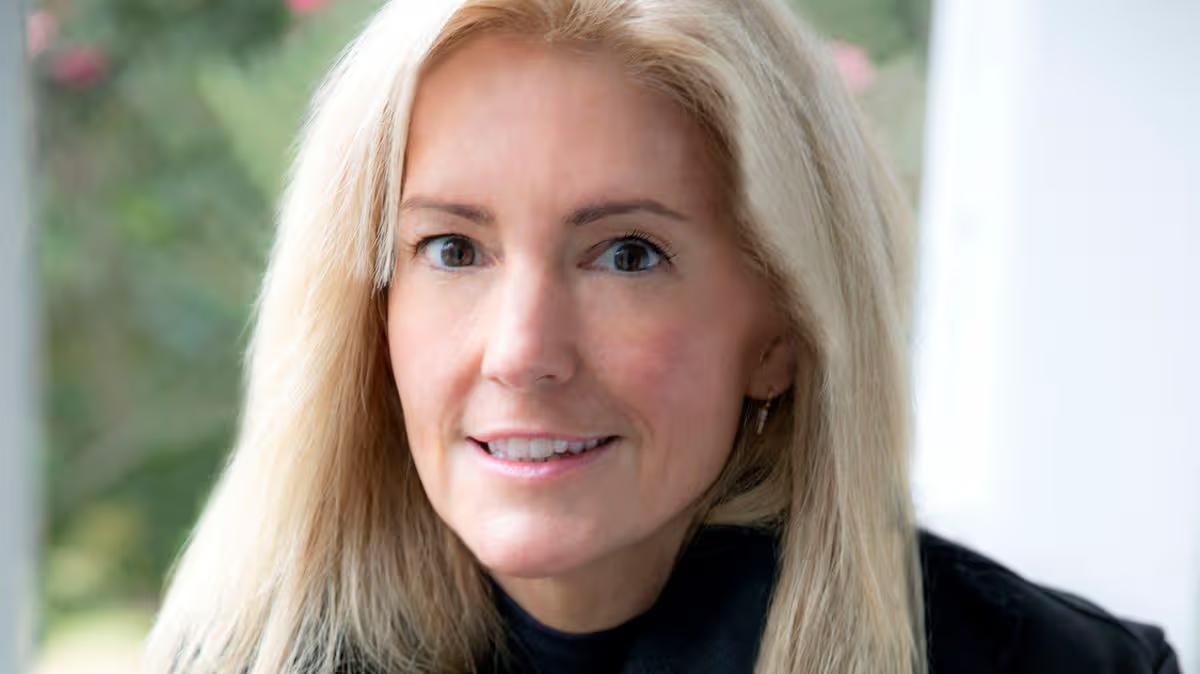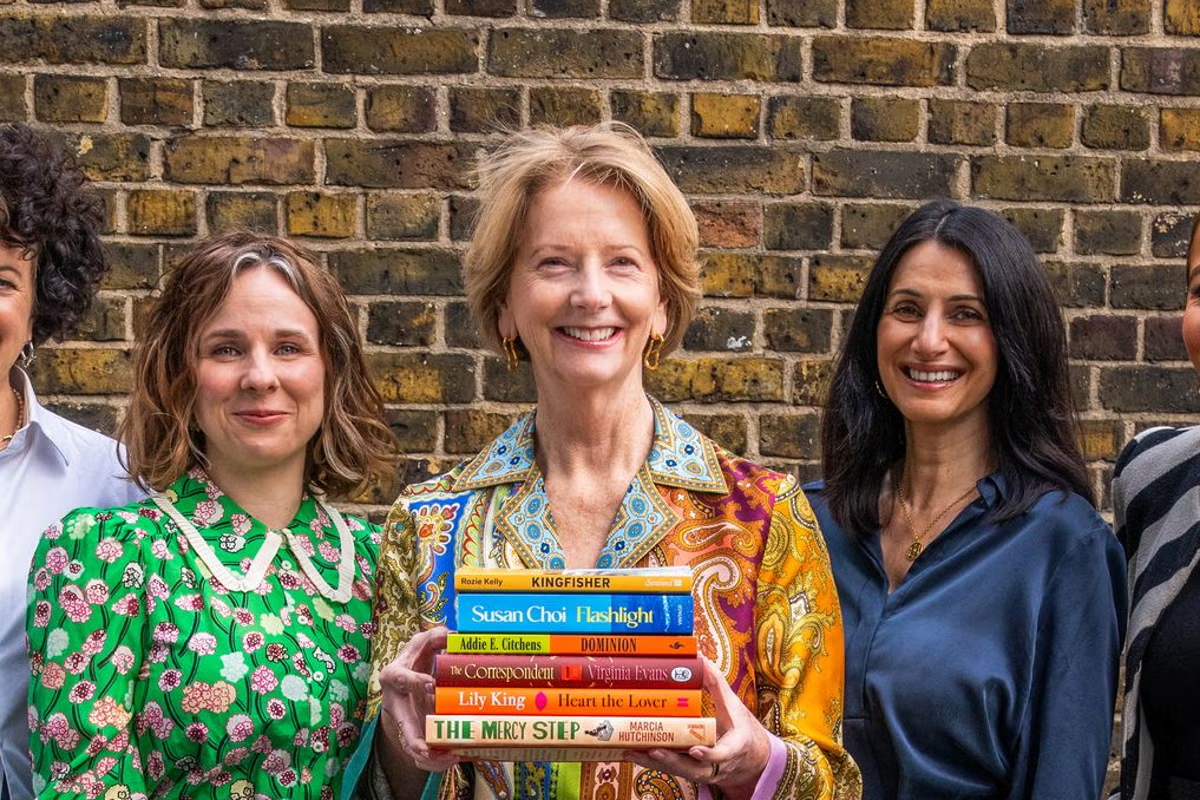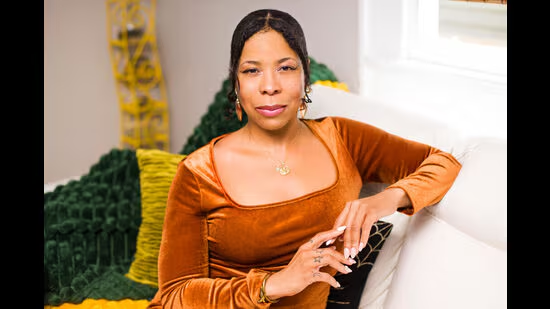
How did you structure the novel, with its notes from the Minister’s Desk, two dominant voices, and interludes?Author Addie E Citchens (Courtesy Britt Smith Photography)I just let the story come out like it wanted, refusing to make it bend to my will to write a more traditional narrative. The minister’s notes come from the types of programs that were used in the old, rural churches I grew up in. I always knew I would use them in some way in my work, and with the novel being set mostly in church, I thought these programs would be a natural and titillating fit as chapter headers.Was Dominion aimed at centring how religious institutions disenfranchises one gender? What were your personal experiences of this?Absolutely, I wanted the story to illustrate how, under patriarchal entities like Abrahamic religion, the marginalised are forced to vie for their oppression. I had a strict Baptist upbringing, and where I am from, congregations were mostly composed of women, while pulpits were exclusively male.When it came to labour, women decorated, cooked for funerals, wrangled children, and well, men, they were available for when doctrine was explained, not actually enacted with integrity and humility.There’s a marked difference in the voices of Diamond and Priscilla. Their interiority is revealed in their unique language, and in how they mould it in the face of events, even as they keep up appearances and perform for others?Both these characters are similar to people with whom I am intimately familiar. Otherwise, I really don’t know that I did any special tricks to keep the voices distinct; I will say, in regard to their portions of the text, it felt less like I was writing their voices and more like I was channelling them.The central characters in the book carry a lot of internalised shame. Would you agree?I do agree that shame is a big part of who the characters are, as it was socialised into all women who grew up as I did. I often say that in my community, men and boys are handed power while girls are handed shame and responsibility. Not only were we taught shame as a general practice for ourselves, but the onus of the prevention of being also victimised fell on us, so that one might carry shame for everything that ever happened to them.In the novel, in addition to the shame gifted to her, Priscilla carries shame based on her physical affliction and the fact she can’t keep her husband from being unfaithful. Diamond carries shame due to growing up a poor orphan. Both see the stability of a relationship with the right kind of man as antidote to shame, and because of the benefits of proximity to these men, the validation of being possessed by them, these women are willing to overlook a lot of evil.“I knew hunger so deep that it was like a friend”, Diamond says. Hunger here has several connotations. Please talk about how hunger informs decision-making, and how those decisions are a result of structural violence, which is never addressed? Hunger, in this novel, most often shows up as yearning. As much as each character expresses, or ignores, that longing, it shows up in their actions. The novel is just a bunch of characters chasing unmet and undisclosed needs, and as most often is the case in fiction and in life, what fuels these hungers is moot. Most of us aren’t grappling with the source of what informs us in the moment; in the moment, all we know is to act.Diamond seems to understand “snap” both as a literal thing — for example, People rarely just snap and do crazy shit — and as a feminist approach, too, as noted by Sara Ahmed in The Killjoy Feminist: A Handbook where she reflects how a feminist snap is both an inflexion point and an act of liberation. It’s something Diamond demonstrates towards the end. At some points in the story, I got exasperated with Diamond’s inability to see what she’s looking at. But I have to realise she is a young girl, who is making decisions from a very limited world view. She’s also evolving in real time, coming to a wholeness of self most of the adult women in the story never achieve.Diamond’s “snap” pivots her away from acting only out of her original yearnings to belong to somebody to the desire to establish and maintain her own autonomy, ie belong to herself.Please talk about the influence of William Faulkner’s As I Lay Dying on Dominion.As I Lay Dying is harrowing, hilarious, and absurd. It trips through time, and it’s one of those novels that’s as Mississippi as Mississippi itself. Dominion is also that. And with anything that so closely follows the fleshy identity of place, especially somewhere like Mississippi that’s often so misaligned and misunderstood, it can be especially polarising, but also intriguing. I don’t regret the associations of Dominion with As I Lay Dying.In an interview, you mentioned that you play a song on repeat while writing a particular story. What were you playing while writing Dominion?The theme music for this work is a song called Seven Seals by the Pattersonaires, a gospel group from Memphis, Tennessee. It is a jauntily-performed but rather melancholic rundown of the unworthiness of humans. I always knew I would use it in some writing, and I thought it would be perfect to illustrate the hypocrisies evident in the Seven Seals Church of Dominion, so much so that I wrote the song into the novel. I still love the song and will probably use it again in a more esoteric way in another story.When the book ends, the reader is struck by how society valorises “bright young men” even though their actions have an adverse impact. The idiom “Boys will be boys” has always irritated me, as it gives boys carte-blanche for bad behaviour, long after actual boyhood is over. It means boys will be boys, while the rest of us be damned and is reflected in all the things men do without thought to whether that action is logical, dangerous, or catastrophic, and ranges from pranks to warfare.We are so conditioned to excuse this behaviour. If we really deconstructed the patriarchy, we would see how much of a sham it is. We would have to examine the actions of our fathers and husbands and sons in light of this, and we would have to examine the ways we, as marginalised genders uphold patriarchal notions, even to our detriment. We would have to change our hearts and minds and act accordingly. All that said, there have always been those of us who care, who fight, who pushback, and who educate others to pushback. That number is always growing.Saurabh Sharma is a Delhi-based writer and freelance journalist. They can be found on Instagram/X: @writerly_life.
Addie E Citchens: “Boys are handed power while girls are handed shame”
The PEN/Faulkner Award finalist whose Dominion has been shortlisted for the Women’s Prize for Fiction on organised religion, gender, evil, and hunger
1,138 words~5 min read