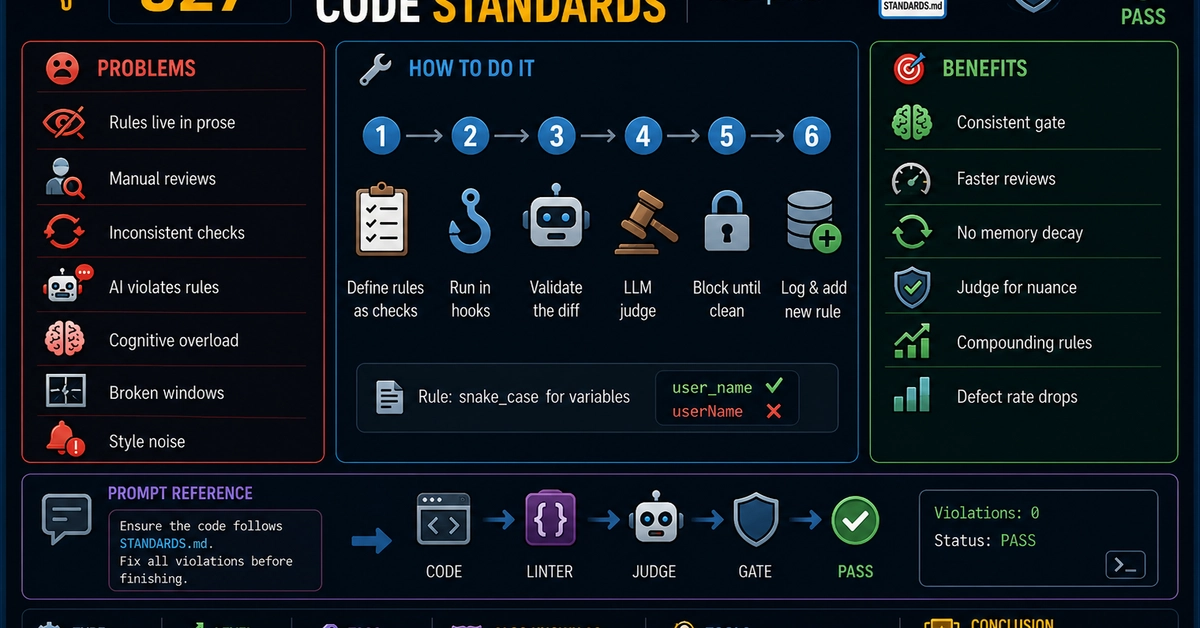
Why I stopped telling my coding agent the domain language and started enforcing it.
I wrote my coding agent's rules for the project's terminology as prose on April 24. I wrote a script to check those rules on May 2. The first run found 737 violations, in a codebase of roughly 150,000 lines that the agent had written under my direction and that I had, ostensibly, been keeping consistent the whole way.
It's worth being precise about what those 737 were, because the easy reading (the agent ignored my rules) is wrong, and the real story is more useful. I'd adopted a spec-driven way of working. When the domain language needed sharpening, a rename began in the glossary, with the old term retired and the new one defined; from there it flowed into spec amendments, and only then reached the code. Each rename was supposed to be total. None of them was. A rename propagates cleanly through the parts a compiler can see, and leaves a residue everywhere it can't: a directory still named after the old concept, a string in the frontend, a term in a comment, and often enough in the specs themselves, even though the specs are far smaller than the code and were being actively rewritten as part of the rename. I kept catching that residue by eye, one piece at a time, with the uneasy sense that I was only seeing a fraction of it. The 737 was the first time I built something that could count the rest. The rules in the file weren't wrong, and weren't being defied. They just couldn't see the artifacts they governed: not the code, and not even the specs being rewritten right alongside it. A sentence in a markdown file is a wish. The check was the first thing in the project that could tell me how far the wish was from true.