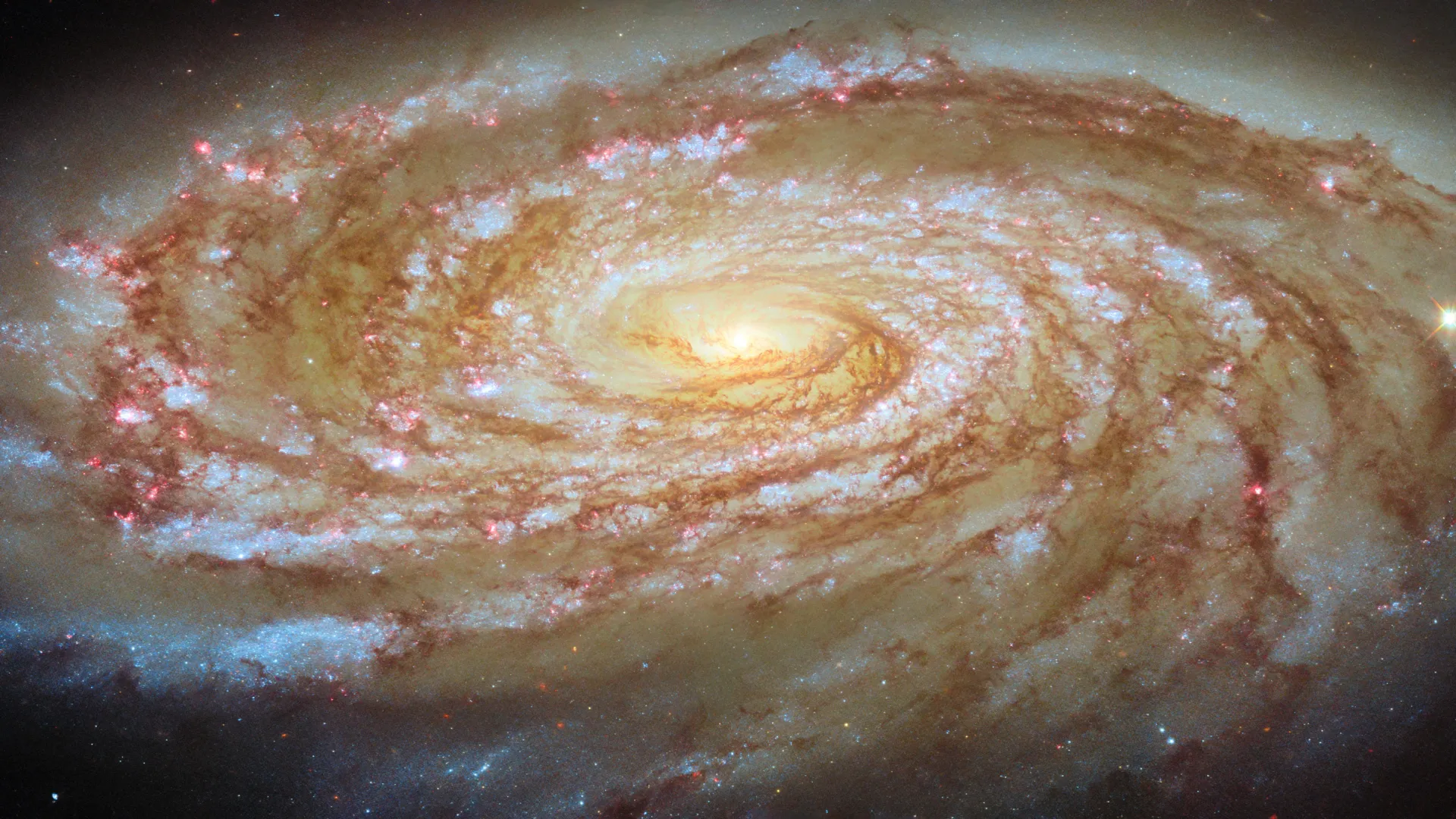
A striking new image from the NASA/ESA Hubble Space Telescope highlights Messier 88 (M88), a spiral galaxy embarking on a journey that will unfold over hundreds of millions of years. Also known as NGC 4501, M88 lies about 63 million light-years from Earth in the constellation Coma Berenices (Berenice's Hair).
M88 is classified as an active galaxy because a supermassive black hole at its center is actively consuming gas and dust. Scientists estimate that this black hole contains roughly 100 million times the mass of the Sun. As it feeds, it appears to drive streams of gas outward from the galaxy's core.
Surrounding the black hole is a dense population of older, reddish stars that create the galaxy's warm central glow. Extending outward are several tightly wrapped spiral arms arranged in a remarkably symmetrical pattern. These arms are lined with bright pink and blue star clusters as well as dense clouds of dust. Because M88 is viewed at an angle from Earth, the galaxy appears stretched out, with its spiral structure gracefully spreading across space.
M88's Journey Through the Virgo Cluster
M88 is part of the Virgo Cluster, a vast collection of more than a thousand galaxies bound together by gravity. Within this enormous cosmic gathering, galaxies are constantly moving as they orbit the cluster's center of mass.