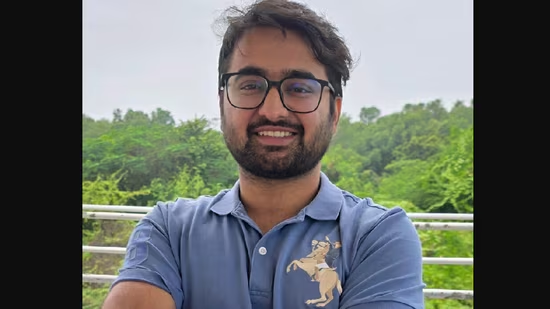
Most people associate entrepreneurship with fundraising announcements, product launches, rapid growth, and the occasional story of failure. What often goes unnoticed is the emotional weight founders carry every single day. Behind the confident presentations, optimistic team meetings, and ambitious goals lies a constant mental balancing act. Recently, Gurgaon-based entrepreneur Jasveer Singh opened up about this lesser-known side of startup life, describing the psychological contradiction founders must learn to live with if they want their companies and teams to keep moving forward.Jasveer Singh, CEO and co-founder of Knot Dating, took to X to share what he believes is one of the least discussed aspects of being a founder. According to Singh, the toughest challenge is not fundraising, hiring, firing employees, or even dealing with failure. Instead, it is the daily responsibility of carrying uncertainty while projecting confidence.He explained that founders often do not have the luxury of complete emotional transparency. Even on their worst days, they are expected to appear composed. Even when things are going wrong behind the scenes, they need to remain calm. And even when fear exists, they must look certain. As Singh put it, leadership is “contagious.” The mood and confidence of a founder often spread throughout the organisation.Why founders carry their emotions quietly?Singh argued that when leaders appear uncertain, teams naturally slow down. When leaders seem exhausted, motivation can decline. Because of this, founders often carry stress silently.He noted that they smile in front of their teams not because they are pretending, but because outcomes often depend on maintaining momentum and belief. For founders, confidence becomes more than a personality trait. It becomes a responsibility.— jasveer10 (@jasveer10) The challenge of leading through uncertaintySingh pointed out that startups are inherently unpredictable. A founder can make ten decisions with full effort and still watch most of them fail. Yet despite knowing the odds, founders still need to stand before their teams and convince them to commit fully to a plan. According to him, this creates a difficult paradox. If a founder communicates too much doubt or repeatedly signals uncertainty, team members can sense it immediately. Once confidence weakens, execution suffers, energy drops, and the chances of failure increase.Because of that, founders often choose to commit completely, speak with conviction, and encourage their teams to go all in, even when they know there is a significant possibility that things may not work out. Singh stressed that this is not about misleading people. In his view, it is leadership because belief is often one of the few variables leaders can actively control.The second battle begins after failureWhile uncertainty is difficult, Singh believes an even bigger challenge arrives when a decision fails. At that point, founders must return to the same room and face the same people who trusted their judgment and invested their time and effort into the plan.They then have to acknowledge that they were wrong. Singh described this as the moment where ego, credibility, and responsibility collide. One day, a founder may appear completely confident while asking others to trust a decision. The next day, the results may prove otherwise.He also humorously referred to the familiar reactions that often come from observers, joking about people at the local chai shop discussing how confidently a founder had promoted an idea that ultimately did not succeed.According to Singh, founders cannot simply claim they were never sure in the first place. Doing so would weaken the leadership they worked hard to build. At the same time, they cannot ignore failure because the outcome is visible to everyone. That would damage trust.How should founders react?Instead, he believes there is only one productive response: acknowledge that the best decision possible was made with the information available at the time, execute fully, accept the result, learn from it, and move forward without excuses or blame.The real meaning of leadershipSingh concluded by describing leadership as a constant balancing act between confidence and accountability. In his view, real leadership emerges when founders are willing to believe deeply in uncertain outcomes while also accepting responsibility when those outcomes do not materialise.That mental battle never truly disappears. The uncertainty remains, the stakes remain, and the pressure remains. What changes over time is a founder's ability to carry those burdens while continuing to show up every day for the people who depend on them.For Singh, that quiet resilience is one of the defining realities of the founder journey, even if it is rarely visible from the outside.
‘Even on your worst days, you show up smiling’: Gurgaon-based CEO explains the hidden burden of a founder
Startup founders face a daily challenge. They must project confidence even when uncertain. This leadership trait keeps teams motivated. Jasveer Singh, Knot Dating CEO, highlights this hidden struggle. Founders manage fear and doubt internally. They acknowledge failures and learn from them. This resilience defines the founder journey, though it remains largely unseen.
TL;DRAI
Knot Dating CEO Jasveer Singh argues founders' hardest challenge is projecting confidence while privately carrying uncertainty. For tech leaders, emotional discipline becomes a strategic obligation—team execution depends directly on visible conviction.
738 words~3 min read